
By Catherine DiMercurio
A scene from Wes Anderson’s new film, Asteroid City, keeps playing in my head. In it, actor Jason Schwartzman plays actor Jones Hall, who is playing the role of Augie Steenbeck in a play called “Asteroid City.” Jones breaks out of his role as Augie to tell the play’s director, Schubert Green, played by Adrien Brody, “I still don’t understand the play!” Jones expresses his angst, asking “Am I doing it right?” Schubert tells Jones that it doesn’t matter. “Just keep telling the story,” the director insists.
The film makes use of a multilayered frame narrative. It opens with a scene from a 1950s television special about a playwright (Conrad Earp, played by Ed Norton) and his play, “Asteroid City.” Throughout the film, the actors are not just playing their role in Wes Anderson’s film; they are playing their role as the actors in the play. As actors in they play, they periodically step out of their roles and interact act with one another (as characters in Wes Anderson’s film). Get it? All of that can be a little hard to follow, but it speaks to something essential about the ways we enact multiple roles in our lives, how interconnected those roles are, and how often we find ourselves sitting with that question: am I doing it right? Anderson’s film and his characters are as self-reflexive as we are.
The director’s answer—It doesn’t matter, just keep telling the story—sticks with me, both as an angsty human with a hazy understanding of her own role in this world and as a writer with a similarly foggy grasp of how to approach that role.
When I was in my twenties and just getting started on my how-to-be-a-writer journey, I had joined a local writers’ group in the town in Illinois we’d just moved to. My then-husband had accepted an engineering position at an automotive plant. The Michigan-based company he worked for often had its contract engineers do a stint out of state for a couple of years before being hired in directly. This was the path we were on. We knew the post was temporary, which made everything feel temporary. There was no sense in putting down roots since we knew we’d be headed home before too long. I knew no one, and had begun freelancing, so I didn’t have a workplace to meet people. So, I joined a writing group. They were an eclectic mix of people. They had an annual gala where everyone read from their work. I was working on a novel at the time. I had never read my work in front of people before, and I was terrified. Yet, I really wanted to belong, to behave as a writer would, so I promised myself I would do it.
At around the same time, my husband and I had also decided to take a yoga class together, a first for both of us, at the local YMCA. Our instructor used to tell us to “relax into the pose.” I clutched this notion like a life preserver as I approached the podium the evening of the writers’ gala. I told myself to relax into the pose of writer. It helped, somehow.
I think of that now because the phrase, which has often returned to me at various points in my life, recalls the themes of Anderson’s film, and reminds me of all the ways we struggle in our various “poses” or “roles.” We ask ourselves, am I doing this right? Because often, it doesn’t feel as though we are. Am I being a good parent, a good friend. Is this the kind of person I want to be. What kind of partner am I. What kind of artist. What kind of me. Sometimes it feels wrong, or strained, or unfamiliar, to be who we are or where we are, or we find ourselves in roles we never expected to be in.
And sometimes we have the opportunity to isolate ourselves from our roles. I recently returned from a solo camping trip. In the woods, setting up my tent, or out on a hike or kayaking, it was impossible to avoid memories of past trips, to see myself through the lens of my various roles. Camping was something the kids and I always used to do together, so I thought of what it was like to be a parent on such a trip. I also thought of a former role, that of “wife,” because I didn’t start camping until I married. After the split, the kids and I continued to take a camping trip every summer.
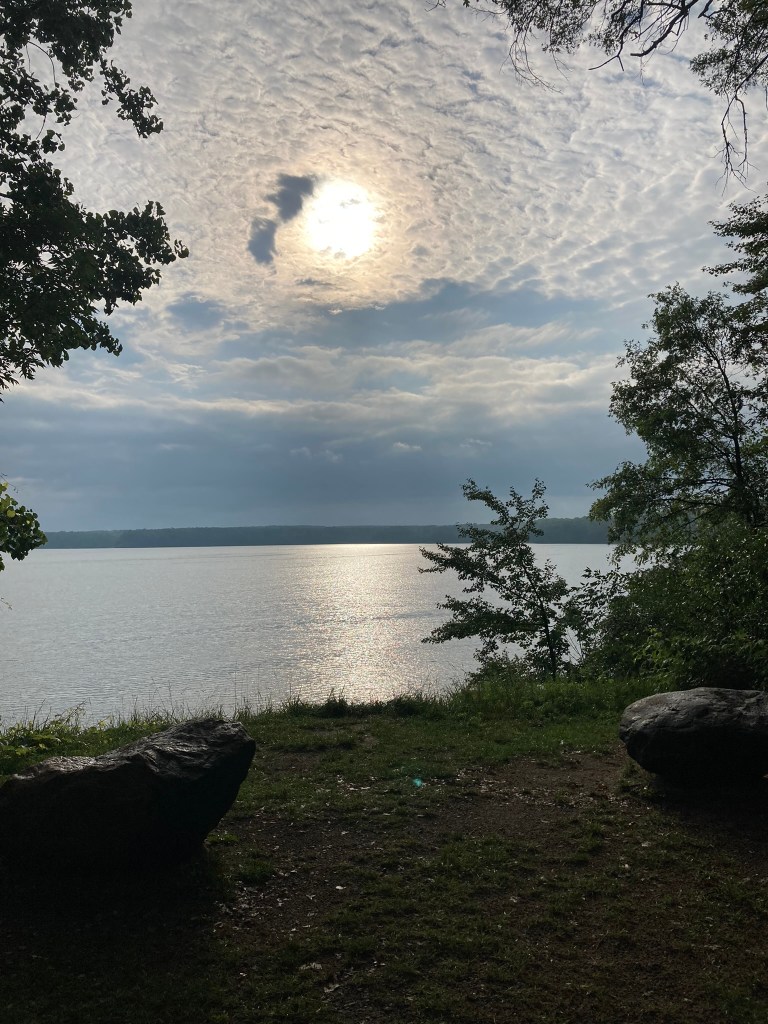
But now, out there on my own, flooded with memories as I was, I also experienced a whittling away. The memories came and went, leaving me focused on the tasks of camping: gathering firewood and kindling, pumping water from the hand pump, guarding against rain, cooking, and cleaning up. And there was quiet and solitude. I had time to decide based on my own whim what I wanted to do next. Read for hours? Go to the beach? Haul the kayak down to the water for a paddle? Take a hike along the ridge that looked out over the lake? There were a number of instances where I was keenly aware that it was just me, as me, out there. The absence of responsibility to anything but my own needs was essentially an absence of roles. And in that space, I found that my brain was able to disconnect from the perpetual figuring it out that it is always compelled to do, the spider web of concerns and ideas and emotions I feel daily as a home owner, an employee, a potter, a writer, a mom of on-their-own kids, a mom-guardian-friend to my dog, a friend, a freelancer, a sister, a daughter.
I love my roles. They, and the absence of them, make me who I am. I exist both in relation to the people (and dog!) and activities in my life as much as I exist in relation to no one. I think these two modes of being are in dialog with one another, under the surface, in ways we don’t comprehend or have an awareness of. And maybe what I have been trying to do my whole life is to connect with that awareness, that unity that hums beneath it all. Sometimes there is a sense of fracture, the feeling that we are broken apart into pieces, fragments of ourselves. There’s an undercurrent of anxiety or urgency at times, one that is hard to put a finger on, where things feel off, misaligned. Sometimes it seems that our various roles are disparate, independent identities but they are all yoked to the core of who we are, and in that way, are connected to each other. Though, we live in a world where it is not always encouraged or advantageous to bring our whole selves into everything we do, so the prickly sense of fragmentation persists.
After all the afters—after the kids moved out, after I moved out of my old house, after my last breakup, etc.—there were moments I experienced a specific kind of hollowness. The roles I’d been playing to that moment all needed to be redefined, reshaped. But, I wasn’t entirely clear how to do it. I tried to figure out if the roles themselves—understanding them, inhabiting them—were supposed to be my purpose, or, what was the game plan, what did unity and alignment feel like now?
Consequently, I often ask myself am I doing this right? Is this how it is supposed to be? Is this how you do it? Is this how I do it? To see Jason Schwartzman’s character in Asteroid City asking the same questions was piercing, enlightening, and a relief. I always feel as though I’m trying figure IT out. My role. Life in general. The nature of purpose and being and doing. Trying to understand it all feels at once vital and futile, as if, at birth I was assigned a quest that it was not humanly possible to complete. I do not remember a time when I did not have a sense of wonder and confusion about the nature of self, in all its fracture and unity. Trying to wrap my head around what I was and what I was doing here is in fact one of my earliest memories. I don’t think I’m supposed to stop doing that. I’ve realized lately that I don’t want to stop doing that, that I don’t need to. For some time, I wondered if, in the ceasing of that effort, some sort of peace or perpetual happiness waited. Maybe it does, but to get there I have to stop being who I am, and if that is the path, it is not one I am ready to be on.
At the same time, doing all that gets exhausting. It often doesn’t feel like I’m relaxing into anything. Which is why I knew I needed the break that camping provided. Where whim was the guiding force, where all of the talking and wondering and chatter in my brain quieted down. I am getting more in tune with how that balance works for me, between the busyness of figuring out how all the roles exist and talk to one another, and the quiet, blank-slate absence of roles I know I can find when I need to.
I don’t want to be any other way than how I am, when I think about it. Maybe I have more figured out than I think I do, maybe we all do, and the issue we deal with is that this world is loud and full of messages that compete and contradict and confuse. It is full Stuff to Deal With. Jobs that pay the bills but also sap our energy, things that go wrong, that fail in our houses and cars and bodies and hearts. It is so easy to get shaken up, shaken off course, shaken to the bone. Of course we’re going to wonder if this is how it is supposed to be and if we’re doing it right. How could we not wonder that?
Maybe the secret is not to eliminate the questions and the angst, but to stop resisting it. We need to make room for it, get comfortable with it. Relax into it. I think in the end, that’s what was so freeing and elating about the director’s response to Jones’s question in Anderson’s film. It doesn’t matter. Just keep telling the story. It was permission. As if someone gave me, gave us all, permission to not have the answer. We can keep trying to figure it all out, if we feel compelled to, if we like it, if that’s the way our brains work, but we are allowed to not find the answer; there is no failure in not coming up with a tidy explanation or an essay on synthesis. We’re allowed to just keep telling the story. It’s our story after all. We can tell it any way we like.
Love, Cath


 Chronicles of the Open Hearted