On Be-ing, Figuring, and Breathing

By Catherine DiMercurio

I don’t recall a time when part of my long walk entailed two miles barefoot at the water’s edge. Where Lake Michigan splashed at my ankles as I strode south. I don’t recall ever being able to go to the beach four times in one week. These are some lovely benefits to completely reshuffling your life.

It’s still a bit surreal, the move. There is so much that I’m still processing with the way this year has unfolded so far. I’m trying to pause more. Throughout this whole process, with a million little and huge steps along the way, I have felt catapulted from one thing to the next. Have barely been able to take a moment to enjoy a sense of accomplishment at meeting various milestones, because the process doesn’t let you rest. Even on the day of the move, an enormous, choreographed event, I was barely able to take a moment to consider the enormity of it, to congratulate myself for choreographing it. There was a brief period of time where I sat with my sister at the picnic table out back while the movers unloaded the trucks when I tried to catch my breath, tried to let the big truth of the moment sink in. I had done it. Moved to a lakeside town. Gotten myself as close as possible to the lake. I had, against the backdrop of some heavy personal turmoil, gotten my old house ready to sell, endured the ups and downs of all the showings and waiting for an offer, accomplished all the work to prepare the new house for my occupancy. Shepherded my anxious, reactive dog through it all. And I had moved farther from my children, from most of my family, from all of my friends, too. All of these things swirled through my mind—the work, the pros, the cons, the hopes, the fears—for a few overwhelming moments before I was pulled back to the reality of a house so chocked full of boxes I could barely make my way through it.

And then I faced the next enormous task. Unpacking. The tiny home was barely navigable. A narrow path led through a maze of boxes. I slept on the couch, unsure how I would even move things around in order to put my bed frame back together. But in two days I created some sense of order out of the chaos, and then I worked for two days in the office I’d managed to set up, and then spent most of the weekend unpacking the rest of the boxes. I can breathe a bit again and am no longer surrounded by cardboard. The basement is still a disaster and will likely remain so for some time. I want to take a few days and just feel normal, want to immerse myself in my regular routines, but my brain is already worrying about organizing the basement, and finding a new vet and dentist and doctor, and calculating when I’ll upgrade the electrical panel and replace the aging appliances.

There is always The Next Thing. There is never a clear deck with no items waiting for our attention. I’ve known this for a long time. It’s a lesson everyone learns at some point. It makes no sense to scramble and scramble trying to get all the Things attended to for the foreseeable future so that you can relax and be happy. It just is not reasonable to postpone feeling okay until all of the worrisome items are attended to. We have to keep figuring out how to find peace and joy in the middle of it all.

But knowing this doesn’t make the mindset adjustment any easier. If there are simple ways for moving the Things to Worry About to the edges so there’s some clear space to breathe, I don’t know them. The ways I know are about conscious, deliberate efforts. Maybe this work is easy for some. For me, it’s a huge mental challenge, a heavy lift. Some of it is self-protective. There is a part of me that is convinced that the only reason I get things done and avoid having important things fall through the cracks is because I do worry. It’s as if I need to worry because that’s the only way things will be ok.

It might seem like a whole lot of exhaustive nonsense if this is not the way your brain works. I think one of the things I love so much about being at the lake is that it is capable of taking me out of that mindset. The water is a live, physical presence; the experience of being there is multisensory. It diffuses worry, calms the loud thinking and overthinking. It’s the only shortcut I know. This past weekend, I took a long walk, some of which was barefoot along the shoreline. At one point, the absence of racing thoughts became apparent. It was shockingly peaceful. For a moment, I felt like Winnie the Pooh, just strolling along, with a hum-de-dum sort of song in my head. “Pooh just is” is a line I remember from Benjamin Hoff’s The Tao of Pooh. And striving for that state of just be-ing feels impossible sometimes.

Part of the problem isn’t just a brain that is wired (by so many things, some of it innate, for sure, but some of it experiential) for worry. Part of the problem is a world that’s all digital and hurry up and loud and bright and urgent and in so many ways frightening and terrible. Of course we want to remain in a cozy bubble, try to feel good and safe and separate. To eliminate as many of the things to worry about as possible until there’s nothing to worry about anymore so we can just be.

I want to believe that while there is no end to worry (do you ever worry that there is something you forgot to worry about?), that the opposite is true, that there’s no end to peace, as in, isn’t there a well of peace within us, a transcendent and universal peace? And if so, how do we get there, how do we find it when we’re lost in all the other stuff. I don’t expect to stay there, I don’t know how people could do that with life being what it is but finding a path there, an easy path, a good path, a clear one, would be nice. I’m trying meditation but it’s quite a challenge.

Maybe I have found a path, maybe that’s why I moved here. It’s surely different for everyone and probably not everyone wants to go looking for that kind of peace. Maybe we’re not supposed to because don’t we need to stay worried so that we can fix little parts of the brokenness in the world? Or do we do that by finding and being peaceful within ourselves, and bringing that energy to everything we do?

Photo by Athena Sandrini on Pexels.com

Yesterday after work I attended a program at a beautiful historic library. It was a book discussion led by a professor from a nearby university, for a book I really loved, about a man who sails Lake Superior in a dystopic, near-future Midwest. The framework of the talk was “dystopia and hope.” I contributed a lot to the conversation. It felt good. And then I drove the few minutes to the lake, strolled on the beach, watched the sun start to set behind the churning waves. I didn’t worry about finding a vet or a dog trainer or a dentist, or work, or what I’ll do with Zero if I want to go visit my people on the other side of the state. I didn’t think about the boxes in the basement, and the logistics of that space. These are things I have to figure out. But for a brief window of time, I was exploring my new community, interacting, living outside of my own thoughts, and getting soothed by the lake. I felt a greater sense of belonging than I have in a while.

I probably won’t ever stop being a worrier, but here there seem to be more opportunities to take breaks from it, and that’ll be good for me. I don’t worry that I will fail to figure out the things I need to. I just don’t always want to go through the figuring out process. It gets tiring dealing with the obstacles that come along with so many decisions. And obviously I feel a bit drained from having navigated a major life change, and that’s okay, is what I remind myself. We get decision fatigue, along with plain old regular fatigue.

But, I do know that I’ll figure out a lot of it. Maybe not all of it, and not at the same time, and often not elegantly. But I’ll do my best, as we all do, and maybe it’ll be a little easier now, here, to stay even-keel through it most of the time.

Be well. Love, Cath
On Fallowness and Mud

By Catherine DiMercurio

Sometimes a word grabs me and won’t let go. Yesterday morning, walking the dogs in the strange warmth of February sun, it was “fallow.” Fallow as in, plowed and unsown earth; as in, quietly replenishing after having been depleted.

The recent warmish weather and the thawing of a frozen winter’s worth of snow has got me thinking of what it means to be fallow and waiting. Maybe these thoughts took root at least in part because of the Rilke quote I came across recently: “Have patience with everything that remains unsolved in your heart. Try to love the questions themselves, like locked rooms and like books written in a foreign language. Do not now look for the answers. They cannot now be given to you because you could not live them. It is a question of experiencing everything. At present you need to live the question. Perhaps you will gradually, without even noticing it, find yourself experiencing the answer, some distant day.” (Ranier Maria Rilke, from “Letters to a Young Poet.”)

Like anything that I consider to be a strength, patience, that deep cosmic kind I think Rilke is talking about, plays hide and seek with me. I must peek in corners to catch a glimpse of it, or chase it down, often unsuccessfully, when I need it. I think I do possess it, somewhere, but it is elusive. And there is plenty about myself that feels unsolved, plenty that resists my current capacity to understand. How like fallowness it is, this kind of patience, and how hopeful to imagine there is a latent richness that will produce a surprising yield at some unknown time.

This way of thinking stands in sharp contrast to the restlessness I often feel, to my urgency to know what is going to happen next, in the coming weeks, and years. Often, this anxiety about the future is rooted in past experiences; for me this is true. Many, maybe most, people endure events at some point in their lives that change every version of the future they had envisioned for themselves, and have an awareness as it is happening that this is what is occurring, this loss playing out in full vibrant color all around you. You see the future erasing before your eyes, you see yourself vanishing too, in a way, in all the ways. New things, good things, begin to coalesce and emerge, though. They begin to form themselves into solid figures here and now, and you start to feel healthy and strong in ways you didn’t imagine possible before. Even so, there remains a fog up ahead in which you fear you will lose your footing, or everything.

I would like to think this long, cold, pandemic winter, this period of vigilant caution, of staying put, of worry and fatigue, is all part of a prolonged fallowness, a period of forced patience. Maybe like the soil under a bed of leaves lying beneath melting snow and ice, we are in a process of becoming enriched, we are readying ourselves for understanding what we cannot yet comprehend, truths about selfness and strength. Maybe after the period of fallowness is over, we will understand something we currently do not about the way expectations can vanish, but selves do not.

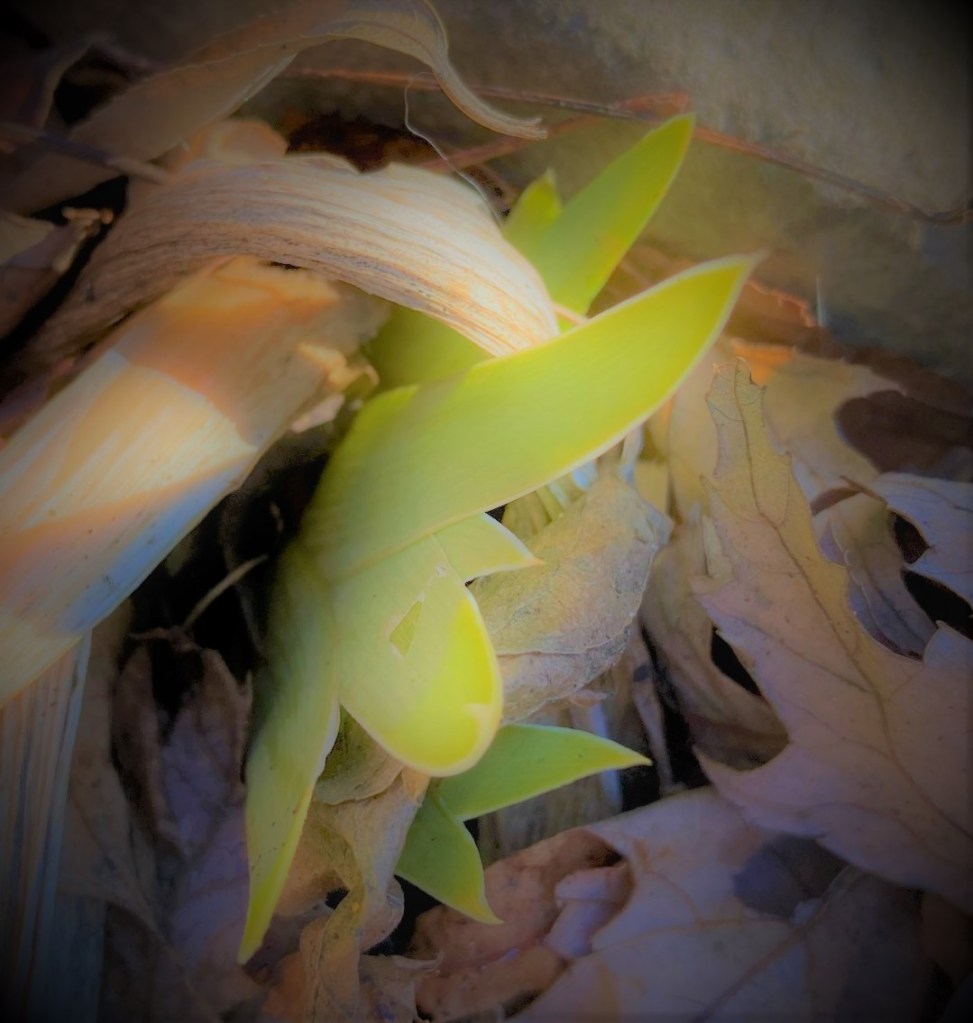
Still, it is difficult to wait. It is difficult to pursue goals – whether they be artistic, personal, professional, relationship-related – and not see the results we hope for. We wonder, why will this not look the way I thought it would? We wonder if we’re doing it wrong, or if we are simply looking at it from the wrong perspective. Maybe everything is falling into place exactly the way it should, and we have not yet reached the point where we can make sense of it. Maybe it is all still fallow-ing and when we are ready, we will grow – into our selves, and our lives, into our own big hearts and dreams, into the worlds we’ve been constructing for ourselves almost without knowing it. We are tiny lives in iris bulbs building our selves in the rich hidden worlds in the soil all winter long.

So many things do not look the way we thought we wanted them to. I think of my veneration of soil here and wonder how I can be so anxious to get my hands in dirt and plant things, when at the same time, the melted snow and the pounding dog feet have made a mud pit of my little plot of suburban soil. It is all the same substance but when acted upon by external forces, it changes form. We are not so different. Our little selves in iris bulbs transform to stem and leaves with the application of sunlight over a certain number of hours each day. We are all acted upon by time and by the weather of our lives. Even so, we are comprised of the same elements we always were.

Perhaps it is the same with everything we do not yet understand about ourselves. Truths waiting to be seen from another angle. Us, waiting to be acted upon by this force or that until we are ready. But for now, we must be patient, learn to love the mud and the questions, wait for the sun and rich soil, wait for the answers, knowing it is all the same stuff anyway. Maybe in this way we get closer to knowing and loving what we are made of, here, now.

Love, Cath

On Vestigial Vigilance, Instinct, and Happiness

By Catherine DiMercurio

Sometimes self-protective vigilance masks our instincts …

Life has been busy. Good-busy, mostly. In the middle of it all, living, loving, and learning are all happening. Life unfolds in all directions the way fern fronds sprawl slowly out and askew in the spring, the silent and celebratory party favors of the season.

closeup photography of green fern palnt
Photo by Pixabay on Pexels.com

Yet, the part of me that maintains a hyperawareness, a vigilance about everything in this phase of my life is looking for trouble. It wants categories; it strains to sort. It wonders, are we now post-[post-divorce]? If so, do we need to call it something else? That vigilant consciousness is always on the lookout for chaos, ready to find a way to diffuse it. It feels like an anxious, hyperactive, working dog without a job to do is pacing inside my head, nervously chewing on shoes. But another part of me – maybe new, maybe long dormant and grizzly bear waking now – is wanting to learn the way to live differently. Without waiting for the other shoe to drop. Without needing to gnaw on something to feel busy and safe and purposeful.

Sometimes I wish we could extricate ourselves from the parts of our psyche we don’t need anymore. Perform surgery on a vestigial organ and bury it, entomb it, pharaoh-less, with no afterlife. I suppose, though, we worry that we might need it again someday. I suppose we maintain a sentimental attachment to it as a once-favorite thing. The vestigial and vigilant worrier warrior, the protector, was once more than a part of me. It was most of me. And though now I’d like to bury it or send it packing, sometimes it remains, fretting and pacing and making work where there isn’t any. Today I wonder if I can find another job for it to do. I wonder if it can be escorted off the premises, and if not, can it be given a makeover. It’s too bad I can’t simply assign it a different task. You don’t need to protect me anymore. I’m okay. Can you help me learn to play the piano instead? How are you at financial planning?

During tough, or worse, traumatic times, the vigilant worrier in all of us gets amplified, elevated to superhero status. It works overtime; it has to. When life calms, and chaos retreats, that part of us can be unwilling to relinquish its elevated status. Sometimes it seizes on any worry, no matter how big or small, and amplifies it, so the cloud of anxiety cloaks everything, things we didn’t even think we needed to worry about. The vigilance works against us. As if to say, you don’t recognize threats anymore; I need to remind you.

I think the worst part of this is two-fold. Though our psyche wants to protect us, it goes too far, and seeks to shield us from threats that aren’t there. But it makes it hard for the rational part of us to grow and get stronger and be able to see clearly. It also makes us question our gut. We wonder, what if all this anxiety, this worry, IS my gut. Is this what it looks like when it is trying to tell me something? Sometimes it is tough to know. But, if it is tough to know, then I suspect it isn’t your gut. Instinct doesn’t make us chase our tail or pace and fret at everything – experience does that. Instinct is a magnet that pushes us toward what’s good for us and repels us from what isn’t. It is strong and quiet and deep, not frantic.

For me the question has become, at this (post [post-divorce]) point in my life, how do I move past what my good-natured but often misguided vigilant worrier warrior is trying to do, and grow more in tune with my instincts? How do we move away from fretful what-if-ing and move toward calm, toward trust (both self-trust, and beyond)?

I think that answer is different for everyone. Sometimes I have to write my way to it, sometimes I have to pick at it, run toward it, run away from it and back again, talk through it over and over. Sometimes we wear ourselves out with worry and then, quiet and exhausted, we find our true way. I’d like to find the straight line there, the shortest-distance-between-two-points path rather then the endless circles I pace in first. But I suppose that’s part of the journey too.

All of this might sound a bit familiar, if you’ve been following this blog for a while. We tell ourselves the same stories in different ways, trying to make it all make sense. I also find that anxiety rises up most in periods of happiness, a pattern that is perhaps common to many of us. It’s easy to be wary, easy to wonder how will this be taken away (this time) or how will I mess this up (again)? Seeing others do this, I wholeheartedly want to reassure, to tell them, go easy on yourself, it’ll be okay, let yourself have this. It’s always more difficult to be generous and kind and loving with ourselves than it is to be with other people.

It’s a good time for all of us to try. Love, Cath