On Socket Wrenches and Sight Reading

By Catherine DiMercurio

I keep thinking about Carl Sandburg’s poem, “Fog,” which opens with the lines “The fog comes / on little cat feet.” In the very brief poem, the fog arrives, hovers briefly over the city, and moves on. I’m thinking about those little cat feet because it seems like some of the best things come into our lives this way, quietly and softly.

Sometimes when you’re starting something with someone new, life feels disrupted in a loud, jangling way. This is not always a bad thing and sometimes that’s what we’re hoping for: someone to shake things up, knock us off center, sweep us away. But once we’ve learned who we are and how to center ourselves, once we have come to understand our own person and the value of being centered, the storminess of off-center relationships feels a lot less pleasurable and a lot more threatening to our sense of peace.

Though, maybe the images of little cat feet and fog are not quite the right ones either. Dogs have always been such a big part of my life that I’m imagining what sort of weather might come in on dog feet. Maybe a day of boundless sunshine, maybe a cloudy day that’s made for nothing but snuggling. Maybe that’s how this new person has entered my life, softly and gladly. The sunlight padded in on friendly dog feet. . . .

I wrote a poem once about an ex, about the way he seemed like a stray cat, showing up sometimes for a scratch or a bowl of milk, the way he knew that he’d not be sticking around and the way I believed I could keep him. And the way I showed up like a stray dog, content to misinterpret affection for love. Now, in this new relationship, the energy is different. It’s mutual and earnest, playful and affectionate. And I don’t feel like a stray; I feel like I belong. I may still get a bit wary sometimes out of habit. But I also have the sense that everything is entirely genuine.

Sometimes I have to remind myself that it is okay to let people in, to accept care and hugs and kindness. I went from not knowing how to provide such attention for myself, to relishing in my ability to do so, to wondering if I had to do so all the time now, and no longer knowing if there was something wrong with wanting and needing it from other people. It’s hard to find the right balance.

There was a moment a couple of weeks ago where I very much felt as though I was standing at a crossroads. I was having a bad day, wanting a hug, feeling like I wanted to crawl under my desk and hide from the world. All the defense mechanisms kicked in—the walls, the isolation, the I-will-just-handle-it-myself. The man I’m dating had offered to stop by and give me a hug. I was worried that it was too out of his way and he didn’t really have much time. I didn’t want to be an inconvenience. But he said “I’d be happy to stop by and I’d love to give you a hug.” On my lips were the words “no” and “I’m fine” and “thanks, anyway,” but there was a voice inside saying it was okay. To say yes. To be hugged and comforted and cared for.

Do you ever have that feeling that you are poised between two worlds, and a small decision feels much bigger than it is? There’s the world in which you know are fine on your own and another one, the one in which someone is trying to be there for you, the one in which you let yourself have the comfort they are offering. It is a long moment, and you swing as if dangling from a pendulum between the two worlds.

Many thoughts flash through your head. You think of all the times people who promised to be there for you weren’t, or, the times the person who was coming through for you kept score, metering out how many times they had to show up. Or the times showing up for you was a tool they would later use against you. But this is a new time, this is a new person, you are a new person. We are.

The pendulum swings and you take a deep breath and say, “That would be nice. If you stopped by.” And they do and it IS nice, it is better than nice, and you feel the victory in letting yourself have this, a hug from someone who wanted be there for you.

It is one of the hardest things to do, letting someone be there for you. We are praised for our independence and chastised for our “neediness,” and experience teaches us that we simply have to be able to handle so much on our own because sometimes that’s all we have. We all want to be capable and confident in our own abilities, and those are good things, but so is being able to accept help when it is offered. Or being able to ask for it. That, too, takes incredible strength.

I am thinking too of how wonderful it feels to show up for someone else. Recently my sister needed a favor, which is a rare thing. She’s the oldest of the five of us siblings, and she’s independent in such a thorough and awe-inspiring way that I was completely delighted when I offered my assistance and she accepted. All I did was drive her to pick up her new car and help get the license plate off of her old car, but it gave me a lift all day to have been able to do that for her (and to be in possession of the universal socket wrench that got the stubborn bolt removed). It feels good to be able to return a favor when you have been lucky enough to receive so many.

Since that moment a couple of weeks ago when I accepted the out-of-the-way hug, things have progressed with my new person in promising ways. I’m looking for old anxieties and not finding them. I seem to have found someone who, like me, is not truly capable of being someone he is not. In my last relationship, I wanted things to work out so much that I tried to be very accommodating. I attempted to pretend that uncertainty and unclear communication didn’t bother me. In that way, I was being disingenuous, and it felt terrible, so as things progressed, I tried to be more of who I was instead of who I thought I was supposed to be. I tried to be clearer about what I wanted, though that didn’t really work either, because we wanted such different things. In this new relationship, after two years of focusing on myself, I find the only thing that feels right to me is to be exactly who I am, and I am discovering how delightful it can be to be with someone who appreciates that, who respects not only the action of being me being who I am, but the actual person that I am.

I have had such trouble writing this and I’ve been trying to understand the nuances of why that is. Certainly, part of it is that this new person will likely be reading this. How strange to read about yourself and the way your new relationship is unfolding in someone else’s blog. It is challenging to write about something that is ongoing instead of something in the past, but writing always helps me process, and writing for an audience is an exercise for me, in elevating that processing in a way that reveals something of the way hearts work (not just mine). I think there are universal properties to the way people love and I am always attracted to writing that I connect with, where I can see a little bit of myself.

What do you see of yourself in this? Have you found joy in being able to show up for someone—a partner, a family member, a friend—who usually seems like they don’t need it? Can you recall a time where being your true, full self did not feel safe or appreciated? Are you learning who you are and being who you are, and at the same time continuing to learn to love yourself while learning to love someone else? I think that is what’s happening to me. In this new relationship, it feels very different than the ways I “fell” in love with people in the past. I feel like I’m growing into it, learning it as I go, as I learn more about him. It is as if we are sight reading the relationship, ourselves, each other.

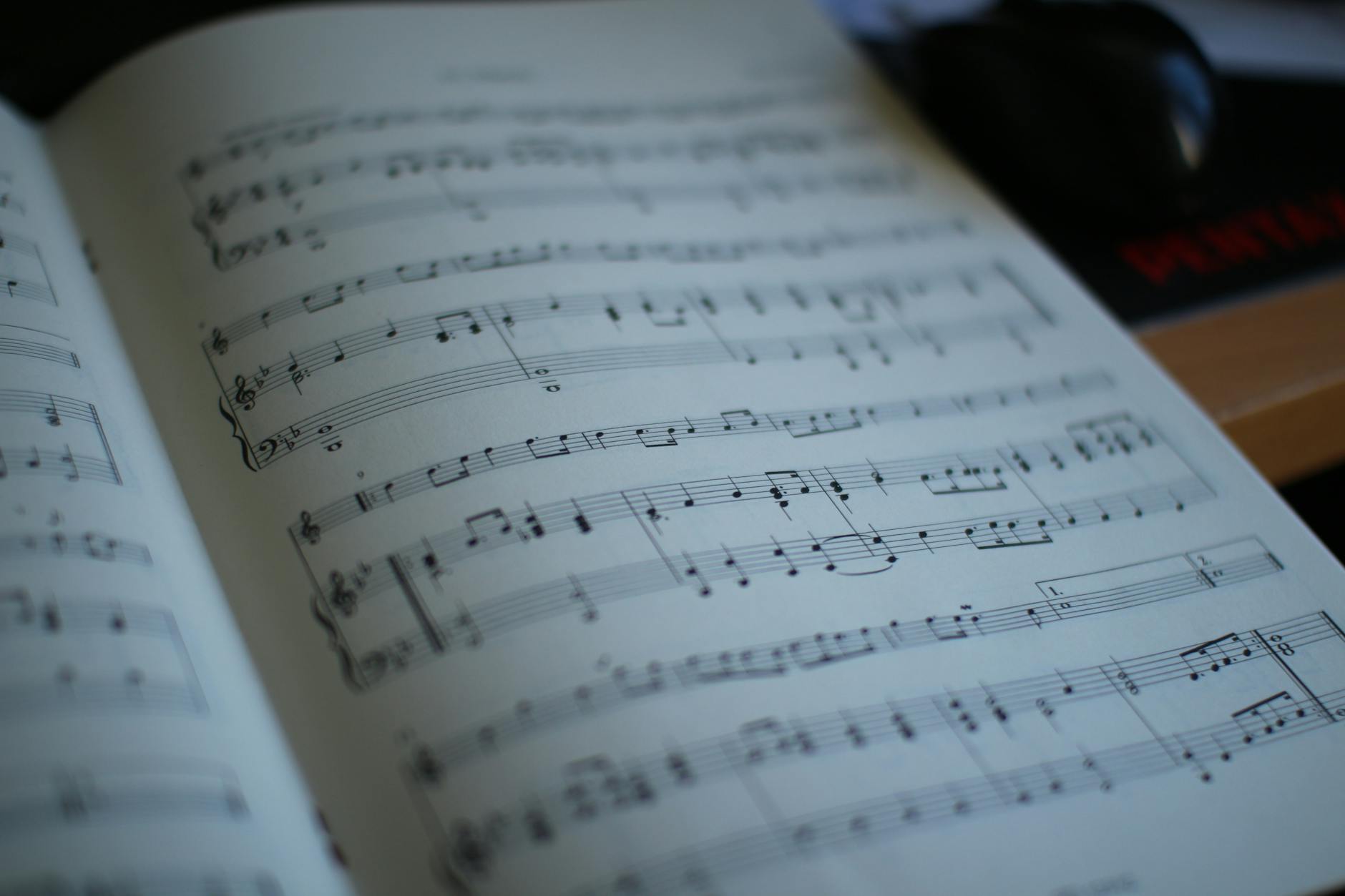
Photo by Pixabay on Pexels.com

[Until my children were in orchestra, I had no idea what sight reading was. In a competition, the whole orchestra gathers to play a piece they’ve never seen before. As a group, they briefly study a new piece of music, are guided by their orchestra teacher, and somehow manage to play something they’ve never seen or heard before. This is an oversimplification, and I don’t play an instrument, so my understanding is limited, but the magic in that music, in that collaborative, focused effort, is breathtaking.]

So, though I am often made uncomfortable by new things, any discomfort in the “new” of this relationship is being diffused as we go, as we learn this new music together. And I’m grateful for that.

Love, Cath

On Vantage Points and Variables

By Catherine DiMercurio

My blog pace has slowed somewhat in recent weeks, which happens when I’m deep into processing new things or big things or sometimes, recurring things. But occasionally, life offers a little sidestep, a time and place away from the rush of everyday life to think, or not to think.

Last weekend, the weekend of the autumnal equinox, my sister and I took a camping trip to Michigan’s Leelenau Peninsula. We were anticipating a cool fall weekend, but it ended up being more like summer. Michigan loves to play those kinds of games. We weren’t complaining. The nights and mornings were chilly enough for campfires and sweaters, while the warm, sunny days had us wading, or dunking ourselves, in Lake Michigan.

I have three sisters and a brother, and I wish I could take a solo trip with each of them, but this trip was for me and the sister closest to me in age; we are 14 months apart. We shared a room our whole lives, until we left for college. Our high school boyfriends were best friends. People often thought we were twins. This is all to say, we’ve always been close.

Well, not strictly always. I mean, it was always there underneath, but we have ebbed and flowed with our life events, as people do. But we always find a way to return to each other. I wish life made it easier. But I love that we made it happen for these brief days near September’s close.

We had a beautiful campsite, a literal stone’s throw from Lake Michigan. A cluster of cedars demarcated the perfect place for our tent. We’d set up camp to our liking and made dinner. As we sat down to eat, someone ran by the campsite warning of a storm blowing through in nearby Northport. We could look out over the water and see it brewing. So we threw what we could back into the car, and hurriedly threw up some tarps over the tent as an added layer of protection, though, I’d just re-waterproofed it, but still. No one likes a soggy tent. We could feel how quickly the weather was changing and though we finished before it did more than sprinkle, it had turned into a “team building” exercise. Did we occasionally squabble? Of course. But with my sister, these things melt away. I’m glad things still melt away.

One of the things I’ve come to understand after a couple of years being single is that I’ve been prone to deprioritize lots of other relationships when I’m in a romantic relationship. These last couple of years, I’ve made an effort to refocus on friendships and family connections that I found hard to attend to while I was in the midst of past relationships. As I’m [suddenly and surprisingly] embarking on something brand new, one of the promises I make to myself is that I’ll do better this time. I will pursue balance. I won’t let go of so many things that are important to me as I’ve done in the past. The amazing part is that I’ve already talked about this with the new person in my life. What I mean is that I’m amazed that I am comfortable enough now with myself to have conversations I would have previously avoided, and that me being me is already so well received.

I was grateful, on this camping trip, to find the close bond with my sister was at the ready, not rusty or eroded, despite the toll of the past few years, the events in our lives, Covid, etc. What I wanted to offer was the same thing I seek in my own close relationships: a safe place.

The best relationships—family, friend, romantic—provide this, but not only safety as in, a place free from harm, though that is the cornerstone of any healthy relationship. But also, safety, as in, a place to grow. A place to be supported, a place to nurture dreams, a place to push that border between peaceful comfort and sometimes painful progress. Because let’s face it, growth is often uncomfortable.

As a parent, I remember thinking some mornings that my children grew measurably overnight. I would be standing in the kitchen making lunches, and morning hugs with the kiddos would suggest limbs and torsos newly stretched. The sleep tousled hair on their sweet noggins was somehow nearer my chin. You grew. You keep doing that. This sudden gain of a centimeter was accompanied by aches and pains, and a new but short-lived clumsiness as their brains tried to catch up with their bodies. So much non-physical growth is like that too. We often feel off-balance as we try to catch up to what our inner-selves are doing, how they are adapting to changing circumstances.

I think this is why, as I’ve started dating someone, I feel a discomfort that has nothing to do with this kind, smart, and earnest man who wants to spend time with me. With him, I feel at ease. In the in-between times, there are all sorts of recalibrations happening within me. Some of it is the anxiety I’ve always lived with. Some of it is the what-iffing that is completely natural when entering into something new. But beyond that, it’s as if I’ve been trying to solve an equation without enough information, and with each of our interactions, I’m given the quantity of one of the countless variables, so the figuring begins anew. (Math people – forgive what is likely a faulty metaphor!) This is the self-protective part of me, and I am watching her evolve and adapt. (Initially, she wanted nothing to do with meeting anyone new, but the curious part of myself and the self-protective part negotiated.) She enumerates the ways closeness has yielded loss in the past. And, there is this frantic figuring. Solving, or trying to, exactly how things will go, and what will happen, and how we can magically be prepared for it all.

It is hard to find the right way to explain to her that sometimes safety is in the action of leaving, rather than hunkering down. Whether it is leaving a bad situation or leaving one’s comfort zone to explore a new situation that has good written all over it, leaving is sometimes the way we move toward growth. It is not the safety of stillness (though this too has its season and should never be undervalued); it is the safety of becoming more and more ourselves, of embracing the strength this movement and growth entails. It is the safety of balance, in a way, of learning how to regain it when the unknown happens, when we move toward or away from something and stumble.

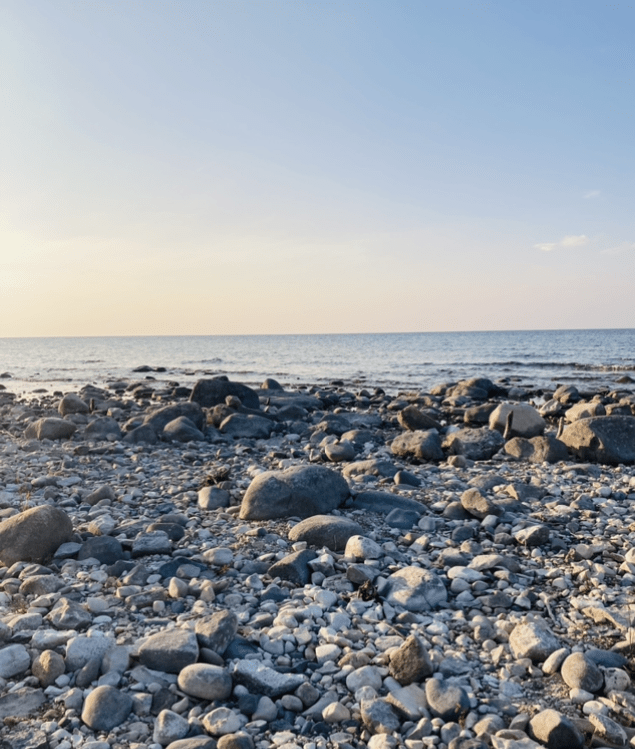
As my sister and I hunched over the rocky shoreline near our campsite, pecking around for pretty stones, we talked. About heavy things and about light things. I watched the way she sought out round, flat stones, the way she stacked them in little cairns everywhere we went. We visited several beaches, and she left these in her wake everywhere we went. I could see in them the precision and care that has always been part of her character, the artistry in both the selection of stones and their deliberate placement, their balancing. I could see the way this activity both calmed and delighted her. I loved the way we were able to fashion for ourselves this time in which to be calmed and delighted near each other, by each other.

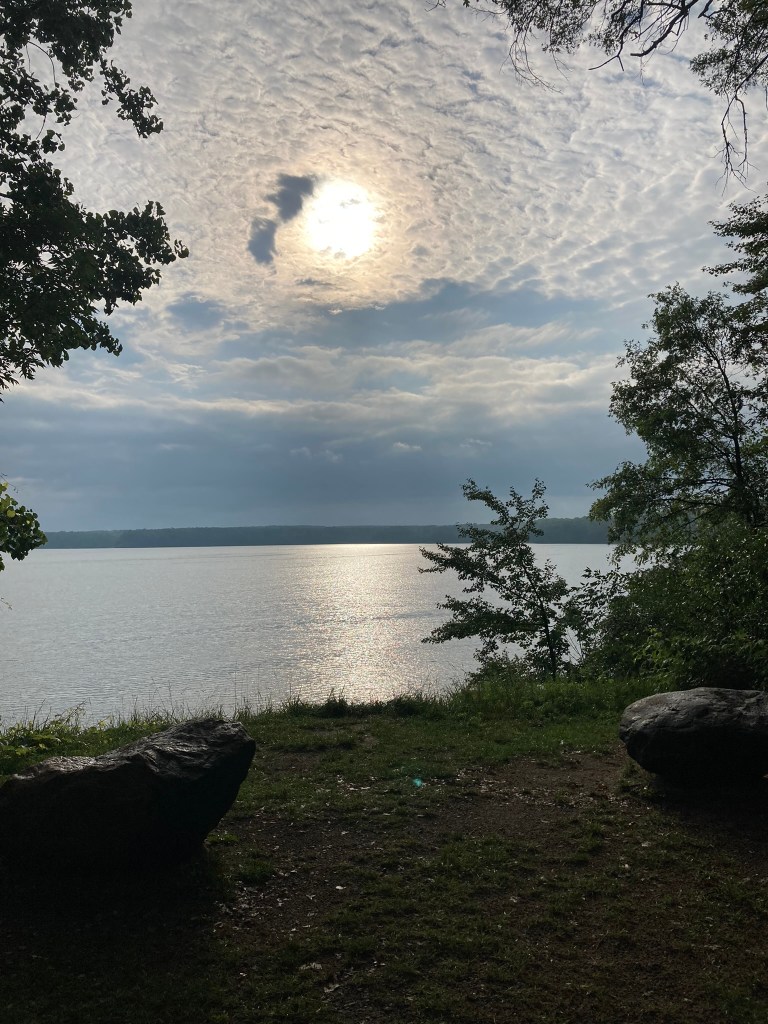
The way the campground is situated at the tip of the peninsula meant that we had the perfect view of both sunrise and sunset, partially over the water, and partially over the rocky shoreline. I think about that now, this perfect positioning, this sense of being precisely between one thing and another. Certainly, it means something different for everyone who finds themselves there. For me it was a vantage point, from which to consider what’s next, as I move between the safety of stillness toward the safety of growth, even though I know I can never solve for all the variables.

Love, Cath

On Curiosity and Conversation

By Catherine DiMercurio

How strange that September is beginning is a thought that chirps through my brain these days. This time of year is so laden with transitions it is easy to feel unprepared. The loss of light has been startling, and though temperatures have spiked this weekend, there has been a coolness to the nights and mornings that smells of autumn. The softer light and cooler air touch your skin differently. I don’t mind grabbing a sweater.

There’s much to love about what comes next, but for me, each season always feels too short (except for winter). In this space, I’ve written often about transitions and transformations.

Sometimes transitions sneak up on us the way fall does. Softly but inevitably. Not urgently, but with a quiet sureness. And internally, we feel ourselves needing to recalibrate, wondering how we hold on to the best parts of one season as we enter another.

I think of what I’ve been loving about summer and how to carry that into fall, despite shorter days and cooler temperatures. I no longer have the busyness of shifting from children’s summer vacations to back-to-school, so the seasonal shift is gentler than it used to be. But it can feel jarring, nonetheless.

At a farm stand in Ann Arbor, I bought a small watermelon, some peaches, and a couple of apples, and I thought how wonderful September is, that it encompasses all this, that it is summer and fall, in conversation with one another.

It’s easy to think in terms of conflict, where we focus on the ending of one thing and the beginning of another, and the summer people and the fall people on social media are either lamenting or rejoicing. It’s easy to look at our own apparently competing desires as an equation to be solved, where the variable, “x,” will equal something when we’re done figuring it out. We will do the math and the result will be an answer to the problems that plague us, to the what-iffing we do about both the past and the future. I’m curious about the conversation between the “this or that” scenarios we paint for ourselves. And how, amid all this contemplation, do we sustain an attachment to the present moment? How do we position ourselves fully in who and what we are right now, when we are so busy trying to solve the past and anticipate the future? We fixate on healing and learning from the past, on preparing for a future we can’t possibly know, but we try to know it anyway. Meanwhile in the present we are trying not to disappear.

Maybe the problem starts when we are little, when we are constantly being asked what we want to be when we grow up, and do we have a girlfriend or boyfriend. Why do people do this to children? This felt like a fairly common practice when I was a child. The goals were laid out definitively for us, even if we were unable to articulate them as such as elementary schoolers. We were not even allowed to live in the present as eight-year-olds. It’s no wonder it is difficult to do so now. The messaging we got from so many angles was that the whole point of life was work and a partner. So when one or both of those things don’t work out how we planned, of course everything feels scrambled. And even if everything goes according to plan, many people still find themselves with a persistent “now what” sort of feeling, since everything they’ve pursued has been external.

These days, I try to train myself to savor the current moment and it has meant a certain type of negotiating. For me, being able to fully experience the present means that I must stop trying so hard to eliminate anxiety about the future or analysis of the past. I don’t want to fight myself anymore. It’s exhausting, and it has begun to feel uncomfortable and disingenuous to wish I was different than I am. For me, the thing to do is to focus on what else is also existing right now, amidst the familiar habits of worry and rumination. Can I shine a light on it? Is it excitement? Hope? Curiosity?

I feel as though the path, for me, is peace-making with the parts of me that admittedly feel in the way sometimes. Maybe instead, I should listen to what they need to tell me, listen with a compassionate ear for hearing, not solving. Maybe if I simply say, I understand your concerns. It’s normal for you to feel that way, they will feel heard. They won’t have to shout anymore because I’ve stopped trying to ignore them. And they’ll stop feeling like I’m trying to figure them out of existence. In a way, given that anxious tendencies develop from vulnerable parts of ourselves, we have to be as patient as we would with a child, and sometimes repeat ourselves, with kindness and empathy.

Then, perhaps, once they quiet down, I can listen to the other parts of myself that don’t always get the attention, the quiet ones, who say softly that things are good, that there is much to delight in, even amidst the anxiety. They remind me to trust myself. To be curious and have fun and to not forget about open-heartedness.

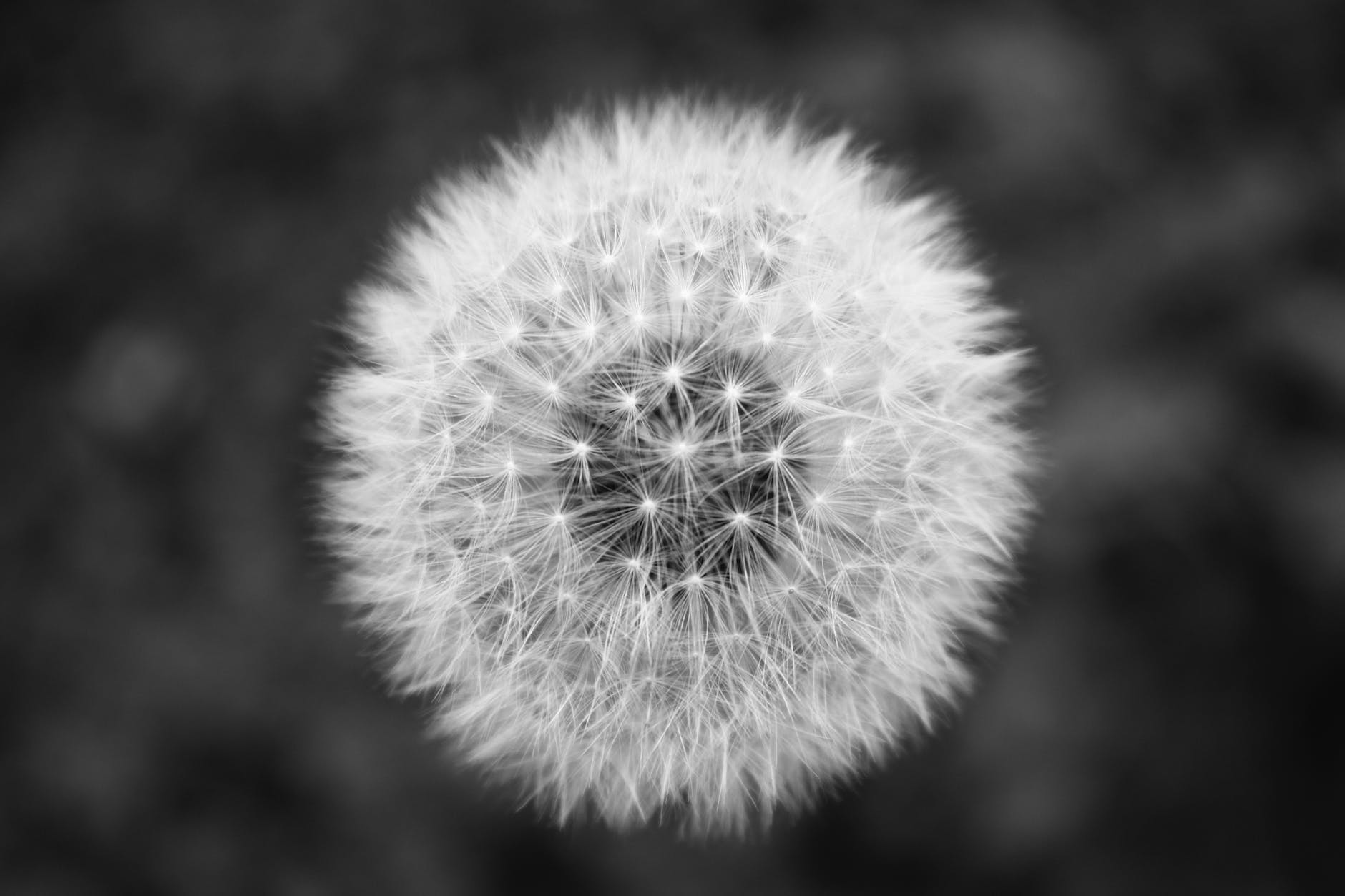
Though I sometimes must remind myself to be playful and silly, I never regret it, and it always connects me with that curious, light-hearted, open part of myself. My son tips me off to the best boxed vegan mac and cheese, and I splurge and buy 12 boxes so I always have something yummy and easy on hand, childhood comfort food. I giggle as I feed my dog bites of ice-cold watermelon and he nudges me for more, his whiskers tickling the bare skin of my summer-brown knee. I sing along to the radio on the way home from pottery, windows open, bright light from the full moon shining down. I make wishes on dandelion puffs. I play with the waves at the beach.

Photo by Jack Hawley on Pexels.com

I remember how to do this, to be delighted, to give this part of myself a seat at the table. But usually, she doesn’t want to sit still. She is laughing and playing freeze tag in the back yard with her siblings, running through her father’s perfect lawn in her bare feet, not minding that she’s “it” again. She is me, I have to remind myself sometimes, and our lungs are full of waiting wishes.

Love, Cath

On Growth and Stillness and Glow

By Catherine DiMercurio

When I was at the pottery studio recently, we were waiting for the raku kiln to reach its final temperature of 1850 degrees Fahrenheit. We worked while we waited. I attached handles to mugs I’d thrown the previous day. I will mention here the details that occur to me as mattering. I worked with reclaimed clay. Scraps once discarded and brought back to new life with water and time and reshaping. I practiced different techniques for crafting the handles, all of which I find difficult, none of which resulted in the graceful form that I’d hoped for, all of which will be fired and glazed and useful and beautiful anyway.

The woman sitting at the table behind me was talking about how she did not like how the nights were getting cooler and that she could hear crickets now. As soon as you hear the crickets, she said, you know summer is coming to an end.

Had I been facing her or had I known her better, I might have started a cricket discussion with her. Is this true? I might have asked. I have cherished cricket song for as long as I can remember, and often lament the summers when it seems to start so late. I had just been thinking earlier that week of how nice it was to finally hear crickets at night. In my memory, crickets are associated with summer, all of it, not the end of it, but mind and memory tends to blur time and boundaries. Cricket song will always be one of my favorite sounds regardless of when in the summer it begins. But I’ve been thinking about what she said.

I thought about how, if this is true, about crickets being a harbinger of the end of summer, then in a way, they are like my favorite moon phase, the waning gibbous, which I’ve written about here before. It is something that to me symbolizes a period of calm in the aftermath of the large, chaotic wildness of the full moon. It also reminds me of the lines from one of my favorite poems, Wallace Stevens’s “Thirteen Ways of Looking at a Blackbird”:

I do not know which to prefer,   

The beauty of inflections   

Or the beauty of innuendoes,   

The blackbird whistling   

Or just after.  


There is so much I love about “just after” moments. Maybe for me, it is a way to prolong a moment, because in the moments after, if you are of a mind (and a heart) that is able to fully savor, it’s almost as though you are still living the actual moment.

Sometimes I wonder, though, if I have difficulty in fully living in the moment. Is the pleasure I take in the “just after” moments merely the counterpoint to the anxiety or anticipation that I often experience before the moment? And do both overshadow my experience within the moment itself? Maybe sometimes. Not always.

Take the raku firing for example. It was explained to all us students the timeliness of what would happen the instant the kiln was opened, how we must briskly but safely retrieve our pieces. Sometimes, based on the choreography of the kiln, we’d need to wait a moment until someone else removes their piece before we can safely access our own. Such was the case with my piece. And in that moment of waiting, I stared at the vase glowing in front of me. At that temperature, all the ceramics glowed like bright stars. My piece had some carving in it, vines and leaves. And because in those places the clay is thinner, they shone even brighter. And it felt like the image was burning itself into my memory. I wished I had been able to take a picture, but there is no time for such things. You have to move quickly and get your piece into a metal bucket filled with newspaper. The paper catches on fire. After it burns for several seconds, you put the lid on it. This is a reduction environment, with a limited amount of oxygen, and it is where the magic happens. The oxygen is consumed by the burning of the combustibles. This creates beautiful effects in the glaze.

Still, regardless of how much you make of a moment, or just after, or just before, they are all only moments. We might be able focus our consciousness during them to experience them more fully, but they last as long as they last.

When I think about how I want to live, I think about moments a lot, and how to make the most of them, whether they are blazingly beautiful and exhilarating or whether they are strikingly ordinary. I think too, of the moments we’d like to forget. Certainly there is a lot of talk about learning from difficult things, and how this is the method to discover value in mistakes and tragedy. Too often, too many of us get stuck there, in this search for meaning. I get overwhelmed by the need to understand the whys and hows of bad things. I replay them in my head from all the angles and look at what could have been done differently. And I do that because the world has suggested that this is a way of making them “okay” somehow, if I at least learned from them. But, what if I didn’t learn the right lessons? What if I didn’t learn enough? We are told we are doomed to repeat past mistakes unless we really and truly learn all the right lessons. But we are also told not to dwell on the past.

Because my brain has formed this habit of overanalyzing past pain, errors, and difficulties, I began to believe that if I failed to learn from the past—enough things, the right things—then I invited nothing but pain and tragedy in the future. But this is a miscomprehension, and one that can leave you frozen. It’s not that the past has nothing to teach us, but it is one class in a full schedule. It’s not the only way, or the only thing, we learn.

Photo by Skyler Ewing on Pexels.com

And one of the things I’ve learned is that it takes focus and endurance to shift our gaze from past lessons and look at other areas of experience. Sometimes we have to keep opening our hearts and looking at the world with a fresh eye. We focus, with all our strength, on the unfurling of fern fronds, and the way lake water baptizes our hearts into their new whole selves, and the way peace stretches roots within our lives when we invite it there every day, and on the star-glow of freshly fired clay. Maybe we must be clear about what we’ve won, not only what has slipped away as loss, and be just as clear-eyed about what we willingly trade every day, as in, I will accept the occasional storm of loneliness so that I can steep myself in calm for as long as I need to, for as long as it shows me how to grow, even though unfurling happens in increments so whisperingly minute it looks like standing still. But it isn’t.

I’d like to say that I find myself at an inflection point: tired of trying to learn everything I am supposed to from the past and ready to refocus my gaze. Yet, I’ve been inflecting. I’ve been at this, refocusing, shifting, turning, for many moments, but because it is so gradual, I sometimes forget that what looks like standing still from the outside can feel like standing still from the inside too. But it’s not. [And also, is there anything wrong with stillness? No.] Physical growth can be demarcated on a wall, a pencil line scratched into poplar molding glossed with white latex paint. I remember the smell of my children’s hair as I marked their height, the earthy sweetness of their sweat, the scent of the summer air clinging to each beautiful strand on their scalp. But how do we mark out our own growth as adults, out of the lattice work of our own pasts and into who we are now? There is no pencil for this, no wall, we simply keep going and wondering. We are unfurling, whether or not anyone can see it. When we think but I am trying so hard we must believe in the efforts we are making, whether or not our growth can be demarcated with pencils or moments or star-glow or nothing at all.

Love, Cath

On Roles and Poses

By Catherine DiMercurio

A scene from Wes Anderson’s new film, Asteroid City, keeps playing in my head. In it, actor Jason Schwartzman plays actor Jones Hall, who is playing the role of Augie Steenbeck in a play called “Asteroid City.” Jones breaks out of his role as Augie to tell the play’s director, Schubert Green, played by Adrien Brody, “I still don’t understand the play!” Jones expresses his angst, asking “Am I doing it right?” Schubert tells Jones that it doesn’t matter. “Just keep telling the story,” the director insists.

The film makes use of a multilayered frame narrative. It opens with a scene from a 1950s television special about a playwright (Conrad Earp, played by Ed Norton) and his play, “Asteroid City.” Throughout the film, the actors are not just playing their role in Wes Anderson’s film; they are playing their role as the actors in the play. As actors in they play, they periodically step out of their roles and interact act with one another (as characters in Wes Anderson’s film). Get it? All of that can be a little hard to follow, but it speaks to something essential about the ways we enact multiple roles in our lives, how interconnected those roles are, and how often we find ourselves sitting with that question: am I doing it right? Anderson’s film and his characters are as self-reflexive as we are.

The director’s answer—It doesn’t matter, just keep telling the story—sticks with me, both as an angsty human with a hazy understanding of her own role in this world and as a writer with a similarly foggy grasp of how to approach that role.  

When I was in my twenties and just getting started on my how-to-be-a-writer journey, I had joined a local writers’ group in the town in Illinois we’d just moved to. My then-husband had accepted an engineering position at an automotive plant. The Michigan-based company he worked for often had its contract engineers do a stint out of state for a couple of years before being hired in directly. This was the path we were on. We knew the post was temporary, which made everything feel temporary. There was no sense in putting down roots since we knew we’d be headed home before too long. I knew no one, and had begun freelancing, so I didn’t have a workplace to meet people. So, I joined a writing group. They were an eclectic mix of people. They had an annual gala where everyone read from their work. I was working on a novel at the time. I had never read my work in front of people before, and I was terrified. Yet, I really wanted to belong, to behave as a writer would, so I promised myself I would do it.

At around the same time, my husband and I had also decided to take a yoga class together, a first for both of us, at the local YMCA. Our instructor used to tell us to “relax into the pose.” I clutched this notion like a life preserver as I approached the podium the evening of the writers’ gala. I told myself to relax into the pose of writer. It helped, somehow.

I think of that now because the phrase, which has often returned to me at various points in my life, recalls the themes of Anderson’s film, and reminds me of all the ways we struggle in our various “poses” or “roles.” We ask ourselves, am I doing this right? Because often, it doesn’t feel as though we are. Am I being a good parent, a good friend. Is this the kind of person I want to be. What kind of partner am I. What kind of artist. What kind of me. Sometimes it feels wrong, or strained, or unfamiliar, to be who we are or where we are, or we find ourselves in roles we never expected to be in.

And sometimes we have the opportunity to isolate ourselves from our roles. I recently returned from a solo camping trip. In the woods, setting up my tent, or out on a hike or kayaking, it was impossible to avoid memories of past trips, to see myself through the lens of my various roles. Camping was something the kids and I always used to do together, so I thought of what it was like to be a parent on such a trip. I also thought of a former role, that of “wife,” because I didn’t start camping until I married. After the split, the kids and I continued to take a camping trip every summer.

But now, out there on my own, flooded with memories as I was, I also experienced a whittling away. The memories came and went, leaving me focused on the tasks of camping: gathering firewood and kindling, pumping water from the hand pump, guarding against rain, cooking, and cleaning up. And there was quiet and solitude. I had time to decide based on my own whim what I wanted to do next. Read for hours? Go to the beach? Haul the kayak down to the water for a paddle? Take a hike along the ridge that looked out over the lake? There were a number of instances where I was keenly aware that it was just me, as me, out there.  The absence of responsibility to anything but my own needs was essentially an absence of roles. And in that space, I found that my brain was able to disconnect from the perpetual figuring it out that it is always compelled to do, the spider web of concerns and ideas and emotions I feel daily as a home owner, an employee, a potter, a writer, a mom of on-their-own kids, a mom-guardian-friend to my dog, a friend, a freelancer, a sister, a daughter.

I love my roles. They, and the absence of them, make me who I am. I exist both in relation to the people (and dog!) and activities in my life as much as I exist in relation to no one. I think these two modes of being are in dialog with one another, under the surface, in ways we don’t comprehend or have an awareness of. And maybe what I have been trying to do my whole life is to connect with that awareness, that unity that hums beneath it all. Sometimes there is a sense of fracture, the feeling that we are broken apart into pieces, fragments of ourselves. There’s an undercurrent of anxiety or urgency at times, one that is hard to put a finger on, where things feel off, misaligned. Sometimes it seems that our various roles are disparate, independent identities but they are all yoked to the core of who we are, and in that way, are connected to each other. Though, we live in a world where it is not always encouraged or advantageous to bring our whole selves into everything we do, so the prickly sense of fragmentation persists.

After all the afters—after the kids moved out, after I moved out of my old house, after my last breakup, etc.—there were moments I experienced a specific kind of hollowness. The roles I’d been playing to that moment all needed to be redefined, reshaped. But, I wasn’t entirely clear how to do it. I tried to figure out if the roles themselves—understanding them, inhabiting them—were supposed to be my purpose, or, what was the game plan, what did unity and alignment feel like now?

Consequently, I often ask myself am I doing this right? Is this how it is supposed to be? Is this how you do it? Is this how I do it? To see Jason Schwartzman’s character in Asteroid City asking the same questions was piercing, enlightening, and a relief.  I always feel as though I’m trying figure IT out. My role. Life in general. The nature of purpose and being and doing. Trying to understand it all feels at once vital and futile, as if, at birth I was assigned a quest that it was not humanly possible to complete. I do not remember a time when I did not have a sense of wonder and confusion about the nature of self, in all its fracture and unity. Trying to wrap my head around what I was and what I was doing here is in fact one of my earliest memories. I don’t think I’m supposed to stop doing that. I’ve realized lately that I don’t want to stop doing that, that I don’t need to. For some time, I wondered if, in the ceasing of that effort, some sort of peace or perpetual happiness waited. Maybe it does, but to get there I have to stop being who I am, and if that is the path, it is not one I am ready to be on.

At the same time, doing all that gets exhausting. It often doesn’t feel like I’m relaxing into anything. Which is why I knew I needed the break that camping provided. Where whim was the guiding force, where all of the talking and wondering and chatter in my brain quieted down. I am getting more in tune with how that balance works for me, between the busyness of figuring out how all the roles exist and talk to one another, and the quiet, blank-slate absence of roles I know I can find when I need to.

I don’t want to be any other way than how I am, when I think about it. Maybe I have more figured out than I think I do, maybe we all do, and the issue we deal with is that this world is loud and full of messages that compete and contradict and confuse. It is full Stuff to Deal With. Jobs that pay the bills but also sap our energy, things that go wrong, that fail in our houses and cars and bodies and hearts.  It is so easy to get shaken up, shaken off course, shaken to the bone. Of course we’re going to wonder if this is how it is supposed to be and if we’re doing it right. How could we not wonder that?

Maybe the secret is not to eliminate the questions and the angst, but to stop resisting it. We need to make room for it, get comfortable with it. Relax into it. I think in the end, that’s what was so freeing and elating about the director’s response to Jones’s question in Anderson’s film. It doesn’t matter. Just keep telling the story. It was permission. As if someone gave me, gave us all, permission to not have the answer. We can keep trying to figure it all out, if we feel compelled to, if we like it, if that’s the way our brains work, but we are allowed to not find the answer; there is no failure in not coming up with a tidy explanation or an essay on synthesis. We’re allowed to just keep telling the story. It’s our story after all. We can tell it any way we like.

Love, Cath

On Joyful Moments, Good Light, and All Our Selves

By Catherine DiMercurio

Sometimes I reflect on how this blog began, and the name of it. My dog had just died and I was about a year and a half into a new relationship. I was feeling broken hearted and open hearted at the same time. The relationship ended several months later. I took a few months off from dating, then hopped back into something new, which also lasted about two years. Now, that relationship is two years behind me. I didn’t hop back into anything, and another of my sweet pups has passed.

Since that death there have been times over the past two months when it has felt as if things are slowly sliding down a muddy slope. I have struggled to get my footing and little and big things seem to be going wrong. I look everywhere for signs, for tiny joyful things, so I may imprint those things on my heart in an effort stop the mudslide, give me something to hold on to. I know from experience that it is an effective practice, but like everything good for you, it takes consistency and hard work to keep looking. And the more things that go wrong, and the bigger the things, the harder it is to see anything else, harder to feel open hearted in a world full of sharpness.

One of the good things about me is that I like routines. I’m trying to make sure I’m moving more and I bought a pedometer to better monitor myself. Sitting at a desk for 40 hours a week not only has its own detrimental effects but has dulled my ability to gauge how much or little I’m actually moving. Now, my habit is to walk the dog in the morning, take a few breaks to get some steps around the house throughout the workday, then walk again, solo, in the late afternoon or evening. I feel so much better when I do this.

But being a lover of routines has a downside too. It can be hard to try new things. There are a million reasons why I adore the safety and predictability of routines, but basically it’s a combination of how I’ve always been, and what I prefer in the aftermath of some of the roller coaster relationships I’ve been in. Routines keep me writing every morning, keep me and my dog healthy. But breaking them to try other things can be a challenge. Though, trying the New, Big Thing of pottery a year and a half ago was my proof to myself that I can change up the routine and it can be really good for me. And it still feels like a New Big Thing, even though it has been incorporated into my routines.

Routines can also lead us to so many happy moments. My writing practice never fails to ground me, to keep me connected to my self, and to big ideas I want to explore. The quest for little happy moments was most recently undertaken in the aftermath of a storm that resulted in some expensive roof damage. I had been feeling particularly low. But on a routine walk with my puppy Zero, we were led to a beautiful toad. The toad moved in such a lopsided fashion, a half slide, half hop into the grass at our approach that at first I thought it was a wounded bird or something. A good portion of my joy at discovering the toad was seeing that it was an alive-and-well someone instead of a wounded someone.

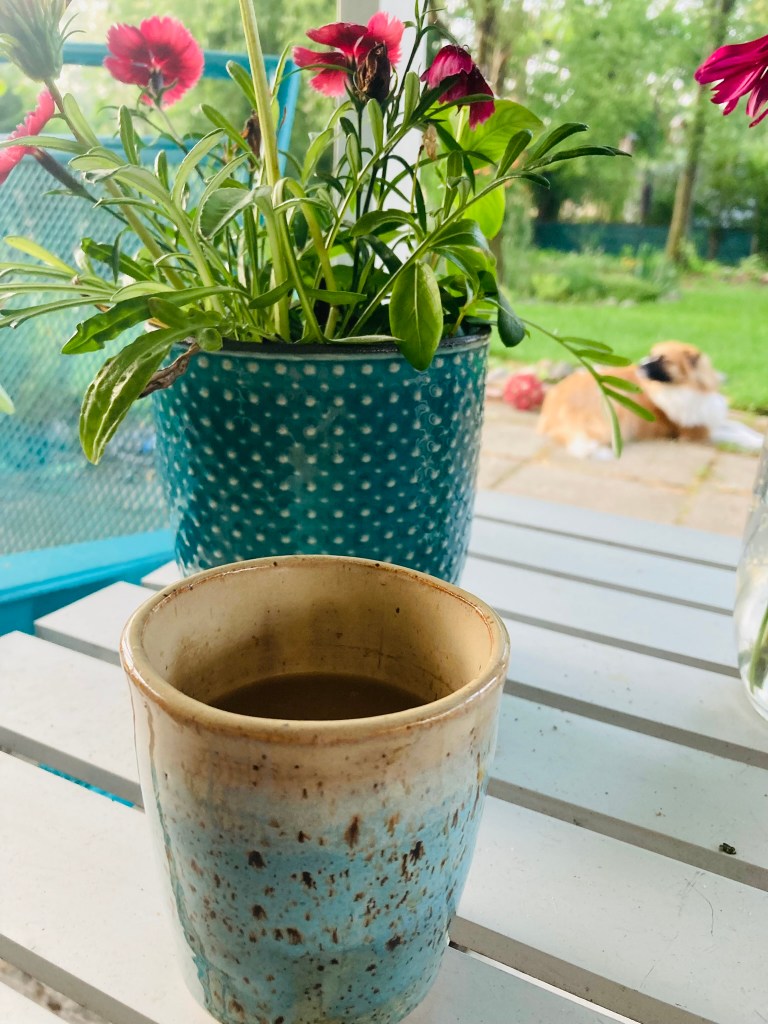
Other little happy moments that happened recently also occurred as my morning routine unfolded. I typically begin the day with a cup of coffee on the patio when I let Zero out. Yesterday, I was drinking coffee from a mug I threw and trimmed and glazed myself. The coffee contained a drizzle of cardamom simple syrup, as I’m obsessed with cardamom these days. I was surrounded by flowers, including a pretty pot of them given to me by a good friend. It was one of those moments, one I wanted to capture and imprint upon my memory for when times are tough, so that I could draw it like a card from a deck and say See? You felt good and happy and peaceful that morning. This morning too, as I stood on the patio looking out into a pale and hazy morning sky, I was surprised to see an enormous waning gibbous moon. I once wrote about that particular moon phase being my favorite, and it was a delight to see it there, perched and oddly bright in the morning sky. It was such a strange, good light, and I’m glad I took the time to bask in it.

I feel like our brains are constantly shuffling the deck of memories. A song will retrieve a memory so long ago and so good that it bruises you to remember how lost and faraway it is. A smell will bring forth another memory of a kitchen full of people you love, and you will smile. The tough memories get added on their own without any effort. I’ve read that our brains imprint—sear?—bad experiences into our memories as a protective mechanism, but good memories are not written in the same fashion. Though, what greater protection from bad memories is there than good ones? It’s a strange way for our brains to work, but if we want to make protective charms of the good memories, we have to do that work ourselves.

One of the beautiful parts about these little happy moments that we’re trying to imprint upon our brain as memory is that there is a lovely now-ness to them. Somehow noting them as they are happening opens up a pocket of time-space and lets the moment exist for longer than normal. Such moments are as much about future enjoyment of the past as they are about the present. Isn’t it amazing how they can exist and extend in all those different directions?

Still, when things are bad, at least for me, my tendency is to resist seeing things, anything, in a good light. I have to heavily lean into the part of myself that knows what to do, to trust her to pull us out. To take us for a walk, to reach out to a friend, whatever it takes. When I feel clearer-headed, I can see that the part of me that knows what to do knows because she fought for this knowledge. She worked like hell to build the scaffolding for us, to make sure we always had a way out. She helped get us out of bad situations and the unhealthy mindsets that went along with them. When things start to get bad, my thoughts become a mantra of “I don’t know what to do.” But, we have always figured it out. I hope, as I’m building this muscle memory, I can catch myself sooner and sooner each time and remember to trust and work with myself instead of against, to have all the disparate parts of myself pulling together and being a team. One part of my brain looks for the good, joyful moments, another does the research and finds the answers, another knows when we need to get out of the house or talk to a friend. And they all comfort the scared part that is worried about all the bad things that could happen.

Sometimes I wonder what it’s like to have a brain that operates as a singular unit, not a crowd of selves constantly in dialogue. But this is the brain I’ve got so we’re going to keep learning, keep talking, and keep growing. I’m off to jump into my next routine of the day. I hope you have a good one, full of happy, collected moments and good light.

Love, Cath

On Donkey Tails and Butterflies, or, an Alternate Theory of Happiness

By Catherine DiMercurio

When I was much younger, I used to think of happiness as something fixed, the donkey’s tail reunited with its waiting body at a child’s party. Life was the twirled and blindfolded eight-year-old, and when they pinned the tail, whether it found its way to the donkey’s nose or flank, it stuck. I used to think that it would stay stuck. I counted on it, as one does when one is young.

Still, even when it didn’t stay stuck, I assumed that there was always another chance, another spun partygoer who would make an attempt to once again affix happiness to my waiting existence, and it often worked this way. I felt lucky. And patient. I could wait it out. Wait for the next chance, and then prance ecstatically once again, when that magic reunion happened.

What I didn’t count on were the people in my life who were less optimistic about the return of happiness to our waiting bodies. They seemed to assume that once it had fallen away, that was it, game over. What they never understood was that the odds were in our favor. It would return, it always did if you believed it would. What I had to learn was that while there was chance involved, and luck, and optimism, you also had to make yourself an easy target. You have to watch the way everything is spinning and try and get out in front of it. Be hopeful and easy and trusting that it is on its way back around.

I lived that way for a long time, trusting and certain that happiness would make its way back to me. Sometimes it was just so easy, how could I not believe that? But when the person you’re with has a different philosophy, as a pair, the two of you become a less likely target. And then, when you’re no longer a pair, you find that you’ve begun to doubt your own beliefs. Life becomes less like a dizzy, capricious child at a party. Happiness is bestowed less easily and frequently. It becomes something you pursue instead, a quarry that seems to prefer remaining hidden, and life provides countless obstacles that make the hunt even more challenging.

Everyone is always trying to figure out how to find happiness, how to keep it, how to be it. But I remember that I once simply cultivated peace and contentment, and I enjoyed happiness when it found me. But I didn’t expect to permanently live in a state of it. I made myself an easy target for it. I practiced the good habits that made me feel healthy and whole, and when happiness found me, I was there for it. Ready to soak it up. There is a way to bask without grasping for it, without trying to bottle it up like so many fireflies.

I feel as though I have forgotten some of my former way of being, my pin-the-happiness-on-the-human philosophy. With the ebb and flow of life, with the stress, and the changes and the losses life throws our way, it seems sometimes that we are made of steel, that there is no soft surface any longer for happiness to be affixed to. It doesn’t help that a lot of the messaging we’re bombarded with tells us that happiness is something that we should be striving to fully embody at all times. That unless we’re able to say, I AM happy, simply feeling happy sometimes is somehow not enough. It’s easy to conflate being and feeling, especially when we’re young. It’s that notion of happiness being affixed, the idea that we have it now, as if there is permanence to it, which makes the losing of it harder to bear.

Photo by Hebert Santos on Pexels.com

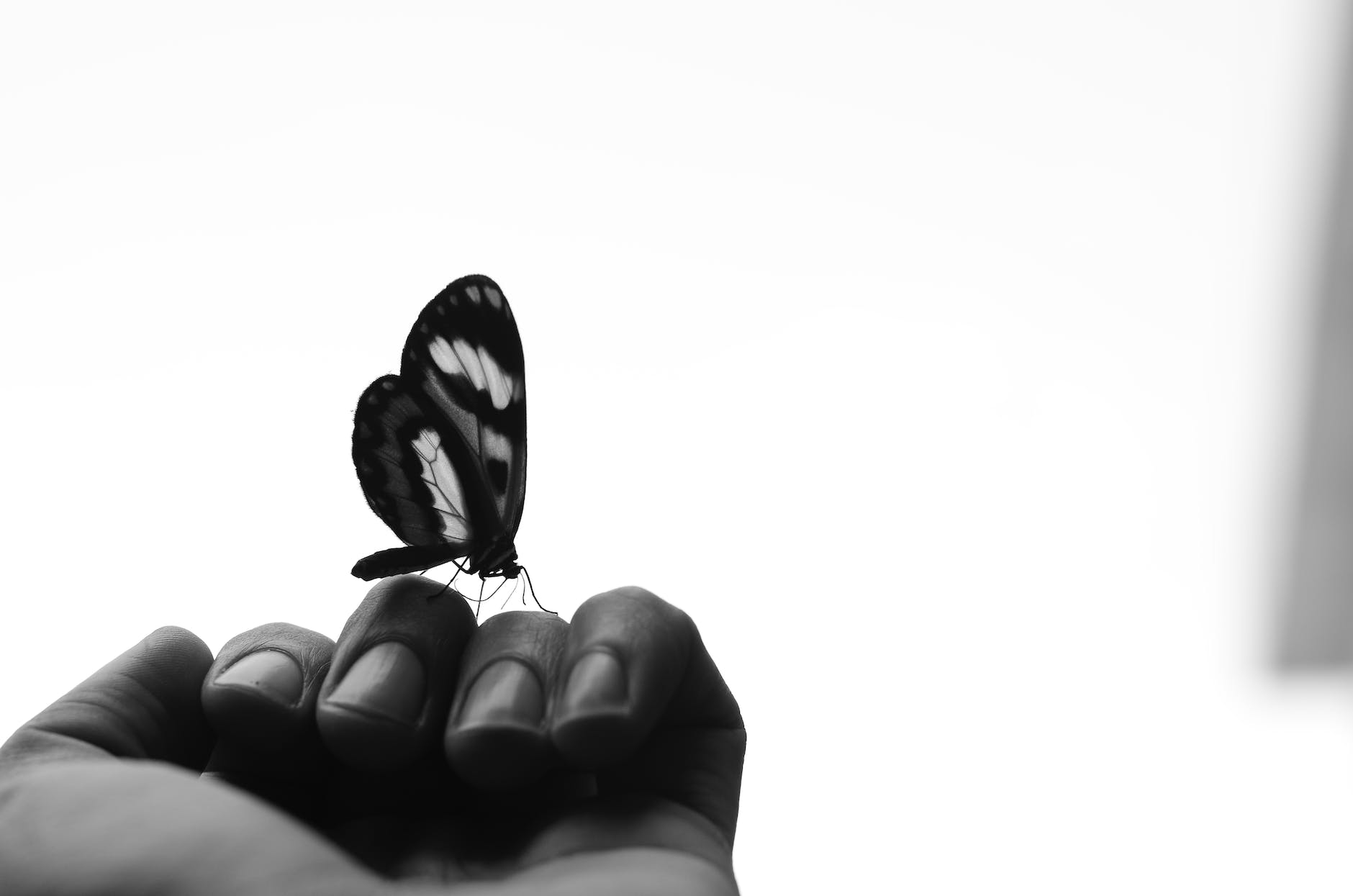
But if we acknowledge that it is a transitory thing—something that lands on us when the conditions are right the way a butterfly lands on you when you’re standing very still in the sunshine and wearing the right color—the loss of it is softened. If we stop demanding happiness, searching for it, clutching it, then maybe when it finds us, we can enjoy it more fully, and when it flutters away, we’re not left with a shattering loss, but rather, the peaceful and contented state we have been cultivating, and which we were in, before the butterfly, or the tail, alighted upon us.

We attract happiness in the way we construct our lives, but that doesn’t mean we can live in a permanent state of happiness. To expect to do so invites disappointment and even despair. But we open ourselves to it, and we control what we can. We monitor and tend to our health—physical, emotional, mental, spiritual—and we are careful with those we surround ourselves with, drawing near to us those who encourage us to be our full selves, who don’t diminish us through word or action. Life has taught me that there is a high price to pay for being with someone who prefers a certain, constrained version of yourself to your actual self. And even after you realize it, the rebuilding of self takes a long time.

I have a theory that when the quest changes from how do I find and keep happiness to how do I cultivated peace and contentment, happiness finds its way to us with more regularity anyway. I also believe that peace is not arrived at through conflict avoidance but instead through a reverent attention to self-growth, self-acceptance, and self-respect. It’s different for everyone, I’m sure. But after a confusing decade filled with so much change and so many beginnings and endings, taking time to look inward has made the most sense to me. And doing so reminds me of all the earlier iterations of myself and what worked and what didn’t.

This morning I woke earlier than I have been lately, and it was still dark outside when I let the dog out. I recently strung fairy lights beneath the newly painted patio area. They are solar lights and I am often in bed reading before I really have a chance to spend any time beneath them in the evening, so it was unexpectedly joyful to have them still glowing this morning, when I was out with my coffee and the pup. I felt happiness rustling nearby and I let it find me, let it erase my grumpiness at having woken too early after a restless night. I created that outdoor space for just such an experience. It’s filled with flowers and comfy furniture, and though it’s rustic and imperfect and really needs to be rebuilt, it is doing exactly what I hoped it would do: setting the stage for the peaceful and contented mindset I’m trying to cultivate. And in this environment, happiness alighted, and affixed, at least for now, which is all that we can ask of it.

Love, Cath

On Synthesis and Momentum and Messiness

By Catherine DiMercurio

I’ve been single two years to the day. Since the breakup that started this chapter of my life, I’ve spent a lot of time exploring my history and finding patterns and doing long-delayed work. I’ve focused on writing and pottery and self. I’ve mourned old things that it was too hard to fully manage before and I’ve mourned new things and I’ve found unexpected joys in solitude. Despite the periodic bouts of loneliness there’s a lot that simply feels better now. I have worked at discovering what wounds have followed me from childhood and into all of my adult relationships, and have explored many different ways of tending to such things. I’ve found ways to provide for myself things that were missing in a lot of relationships, like emotional safety and respect.

Still, there’s a part of my brain that seems exclusively devoted to tallies. It counts and categorizes the things that have hurt me and the things that helped me to grow. It tells me to keep writing and throwing clay and wandering in the woods. It reminds me of how good it feels to be near a lake and suggests we don’t forget about the plan to move closer to one. It encourages growth and development, but in the ways least likely to cause me pain. It’s very practical, this part.

There’s another part of my brain that unfurls itself like a flag in the wind, singing to me about being in love, and don’t I remember what that’s like, and don’t we want that again? The other part of my brain taps a pen against its clipboard and says something like, “according to the data, this course of action would not be a wise investment of resources. . . .”

They are at odds, and so am I. So for now, I check in with them to see how we’re feeling but stay busy with all the other things. Busy is an easy way to be, between a full-time job, pursuing writing as a serious endeavor, and pottery as art and hobby, maintaining my house and yard, caring for my dog, and trying to exercise and eat well and sleep well, and to generally stay healthy. That all gobbles up a lot of available energy.

At the same time, after my older dog died a few weeks ago, I spent a lot of time just sitting in the sun and watching the irises bloom. Sometimes everything needs to pause. It’s been nearly a month somehow and I’ve been trying to regain my footing. I feel as if I’ve been moving slowly and carefully through the world these last couple of weeks, trying to make sure nothing else breaks.

All this is to say that you get to a certain point and you get to feel very self-protective. I used to feel braver, at least when it came to putting my heart on the line. My loneliness outweighed everything else and it felt like I’d already been through a pretty rough heartbreak, and nothing could be worse than that, so I kept throwing my hat into the ring. But it doesn’t work the way I thought it did. A breakup after a two-year relationship can hurt just as badly as a breakup after a two-decade relationship. They just hurt differently. Hearts seem to have a lot more surface area than you’d expect and can break in a lot of places. And you keep mending it until you have this beautiful piece of art, mended with the gold of all your best efforts at healing, but you tend to get more careful with it. Mended, it’s strong, maybe even stronger than it was in the beginning, but you’re less likely to want to test out that theory.

I think this is why so many people turn to art. It can still break your heart in mighty ways, but they are easier to bounce back from. Art—specifically, my writing—has saved me and picked me back up time and time again. The physical act of it. My pursuit of it, following through with a low-residency MFA program in the middle of a divorce. The people I met, and the community I found. And I swear when I started pottery it was just like falling in love, full of angst and euphoria, and settling into the beautiful harmony between exhilaration and calm. And now there are so many different ways to grow and explore, it can feel overwhelming at times and at other times, I find so much relief in the knowledge that I could study and practice for a thousand years, or at least, the rest of my life, and still have more to learn. And again, I have found a new community.

Sometimes, when I’m not practicing one of these art forms, or actively engaged in one of the other activities that both soothes and invigorates—hiking in the woods, baking, hanging out with my dog, having coffee with a friend—I slip into rumination, or find it hard to stay engaged with work that needs to be done, whether it be my job, or housework, or other routine and necessary things. I’m trying to figure out how to find both joy and contentment in the mundane too, since that occupies a bigger proportion of my time most days than the other things. It was easier to not get so lost in my head when I didn’t spend quite so much time alone, but between working remotely and the kids having moved out and the breakup, it’s been a quiet two years. This time has allowed me plenty of time to do both productive work and to descend into rabbit holes I then have to work to clamber out of.

Photo by Vansh Sharma on Pexels.com

I’ve often looked back on the moment of impact that changed my life and felt as though it separated me from my shadow, and she became something more substantial, as if an outline had been drawn and filled in with tangible darkness. When times are tough, she seems to gain strength, and when I’m feeling good and strong, she retreats. And what I’ve been thinking a lot about lately is integration. Of attaching that shadow back to me the way it’s supposed to be; of the artistic with the mundane; of joy with responsibility and routine. Maybe it’s more synthesis than integration but there has to be a way it all fits together, for fragmentation to gently morph into wholeness.

When we center clay on the wheel we talk about the way this process encourages all the particles in the clay to move in the same direction, and we learn ways to shape the clay that works with its momentum, and that isn’t at all about forcing it to look the way you want it to. I think that’s a good goal for me too, working with my momentum, and gently encouraging all the disparate parts of me to start moving in the same direction, and enjoying the messiness of the process. It’s all a good reminder too that growth is multidimensional, not linear. It can look like you are spinning your wheels, but you are actually creating something extraordinary.

Love, Cath

On the Bearing of Unbearable Loss, or, an Ode to a Best Friend

By Catherine DiMercurio

Like any major grief, the pain you feel when you lose a pet is one of those soul-bruises that you feel every day. Your heart remembers, your muscles do, before your brain does. And then upon waking fully, you realize that this is a different world now, you are in a new phase of your life, the one without your sweet baby in it.

I lost Phin, my dog of 14 years, last week. Lost is such a nice way to put it when the reality is much graver. We bear witness to a painful decline and no matter how much we want to avoid it, we bear the responsibility for making a decision guided by love and empathy, and the desire to protect our loved one from further suffering. It doesn’t matter if the vet and countless other people tell you it’s the right thing to do. It doesn’t matter if you’ve known it for a while. You still have to make this impossible decision, and then follow through on it, and then live with it every day.

I picked up Phin’s ashes recently. It is a startling thing, to see what a body is reduced to.

When the grief hits the hardest, I try to remember how joyful Phin looked when galloping across the yard toward me. I’ve combed through all my photos and videos of him, but I don’t quite have one that matches the memory of him I hold in my head. He loved to run. He loved his walks. I aways used to say he could be at death’s door and still want to go for walks, and this was true to the end. His last walk, the day before his death, was brief, and only lasted a few minutes, a few steps. But he still stepped into the harness the way he always did, certain and eager.

In the mornings he would greet me with a wagging tail and lean into my legs the way big dogs do. Countless times during his life, he upended beverages, either by sweeping them across a coffee table and onto the floor with his tail, or by bumping into a side table and sending everything clattering and spilling.

We don’t get the same death rituals for our pets that we get with people, not in the same structured and expected way. But my dogs are the ones I talk to every single day, there for me when I wake up in the morning and when I go to bed at night. Constant companions since the pandemic sent us home from the office, never to return.

Phinny loved bread, sardines, and pancakes more than just about any other foods. Pita was the food that brought him back from the brink after a bout of pneumonia sent him to the ER a couple of years ago. The day before he died, after refusing rotisserie chicken, hunks of cheddar, a tin of sardines in olive oil, I offered fluffy, fresh pita bread. And he just turned his head away.

I want to remember all of his youthful frolicking more than his painful last days, but it’s not working like that for me, not yet. I’ve lost dogs before. I know how sharp the pain is in the beginning. I know how narrowly focused my brain is on the suffering that prompts the call to the vet. It is such a horrible call, and I think I am self-soothing, in a way, by reminding myself of what was necessary.

My dreams are haunted, but not by him. I’d welcome a glimpse of him in my dreams. I’m eager for any sign I can find that he’s out there, on the other side. I don’t know why I wholeheartedly subscribe to the lore of the cardinal being a sign of a passed loved one, but I do, and I saw one the other day when I was getting ready to take the puppy for a walk. I opened the door and there it was, flitting in the burning bush right in front of me. To be clear, the bush was not on fire; that’s just the common name of it. But a nice touch for a sign from the other side, no?

My big emotions are operating within me the way they have in the past, leaving me longing for connection but also resistant to comfort. Nothing feels quite right. I only want the softest fabrics against my skin, I can’t find anything that tastes really, really good, and there are few sounds that soothe me. I heard a bird this morning chirping in a quiet, rhythmic way that reminded me of the way Phin used to whine when he wanted something. He always sounded like a bird when he whined. When we first brought him home as a puppy, I used to think that a bird had gotten trapped in the house but then I’d realize it was him.

Overzealous gardening a few days after Phinny’s death left me with a very sore knee. Apparently “gardener’s knee” is a thing. The pain is more prolonged and sharper than I imagined anything gardening-related could be, but I think in general my body is telling me to slow down and let myself feel the things I’d rather avoid feeling. But it’s hard and it takes so much out of me. And while anyone who has gone through this understands how ongoingly brutal the pain of losing a pet is, as someone pointed out, there’s no bereavement time from work or anything. You walk into various situations expected to keep performing and sometimes it’s fine, the compartmentalizing, but gosh is it tiring. There are no shortcuts. We’re either exhausted from feeling the pain or exhausted from all the ways we try to avoid it, and we have to do both in order to make it through. Feel it, and take breaks from it.

I’m not ready for this part. I don’t want it. But I guess that’s the way it is when we lose anyone, either by death or other circumstances. But I certainly would never wish away a moment of the time I had with him, and I get that what I’m going through now, what my kids are, is the price of all that time, all those years of love and joy. I miss his earnest face and his big goofy smile and his big dog lean and his ability to see a simple neighborhood walk as expansive and fulfilling. And maybe it wasn’t just the walk. Maybe some of it was his appreciation of the company on the other end of the leash. I’d like to think so anyway. I’d like him to know I tried to give him a good life, and I’m sorry for the mopey years when everything was a struggle. Miss you, my sweet boy.

I wish this wasn’t such an inelegant attempt at expressing what this first week has been like, but we have to start processing somewhere. To anyone who has experienced this, I’m sending you big hugs.

Love, Cath

On Swimming in the Sun

By Catherine DiMercurio

Sometimes I just want to write about the sun, and the way, after so much chilliness, so many grey skies, it soaks into skin as more than just warmth, weighing more than light. I want to write about the way, no matter how many times I’ve written about pain or healing or difficult times, what I feel often, weaving through moments and days, is a sense of peace, warm and substantial as that sun. I want to talk about the way over the past two years, I have cleared away the debris of several past relationships, and set up camp within myself, creating the cozy, safe place I’d been longing for.

I write often about the things I’ve been working through over the years because it’s such hard labor, hauling away the remnants of collapse. And it helps. It helps me to talk about it and I believe it helps people who visit this space who might be going through similar things.

I don’t live in a rural area but a creek cuts through township where I live, and it feeds a larger watershed. The creek runs along the backyards of the houses across the street and in the neighborhood we see more wildlife than I expected to. Last night at dusk I heard an owl and this morning, geese. I routinely see deer, ducks, and groundhogs, as well as the expected neighborhood critters, like squirrels, skunks, racoons, opossums. Once there was even a heron, looking out of place in someone’s driveway. I love seeing and hearing this wildlife, though I always have the guilty sense of us invading their space rather than the other way around.

But there is pleasure in seeing these creatures in the unexpected place of this suburban neighborhood a stone’s throw from a big city, just as there are unexpected pleasures of working through the difficult challenges I often write about. I so often find surprising pockets of quiet in this busy neighborhood, and I am finding them more often in my mind too, much more often than when my bruised heart navigated one troubling relationship and then stumbled into the next before it could catch its breath. I was always looking for someone to feel like home, to work with me to establish the peace and connection I so craved. Of course I heard the messages of how you have to find these things in yourself before you can find them in another person. My sense at the time was something like, “yeah, yeah, I’m sure they’re in there somewhere.” But I wanted the solid, physical manifestation of those things—home, peace, connection—in another human standing right in front of me.

When my last relationship ended, I remember having the sense both that I needed to find those things within myself but also, that if I did, I wouldn’t care about finding them in another person, that I’d stop looking, and that even if I was happy being alone now, would I always feel that way? It was as if I was trying to satisfy my now self and my future self at the same time, as if I didn’t trust future me to figure out and pursue what she wanted. Because I didn’t. I didn’t trust future me to figure it out any more than I trusted now me.

But I knew my now self needed a break. Time.

And in this time, with all the debris clearing and the setting up of camp and taking stock and being with myself, I have discovered so much that I needed to find. While I’m still trying to rebuild a confidence I probably lost somewhere in early childhood, after one too many comments about being too this or not enough that, I have found ways to untangle the knots of anxiety that used to tighten so easily. It’s not gone, of course, and this would be obvious if you talked to the family members and the friends I confide in, but here’s the thing I learned: it’s okay to confide. That’s one of the reasons the knots are loosened is that I have learned to reach out, to receive comfort, to wriggle free of the shame that is so often attached to what society so often perceives as weakness. There is so much strength in knowing when you need to reach out, and acting on that, and so much value in developing those trusting relationships.

I also have found joy again in the delight I take in simple things. I never realized, until I laughed hard, alone in my house, over some silly memory or a joke I told myself, or a hilarious meme, how wonderful it is to not have to put a damper on your own happiness because someone around you is unhappy. I don’t know if I ever learned how to do that in a relationship. I always felt like I needed to mirror the level of happiness my partner felt, as if it would be offensive to be joyful while being near someone who was either momentarily grumpy or definitely suffering in a depressive state. I have found moments of unmitigated happiness in my yard with the dogs, or on a walk with them, as we curiously explore our neighborhood together. I’ve uncovered the thrill of learning the Big New Thing that is pottery. I have also written so much lately, delving in and drafting and revising and submitting, rediscovering how necessary writing is to my sense of self. I feel so foreign to myself if I miss my morning writing time, whether it’s the aimless wander of journaling or the wild creation of a new story, or the focused attention of revision. It’s no wonder, when I so often back-burner-ed my writing in my last couple of relationships, whether due to time constraints or the overwhelming anxiety I often felt about the relationships, that I felt so out of touch with myself. But I’m back, feeling curious and growing and working and writing and creating.

Photo by Guillaume Meurice on Pexels.com

Sure, I feel stuck sometimes, and I write about that candidly, but I also feel like a clever fish, freely frolicking in a big deep lake, swimming to the surface and warming myself in the sun and diving to the depths to explore. That is, I’m embracing a freedom that while scary sometimes is also deeply peaceful and wonderfully delightful.

My point is that for every point I’ve made in this blog about healing and how hard it can be, there is a complimentary point to be made about the reward, the value, the worth of it all. There is always compensation. There is always the awareness that what I’m building is the foundation for everything that is to come next for me.  I’m creating the solid, physical manifestation of the home, peace, and connection I’ve been seeking instead of searching for it in another human standing right in front of me. It’s me. I’ve always been standing right here, but how easily we make shadows of ourselves when it seems like the right thing to do for other people, or because we forgot how to do anything else, or we never knew in the first place. But here we are now, in the sun, at last.

Love, Cath