On Music, Muscle Memory, and Mattering

By Catherine DiMercurio

One of my earliest memories is of sitting next to my maternal grandmother, my Busia, on the bench in front of her shiny, black piano. She was a beautiful pianist and she was teaching me to play. I don’t remember much about how I felt about the music, but I loved being next to her. I felt safe and good. With her soft, dry hands she would position my fingers over the keys.

Photo by Bryan Geraldo on Pexels.com

The essay I thought I wanted to write came to me all at once, and it began there, on my grandmother’s piano bench. It was about the way the ensuing lack of music education in my life shaped me, the way some absences do. And while this version of my history is not wholly untrue, something felt . . . out of tune.

At home, we had a piano in the basement, and I remember not wanting to go down there because it was cold and I didn’t like being by myself in the basement, but that’s where I had to practice. I plunked away at “Michael Row the Boat Ashore.” But it wasn’t the same, sitting there by myself. And then, we moved to a small apartment, and we couldn’t take the piano. We still saw my grandparents frequently, but somehow the piano lessons drifted away.

Later, I wanted to get into the school band program. At my school, fifth grade was when students could select an instrument and join the program. My sisters before me had elected to do so, with one on the clarinet, and the other on the trumpet, but they didn’t continue for very long. I longed to play the saxophone. Instruments were, and are, expensive and my sisters’ instruments were used. M y family suffered a financial setback, and buying another instrument, for me, wasn’t in the cards. (My younger brother would go on to play the saxophone, and my baby sister, born after I was in college, would excel at the flute.) Somewhere along the line, I turned to writing. Cost was not a factor here. I began with a diary and a journal full of poetry.

I think, in that almost-essay, I was looking for my “origin story,” as a writer, and believed I had found it once I began excavating these memories of my desire to pursue music and how I turned to writing. But the fact is, I didn’t find writing because of a thwarted musical pursuit. I think if I had connected with music more, I would have gone after it again and again and again, which is what I did with my writing.

As an adult, I have periodically tried to teach myself piano, with the help of a keyboard my ex-husband and I bought for the kids one year. No one played it much, the kids gravitating toward stringed instruments and excelling in their middle and high school orchestras on the violin and cello. Trying to teach myself piano was a struggle. So many things are easier to learn when you are young. Still, I sing around the house, old songs that get stuck in my head, little songs I make up on dog walks. I sing in the shower and in the car. It isn’t as if music-making is completely absent from my life.

But all this thinking about the way music wasn’t a part of me the way it might have been underscored something else that I’ve been feeling lately. It’s as if I’m caught between two things: wanting my existence right now to have been imbued with a history that it wasn’t, and trying to figure out how to make the future what I want it to be. I wonder which dreams it’s too late for, and which are the ones to pursue.

There is a poem by W. S. Merwin, “Separation,” that reads: “Your absence has gone through me / Like thread through a needle. / Everything I do is stitched with its color.”

I read that and I thought about several things at once. One was music. I romanticized the absence of it in my life. And though I have truly felt that absence as a pervasive presence in my life, I think I was using the music thing as a cover. Was I actually feeling the pain of a different absence? I thought about my past romantic relationships. I don’t feel the way Merwin describes in his poem about any of men from my past. When my marriage ended, I did feel that way, but not about who my ex-husband was at the time. I was mourning who he used to be, what we’d once been to each other, and that’s what stitched its way through everything that I did for some time. Still, that feeling has dissipated to a faint echo over time.

But I wonder now if the reason that poem resonated so much with me is because I gave so much of myself away for so long. To the world, when I wanted to be accepted, to the men in my life, when I wanted to feel as fully loved as I was loving them. Maybe the true absence that has threaded its way through everything was me, the me that was loving everyone else so fiercely because I never even knew that you were supposed to love yourself. And by the time I learned how important that was, I had no muscle memory for it, just like I have no muscle memory for piano. A few piano lessons when I was very young did not etch themselves within me, nor did any innate self-love I possessed survive what the rest of my life was teaching me, that selflessness was a virtue, that pride was a sin, arrogance unattractive. Many women of my generation had a similar experience, where we heard mixed messages: you can be anything you want, but also, cultural and religious messages told us not to be too bossy or smart or sexual or strange or confident. Reveling in one’s self-ness was selfish.

An old friend and I were talking recently about enough-ness, about a self-identity not constructed out of purpose and mattering. There are [rare] times when I believe with my whole being that regardless of anything that I’m pursuing or achieving, I am enough. That be-ing is enough purpose in my life. But more often than not, I feel compelled to demonstrate worth, to feel like I’ve accomplished something, to have a larger purpose. To matter. But isn’t it enough to be the central thread stitched through my own story?

It’s no wonder then, that something in me wanted to push toward an origin story, to shine a light on something that underscores who I am, and what I want to continue to be. There is a type of coming of age story, a subcategory for coming of age as an artist: Künstlerroman. I wanted that story. I’ve talked to other writers who identified music as an artform they pursued before they found writing. They mention ways in which a serious musical pursuit was thwarted for them, so writing both filled that artistic need and opened new doors for them. Maybe I wanted a little bit of that, something like an artist’s journey, as if my sitting in my bedroom with a little grass green notebook—which I still have—penciling in poetry was not the beginning of a story that mattered.

Yesterday I took the day off work. I was feeling myself spinning out and away like a loose spool of thread, coming all undone. I made sourdough pancakes and listened to BBC world news while I ate breakfast. I stared out of the window at leaves I have no intention of raking anytime soon. I hoped the dogs would continue to sleep quietly and not need anything from me so I could just be. Self-love can be as difficult to learn as the piano, but I have learned enough to know when I need to regroup. I’m trying to hold on to being over mattering, to enough-ness. I’m focusing on being a bright thread stitching its way through everything, instead of letting my own absence weave its way through my story. Maybe one day I’ll develop more muscle memory for it, and my heart will know how to do it as effortlessly as my fingers can fly over this keyboard, typing out these essays, which are really just a kind of love letter, from me to you, and me to me.

Love, Cath

On Stories, Journeys, Maps, and Signs

By Catherine DiMercurio

Sometimes, all we want is a sign.

Recently, I wrote a short story with a happy ending. Or, more accurately, I finally wrote the happy ending to a story I thought I was done with. I write a lot about broken relationships and wounded people who are trying to find their way toward new versions of themselves or new love. I write about them in various stages of this process. I’ve imagined people in their 20s and people in their 80s struggling with different versions of this same journey. The stories end not hopelessly, but with some acknowledgment that the journey is long, and not over.

I’d been revising this particular story, taking a fresh look at it the beginning of it for a workshop. As I worked deeper into the story, I suddenly began to see a richer ending taking shape, one that moved the characters past the moment of not being able to connect with one another. As I read the last scene I’d written, I sensed what was supposed to happen next, able now to imagine these two people drawing on the bravery they both possessed in order to be emotionally honest with one another and finally move toward one another. Maybe it’s less artful now, with its happy ending. So many short stories end in ways that leave you thinking and wondering, and maybe I still won’t be able to place it with a literary journal. It’s too soon to tell. But, either way, I feel as though I achieved something with this story.

I was not capable of writing that ending to the story before now. I could not have written it one year ago, and I certainly couldn’t have written it eight years ago. It’s not that I couldn’t envision such an ending, but I felt stuck in a way, or, unable to unstick the words from my throat. Confused about how to unravel the fibers, comprehend them, and knit them back together into meaningful sentences, though I felt all the fine threads in my hands. There were insights that eluded me, and that I didn’t know were eluding me. How often do we feel that way, that everything is right in front of us but we can’t see what we need to? So often, we make do with what we can. We show up with everything we’ve been able to make sense of and everything we haven’t, because, what else can we do?

Journeys take a long time, and often long stretches happen in the dark. It’s no wonder we want to look for signs that tell us we are on the right path, that things are coming together, that we are getting unstuck. It is easy to notice things that we hope are signs, once we are looking.

(A yellow butterfly crosses your path while a meaningful song is playing. You once again happen to glance at the clock and the time is your birthday. As passcode for a two-factor verification comes up as 123456. A moth patiently waits for you to save it from death by lightbulb and you do. On a dating app, you see a picture of a man with a crow behind him on a fencepost. You see this picture just after you’ve finished writing a story with a happy ending, a story that happens to prominently feature a crow. [Yes, I commented on his crow picture. No, he did not message me back.])

Photo by Alfonso Ramirez on Pexels.com

Often, I find myself believing that there is no “right” path. And if that’s the case, what need have I of signs to verify that I’m on it? There is no timeline, nor a single trajectory that you follow to get from one point to another, from the point of hurt to healed, over it, better. Still, sometimes we feel a sort of peace settling in over scars, like gold dust or starlight, and we feel soothed, sometimes even shining and spectacular. We can notice that things feel aligned, or balanced, or magical, if only for a moment. We can take all of this as validation that we are doing something well, even if there is no right path, no one way to go.

This bears repeating. I find my self craving answers sometimes to specific questions: should I do this thing or that? Is it the right time to take this step? And though I agonize over the details of these questions in my head, when my heart raises its voice through all that clatter it asks am I doing this right? Is this okay? Am I on the right path? Deep down, essentially, all I really want is to know what I already know. I’ve got this. I’m doing this right. Everything is going to be okay. And the feeling I get when I see the things that feel like signs to me is one of peace. The voice I hear is one telling me you’re doing well. I think I’m not actually looking for a sign that I should get back on Bumble or whatever. I simply want to know that the decisions I make – about anything – are well-fashioned out of awareness, and contemplation, and self-trust. Sometimes, what we really seek is the validation that we are doing/living/being well, and that this path or that, while not inconsequential, matters less than trusting ourselves to do what feels true and good for us.

The way forward after the low points in our lives is a blue-veined map across the surface of our souls. We follow paths that make sense at the time, and find our way back to our heart, and we leave again, replenished but uncertain about where we’re supposed to go next.

Autumn is a good season to pause, consider your surroundings. The days are getting shorter but for the moment, there is a pleasant balance between activity and restfulness, at least for a little while. When you think about the next steps you want to take, consider whether you need some time to get to know your own heart again. Take a visit back, refresh yourself. Consider too, if you’re heading out once more, that there’s no one right way. You don’t have to pursue whatever it is the world has told you should have by now. You get to do it your way, and if you find yourself looking for signs maybe it’s because you already know whatever it is you’re trying to validate.

But it’s okay to want the sign. It’s okay to crave the sight of crows settling in trees at dusk, or cardinals leading the way on your morning walk, or days when your favorite number keeps popping up everywhere. Dreams of pets who have passed, or the same old song turning up on different radio stations multiple times a day, the butterfly that lands on your shoulder or the cricket that has hitched a ride in your car. Whatever it is that strikes you as special, unusual, take in these signs and cherish them. Then figure out what it is that your heart already knows. Maybe it’s just waiting for the rest of you to catch up.

Love, Cath

On Windmills and Waterfalls, Dreaming and Doing

By Catherine DiMercurio

Sometimes we have to protect and feed our energy.

I love a morning moon. Recently I stood under a 5 a.m. waning gibbous, after the harvest moon. I’m not sure what planet glowed nearby but between the moon, the planet, the still bright stars, and a symphony of crickets, letting the dogs out that early was quite pleasant. It was good energy to begin the day on.

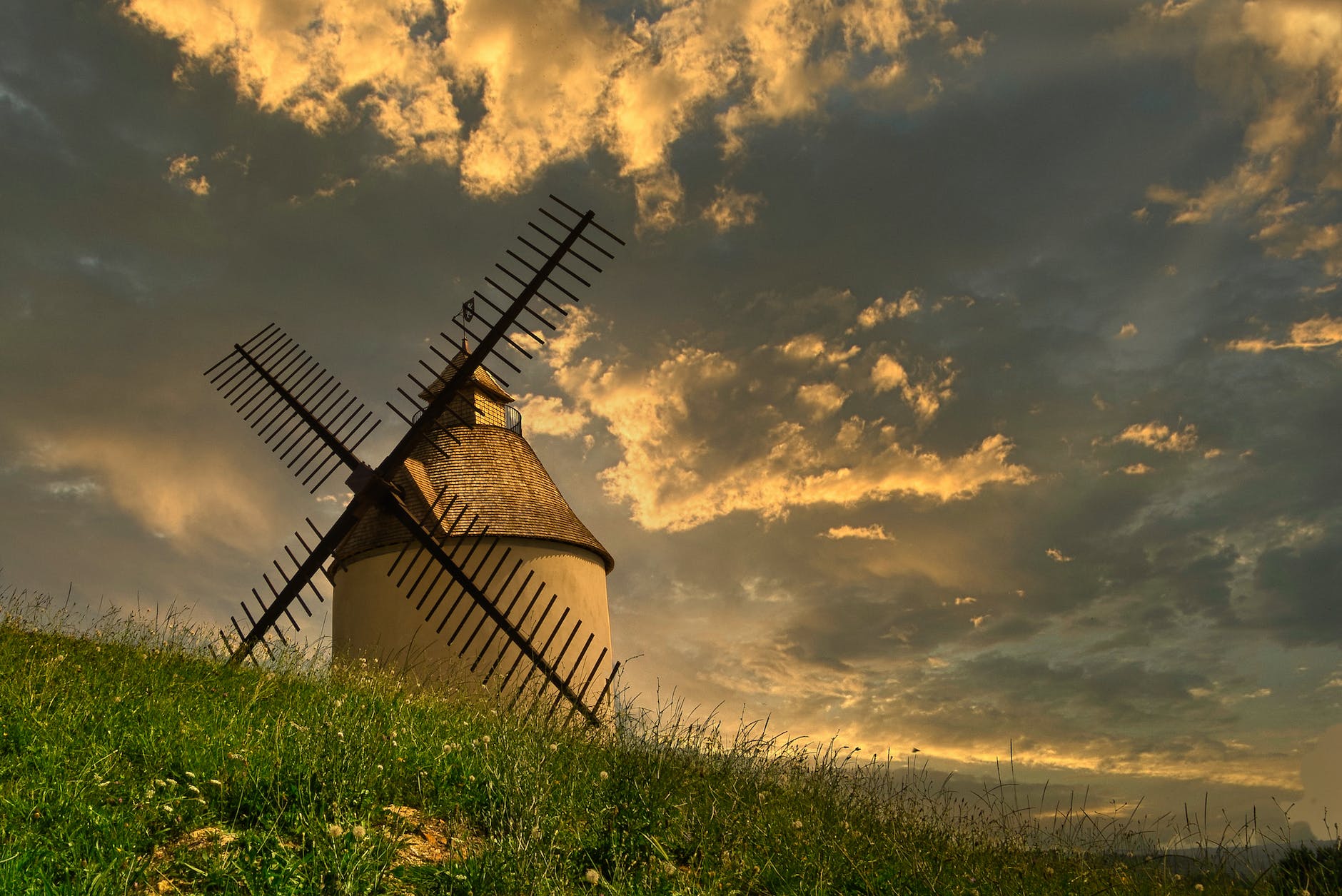
I’ve been thinking a lot about energy lately. My sister recently told me about a dream she had, involving the two of us and a windmill and a waterfall. I feel things churning toward change, as if I’m at some sort of turning point but I haven’t yet discerned what’s next or where exactly I am. I liked the symbols of energy and power she spoke of.

Photo by JACQUES BARBARY on Pexels.com

I’ve had strange dreams about energy as well. One was about electrical cords that were plugged in in strange places, like across the room instead of the nearest outlet, so I was always tripping over them. Another was about a horse. My kids and dogs and I were in the pen with him, and he was alternately restless and bucking, or nuzzling us. Finally, we realized he was hungry, and after we fed him, he was content. This beautiful creature was trying to tell me something simple and urgent, and was getting impatient that I couldn’t figure it out. These dreams left me feeling as though I should be doing something.

On another recent morning, I stood outside at dawn, and white clouds blanketed the sky. I couldn’t get a sense of the sun rising so much as the sky began to lighten every so gradually. And I thought, maybe some transitions are like that. Soft, quiet, and so subtle you don’t notice they’re happening. So unobtrusive you can’t tell where the light is coming from. They are not full of do-ing energy but with be-ing energy.

What is the right balance between energetically pursuing your dreams and patiently waiting for your efforts to pay off? When I look at where I am, what I’m doing, and what I want, it’s unclear where I should focus my energy. Sort of. I am pursuing my writing goals; I’m not yet it a position to pursue my dream of living by woods or water; I’m feeding my creative needs not only with writing but with pottery; I’m maintaining friendships, and trying to be a good dog guardian, and doing my best to be there for my kids to the extent that they still need me to be. But a question mark hovers in the relationship category.

For a long time, I thought if I experienced loneliness, then I was not doing the “being on my own” thing properly. As if I had to prove that solo was perfect and right for me by being fine all the time. But everyone gets lonely. That doesn’t mean I’m failing. Occasional loneliness is a normal thing for everyone, for people in relationships and for people not in relationships. There are going to be times when the feeling crests, but that doesn’t mean it has to swallow us up.

I was hiking this weekend, and while I often find a friend to go with, on this occasion, my usual hiking buddies were busy, so I went alone. I was excited to explore a different part of my usual trail. While doing so, a couple came up behind me. They were walking a bit faster than I was, and to avoid a prolonged period of stalking right at my heels, they said to one another, “want to do a little trot here?” and they jogged past me and got far enough ahead that I wouldn’t be encroaching on them.

When I thought of the ease they had with one another, and having heard snippets of their conversation, I felt a sudden piercing burst of loneliness that brought tears to my eyes. How beautiful to have a likeminded partner to share a hike with, to be so familiar with one another that the conversation flows, and you instinctively communicate with one another on the trail. I thought of my past relationships, and how little we actually had in common in terms of how we enjoyed spending our free time. It’s easy in a moment of loneliness to slide further and further into the past. But I also had the very conscious thought that I did not want to let this bitter pang to continue intruding on my current joy.

I remembered something—a tool to help ground you when you’re feeling anxiety or grief taking over. I knew I needed to firmly root myself into the present moment, the beautiful experience I was having out in the world, not the twists and turns inside my head and heart. I reached out, letting my fingertips skim the bark of a beech tree, and then the next tree, and the next. I took deep breaths of woodsy air, warm and humid on this September morning. I looked down. At my feet was a fallen yellow leaf, of a shape I couldn’t quite identify. It didn’t look like anything around it. I thought it was vaguely poplar shaped, but oddly asymmetrical. I carried it with me, rubbing it between my fingers as though it were a talisman helping me ward off evil.

Because it was. Not that our emotions themselves are evil. But here’s the thing. There’s a difference between noticing/feeling your emotions and having them bond with anxiety in that toxic way they sometimes do. Anxiety distorts our emotions, mutates them. It’s a bad combo. I saw that beautiful couple being awesome in the woods together, and the emotions came at me hard and fast. Grief, loneliness, the confusion of “have I ever had that?” I felt it all in an instant. But I knew anxiety was kicking in when I began to ask the “what if” questions. What if I never find it, etc. That’s when I reached out to the trees for help. We have to know when to reach out.

Funny that I found a little distorted leaf that looked like it didn’t belong anywhere since that’s exactly how I was feeling. It’s like the woods were saying, “you’re not alone.” And that’s also when I realized that feeling lonely doesn’t undermine any progress we’ve made with self-trust and healing. It is simply another emotion. We notice it, feel it, and it’s a good sign when we can prevent it from pairing up with anxiety.

I was pleased that I’d managed to hold onto the good energy, to nurture it. But what of the other energy, the dream energy that seemed to be urging me to do, to act. Was it relationship related? Am I ready to try again? Or is it better to simply be, be me, be open to possibility, to wait and see what happens?

So much of what we want in life, so many of our dreams, are not entirely within our control, so it’s no wonder that it’s confusing when we consider how much energy to put into something. I think we have to listen to what our dreams are pointing us to, but they can be hard to interpret. Maybe the doing my subconscious was hinting at was about simply protecting my own energy. Not wasting it. Feeding it. Maybe it was about reassurance, a reminder to keep tending and keep trusting.

Love, Cath

On Love Letters and Pancakes

By Catherine DiMercurio

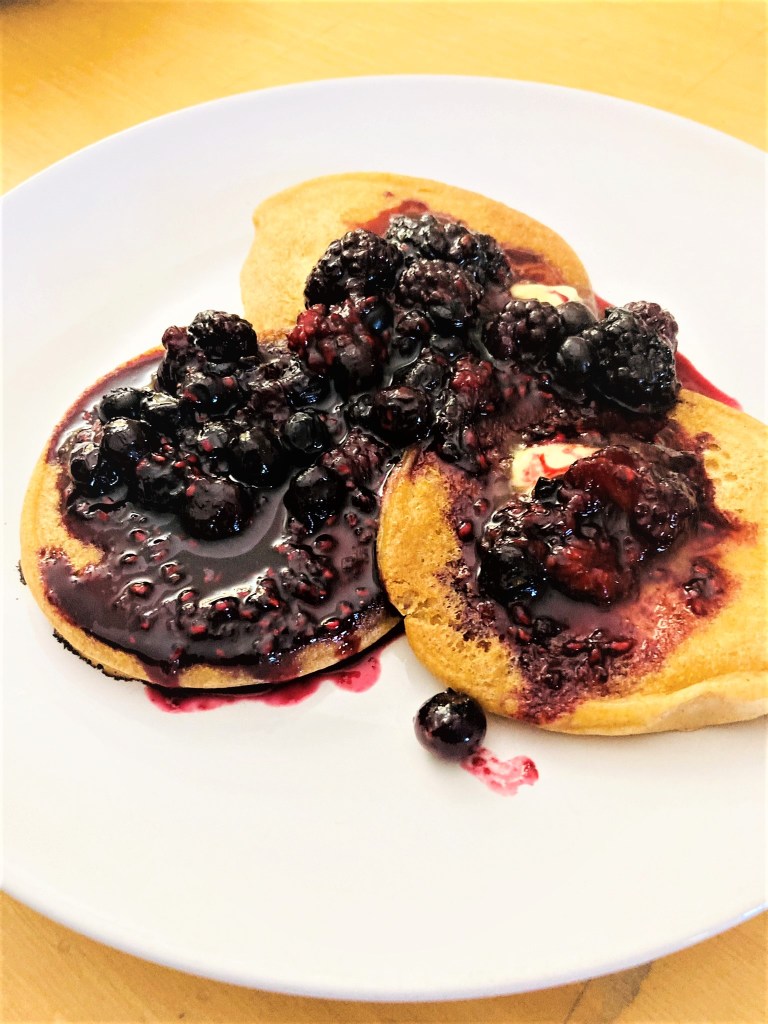
Pancakes are love letters I write to myself on weekend mornings. Yesterday’s were slathered in vegan butter and a syrup made from mixed berries and turbinado sugar, since, shockingly, I was out of maple syrup. I have a long history with pancake-as-love-letter. I used to make them for my family when the kids were little. It was a favorite treat. Every once in a while, if I was up early, I’d make them on a school morning and the kids would be surprised and delighted to have a break from their usual school morning fare of toast and tofu, cereal, frozen hashbrown patties hastily heated, smoothies, or whatever else we threw together. When we’d have neighbor kids over for a sleepover, I could easily be cajoled into making chocolate chip pancakes. All of this was a way for me to say, let me do this for you, make you feel welcome and delighted and full-bellied. Comforted and loved.

Messy but tasty.

Once, when my marriage was building toward its demise, and it seemed like my husband had gradually evolved into someone I didn’t know, who didn’t know me, I made pancakes on a Saturday morning and called the family to the table for breakfast. He sat down, reluctantly, in front of the steaming plate of love letters I’d placed in front of him. “I don’t really like pancakes,” he said. He didn’t even say “anymore,” as I recall. It was as if he was telling me that all along, he’d never liked them, and all along, he’d let me labor under the delusion of my delight in feeding him this treat. All along, what I knew and what I thought I knew were different things. Some seemingly mundane moments like this etch themselves into your soul and you try and talk yourself out of letting them mean too much, but later you are able to understand why it hurt so much more than it “should” have.

Later, after the divorce, after the rebound boyfriend summoned from my college days (for whom I made gluten-free pancakes), my first real new boyfriend spent the night for the first time while the kids were away. I made him pancakes in the morning. I delighted in how much he enjoyed them, how pleased he seemed to be in my space, sitting at the dining room table with me over pancakes and my syrupy love notes. I fell in love easily then, though that relationship did not last long, nor did the one that followed. I have a pancake story for that one too, but like most of the love notes I offered then, the reception was lukewarm.

Now I make pancakes for myself and it still feels like a special treat. Yesterday, I needed to feel taken care of, so I made myself the aforementioned pancakes. It started out just as something that sounded good but as I began mixing the batter, I thought of how satisfied I felt whenever I bothered to make myself a good meal instead of just scraping something together because it’s “just me.” So I completed the task with more deliberateness, thinking about why I was feeling the need for care in this moment, and also being grateful for being tuned in to what I needed. Even just months ago, it was challenging for me to consider both what I needed and figure out a way to get it. It was no easy task to make myself feel loved. To allow myself to feel loved. By the people in my life, by myself. Being partnerless felt burdensome, heavy, huge. It felt like an enormous cloud that shadowed my life. I felt that, theoretically, I loved myself, but I sort of waved away the notion that such knowledge could do anything to assuage my grief or loneliness. Now, I’m able to enact that love in different ways, to sit with emotions that need attention, to take comfort in a thoughtfully made meal, to pull myself away from the damaging loop of anxiety-thoughts by going for a walk or heading to the pottery studio or playing with the dogs.

It’s taken me so long to learn how to connect all these dots. For most of my life the messaging around me was that there was something wrong with prioritizing oneself. We don’t really learn how to do it. I didn’t. Or that we can, or should. For me, it has been so much easier to do now that I haven’t been in a relationship for a while. A year ago, I would not have imagined that I would come to think of the ending of my relationship as a gift. At the time, I felt I was making a healthy decision for myself but it was still a painful process and a grieved ending. It has taken me these many months to get to the point where, beyond knowing what I want in the next relationship (when/if that happens for me), I know myself so much better. Further, I know myself better for the sake of myself, not for the sake of any past, present, or future relationship. In the years since my divorce, I’ve been doing this work, but having this time entirely to myself for the past year has allowed me to further those efforts, to be more conscious, aware, and deliberate about my wants, needs, choices, preferences, and so on. To be clearer about my motivations and my triggers.  

Obviously, as a human, I still desire external validation, connection, conversation, etc. I’m learning what it means to feel wholeness and peace and at the same time desire connection and community. They aren’t mutually exclusive. I also have bad days where nothing seems to help. I’m still a work-in-progress. We all are, and there is so much beauty in that. The people I’m most drawn to are those who possess that same awareness. 

Pancakes are not the only love letters I write to myself. When I look around my space and see houseplants in every room and jars of found objects—pinecones, driftwood, rocks—I see all the ways in which I bring nature inside so that it is all around me, because it calms me and centers me. Every little stone I’ve ever pocketed or tucked inside my beach bag was a way of me saying to myself, trust me, you’re going to need this later.

So, if you’re reading this, take a moment amidst all the loud clatter and chaos that seem to be the norm of the world around us most of the time, and think about what little love note you could give yourself today. Is it cooking a comforting meal, writing an actual note, going for a walk, picking up a lucky penny? Maybe it is pouring coffee into your favorite mug, and stepping away from work for 15 minutes outside. What are the ways you’ve expressed love for others in the past that you can offer yourself now, like me and my pancakes? It’s worth thinking about. You’re worth it. I am.  

Love, Cath

On Playfulness and Practice

By Catherine DiMercurio

In the days that have passed since I returned from the camping trip I wrote about in my last post, I have struggled with exactly what I feared would happen. When I was spending my days in the woods or on the beach, feeling my anxiety get up and take a long walk away from me, I wondered what would happen when I returned home to the things that typically trouble me. Would I be able to hang on to that feeling of being both weightless and grounded, or would I get pulled back under the worry? I wondered if my mindset on the trip meant that I had turned a corner, arrived at someplace new, someplace I could stay and set up camp, so to speak. Or was it temporary, just vacation brain, and nothing more?

While I believe I sort of “leveled up” in my thinking, in my ability to acknowledge my full self and to lean into self-trust in a way I haven’t been able to fully embrace for a painfully long time, I have also realized, in the days since my return, that living in that mindset takes practice. Now that I’ve been there and know how it feels and understand how I got there, I realize that it will take effort to find my way back to that way of thinking sometimes.

I’ve been thinking a lot about practice lately. With pottery, it is easy to understand the importance of practice. At any point you might have a day where it feels like you never learned a single thing. Once I began to be able to center my clay on the wheel consistently, for example, I thought I had reached a certain level. I had this, my muscles had developed the memory they needed to always be able to execute the task. But, I learned quickly that it doesn’t work that way, and that practice is as much about building muscle memory as it is about teaching yourself how to fail. How to not get thrown when you can’t throw. How to make practice feel like play. When my brain insists that I need to accomplish something right now, so that I can prove to my instructor, my classmates, or myself, that I’m learning, that I deserve to be here, that I am a potter, I get frustrated with myself. I create pressure and urgency that impacts my ability to throw the way I want to. I get embarrassed if anyone notices, or mentions that I seem stressed. Then the embarrassment (shame by another name) compounds that feeling of failure. It is difficult, but I am learning that I must practice changing my mindset before I reach that point of frustration. And I do know how to do this, even if I’m not always able to execute. When I haven’t created a sense of urgency for myself, I’m able to say, after messing something up, oh, well, it’s just practice. And I believe it.

A writing friend and I were talking about this recently too. I realized that playful practice is the point of the writing prompts we’re experimenting with. It’s about being open to creativity, and urging your brain to set aside the frustration. You just write without judgement. You are not writing for a deadline or a purpose other than exploration. It’s just play. And unless you are trying to win something that’s all practice needs to be.

The only reason why I have created pressure around the notion of practice is out of habit, out of a cultivated perfectionism predicated on a lot of wrong ideas about love and worth. The benefits of practice, in terms of progress toward your goal, are more easily evidenced in the absence of urgency. At least for me. As soon as there is the pressure of time—I need to learn this faster, be able to demonstrate progress sooner—whatever I’m practicing gets worse instead of better.

Do we practice to improve, or do we practice because we enjoy something, and improvement is a side benefit?  

And how does this relate to being able to maintain a healthy mindset and sense of identity like the one I found/embraced/earned when I was camping on the shores of Lake Michigan? Cultivating that mindset is something else that benefits from playful practice. It’s hard not to think about consequences. If I have a bad throwing day or write something that’s terrible, it does not matter at all. But if I fail to approach my mental health in the right way, the consequences are more serious. My anxiety starts to call the shots, and it changes who I am, how I want to be. If I don’t approach it with a light touch, all I can think of are the consequences, the what-ifs: what if I can’t get back there—to myself, to self-trust. What if I forgot how?

Here again, play is the answer. Play is the way back. Play is how I found myself. All I did after the “work” of setting up camp was to listen to myself and do what sounded fun. The challenging hike was something I was anxious about at first, but aside from the bear scare, it was an uplifting and joyful experience. So was waking up to the sunrise over the lake and listening to the waves. So were campfires, and games of solitaire in the tent while it rained, and reading book after book on the beach, and swimming, and rock hunting, and more woodland wandering.

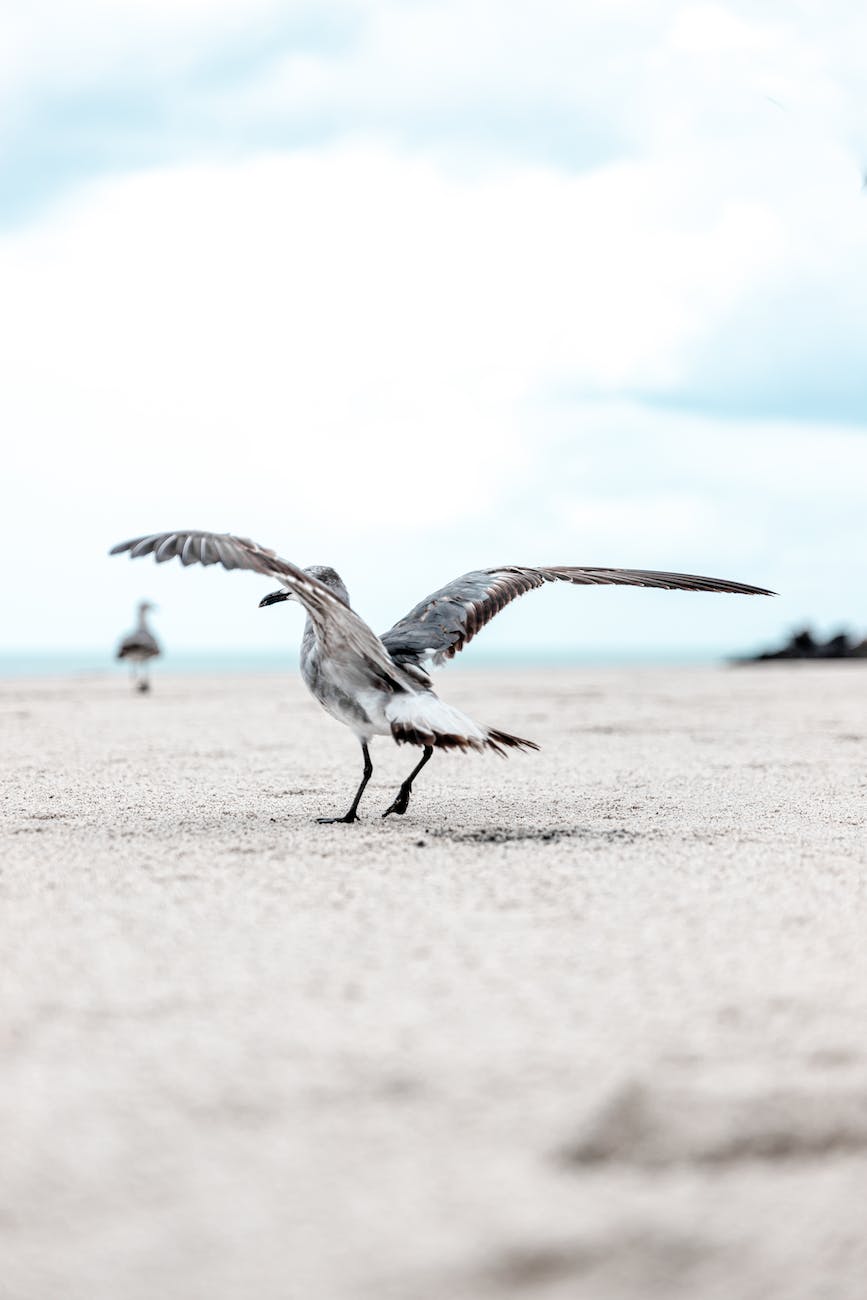
Being playful is something I need to practice. So today, after a stressful week, I decided that nothing bad would happen if I didn’t sweep up the dog hair or clean the gutters, and I took myself to the beach. I read my book. I ate marshmallows and toasted almonds. I swam and waded and people-watched. i watched the clouds and the sea gulls.

Photo by Nick Nu00fau00f1ez on Pexels.com

I have spent so much time over the years doing “the work.” That is, trying to understand and to heal and to grow. I’ve had experiences that seemed like detours or roadblocks, but they were all part of the process, in their own way. But in all that time in my head, thinking and reconsidering and exploring new perspectives, it was easy to overlook the point of being playful. I try to be open to and observant of joy, but I don’t always make opportunities to welcome it, to seek it, grow it. I’ve always had a bit of a Cinderella mentality in that I usually feel like I don’t get to do something enjoyable unless I’ve finished my chores, been productive, done my work. But it is in play, in doing the things we find enjoyable, however silly or small, that we can get in touch with a safe and happy place within ourselves. And when we feel safe and happy, we trust ourselves, we are buoyant, relaxed. There is no anchor of anxiety pulling us down and holding us back, holding us under.

Who would have thought that you would have to practice being playful? Not everyone does, but if you’re learning or re-learning this too, I see you. Have fun! Your very own kind of fun.

Love, Cath

On Lake and Forest Magic, and Self-Reliance

By Catherine DiMercurio

Sometimes, water and woods work magic on your soul.

I planned the vacation I could afford. Camping, no hotel room. Driving far, but not so far that gas prices made it unfeasible. Wonderful family and friends to watch the dogs, so I didn’t have to double the vacation price by paying for dog sitters too. I have traveled alone but this was my first time vacationing alone. I have camped before, but this was the first time I camped alone. I have hiked alone before, but this was the first time I was navigating unfamiliar territory alone. This is all to say that as I headed out for the trip, I had some concerns. My anxiety was stacked up inside me like the clothes in my slightly overpacked duffel.

After a seven-ish-hour drive that included some stretches of blinding rain, I set up camp at a Michigan campground in the Upper Peninsula on Green Bay, where I was about thirty minutes from Wisconsin, in a different time zone, and perfectly situated to watch the sun rise over Lake Michigan. As I set up, not long after a downpour and just before a light sprinkle, I felt deliberate, focused. Later, I would recall what was absent from my mind at the time: reminiscences about past trips, those I had taken with my kids, and before that, those we three had taken with their father, before the divorce.

Those memories did bubble to the surface, but they were more like documentary images and less like melancholy stories. There were certainly moments throughout the trip where I fondly recalled other trips the kids and I had taken, moments where I did miss them. But even these moments were drained of longing and rumination. My brain had begun to work differently than usual. I guess that’s why it’s important to break out of our routines and habits sometimes.

For the first couple of days, I found that relaxing was different when I pursued it and chose it, instead of crashing into at the end of a workday when it feels like I can’t do anything else. I chose activities that I was drawn to in childhood summers—like reading big stacks of library books, and playing solitaire; I chose activities that I knew I liked but associated with a past relationship and that I wanted to reclaim as mine—like doing crossword puzzles; and I chose things that I’ve enjoyed for as long as I can remember—like hanging out at the beach, swimming, looking for rocks, lazing in the sun, and going on rambling woodland hikes. I ate when I was hungry, I slept when I was sleepy.

I was, however, anxious about the longer hike I was planning. Navigating the trails at the campground, despite some confusing signage, was relatively easy, as it was situated between Lake Michigan and M35, the state highway. It was always easy to know where you were in relation to those things. But the state forest campground was different. The Cedar River equestrian campground consists of a handful of rustic sites with paddocks and a small network of trails through the state forest. On the third day of camping, I  followed a dirt road to the gravel lot at the entrance to camp/trail area, and found the parking lot empty. I checked that I had what I needed in my pack and set out, having studied the trail map one more time. There was a gravel road into the campsites, and beyond the camping area, the woodland trails began. It was on that roughly ½-mile stretch that led from the parking lot that I noticed what I thought to be bear scat. I had read a bit about what to do in the event that you see a bear, and I had read that encounters were rare. A little prickle of panic ran through me. I had stuffed my keys, which I carry on a lanyard, into my pack, but at this point I pulled them out to wear around my neck, hoping that the jangling noise would alert the bear, if there was one, that I was around, and keep him or her away from the path.

My noisy rambling did startle some deer, who crossed the path in front of me. It had recently rained and their footprints were everywhere. And some horse poop here and there. The trails didn’t look like they got frequent use, but they had had recent use.

As I came upon each trail marker, I snapped a picture of the marker and took a screenshot of the time. The trail map indicated mileage, so I had a rough estimate of how long it should take me to make it from one point to another, so I figured that would be a useful gauge if I ever started to feel like I had taken the wrong path. This was largely unnecessary, but it was a precaution that comforted me. Unlike some of the well-used nature areas I hike closer to home, these trails were not intersected by numerous side paths that typically make me wonder if I’m on the right one. Nor were the markers so spread out that I ever felt as though I’d taken a wrong turn. In that regard, it was good, confidence-building foray into solo hiking. The only part that gave me pause was when I reached the section of the trail that extended into a large grassy area. The grasses were long and the trail very hard to make out, as they had been mostly grown over. I also didn’t love the idea of traipsing through knee-high grass and possibly having to deal with a crazy tick situation. It was quite warm and sunny that day and the cool shady forest seemed much more appealing than the broad, exposed grassy plain. I turned and backtracked, and tacked on a couple of the interior loops instead.

I was feeling a lot of things at this point, all of them good. The anxiety I’d had about the hike had melted. I felt strong and capable, peaceful and curious. The Cedar River itself was dark and still. The pines and cedars produced such a clean, sweet scent. I could not identify the birds by their calls, but there were plenty of them, some singing and chirping, some squawking. Eventually, as I made my way out of the woods, I once again passed what I was now sure was bear scat. I’d seen enough of the horse poop in the woods to confirm what I’d suspected from the beginning. A few minutes later, I heard a loud crash in the trees. I had seen no other people on the trail or in the camp, and it was not a windy day when a branch might have fallen, and deer don’t make that much noise. I froze and looked carefully around me but did not see any movement in the woods. I remembered reading that if you do encounter a bear, you shouldn’t run, nor should you turn your back on it. All I could really do was pick up my pace and try to make a lot of noise as I headed out of there.

At the car, I kept an eye on the woods and changed out of my hiking boots into a pair of comfortable sandals. The black flies had come out so I didn’t linger long at the car. As I drove away, I had the sensation of something heavy inching itself off of my chest and slinking away. Something heavy that had been there for a long, long time. Deep breaths felt different. More expansive. Sweeter, as if I was still inhaling what the trees had exhaled. I know that compared to what a lot of people do, this six-mile hike alone in the woods was no big thing. But for me, it was about facing a collection of fears, and I had done it successfully. I felt at once elated and grounded. It is a feeling that I’ve had in the past, but only with other people, typically with men I’d once been in love with, when I experienced a feeling both of being safe and exhilarated. Being able to cultivate this feeling on my own, to give this gift to myself, was significant, and I couldn’t remember the last time I’d felt that way by myself. The whole trip made me feel this way, but it ignited on this hike.

We all experience challenges in our lives differently, so I’m not sure how relatable this experience might be. But because of some of the events of my past, I have over the years developed such self-doubt and self-criticism that life has been very confusing and painful at times, both in relationships and out of them. I’ve worked so hard to dissect it all. To understand all the reasons this came to be, and to try and untangle these knots. To have this experience of feeling safe within my own skin, comfortable and pleased with myself, happy, eager, curious, and calm in my headspace, my heart . . . I wasn’t sure if it was possible for me. Long ago, I read Emerson’s Self-Reliance, in which he says, “Trust thyself: every heart vibrates to that iron string.” Is this what it felt like? How long had it been since I’ve had this feeling? I couldn’t remember. This wasn’t just about trusting your gut, this was about trusting who you are.

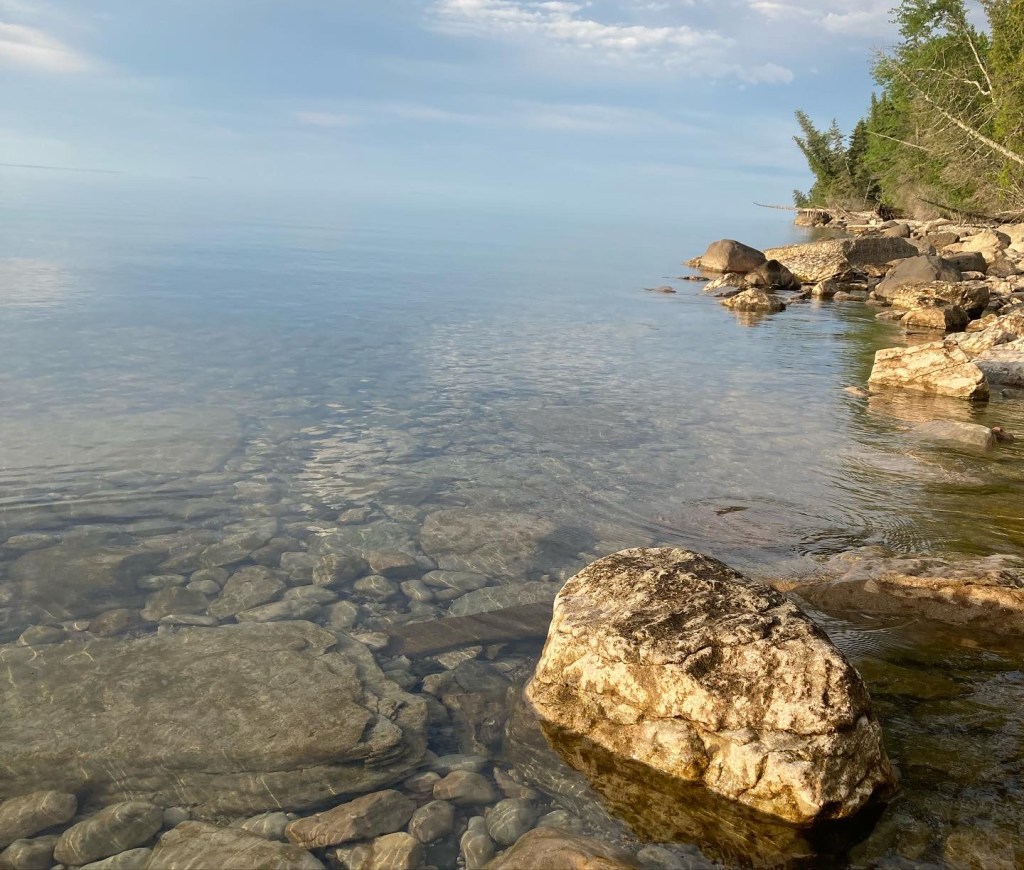
And as the trip continued, my brain continued to empty itself of anxiety. It pulled away from me the way the waves crashing against the rocks near my campsite were pulled back into the lake. At the beach, the water was clear and cold, and I had the sensation of it taking something from me that I didn’t need or want anymore. The lake was big enough to hold it without hurting anyone, this prickly darkness I’ve carried. I felt both the warm water near the surface and the colder, deeper water that came from far away.

I’m not a great swimmer and deep water is at once fascinating and scary. I like to be near it but not too immersed in it. At this beach, and all public beaches on Lake Michigan, and the other Great Lakes as well, there are signs about dangerous currents. This beach had a flag system so that the safety, or lack thereof, could be communicated to potential swimmers by someone reading the conditions. There was another sign about the fatalities that had occurred. In short, I did not take the risks lightly. Maybe it was for these reasons, though we only had green flag days, that the beach was often deserted. Maybe it was because the temperatures were a little cooler than most people like for beach days. But I reveled in the lake, grateful the waves were calm enough that the beach remained open. I would hike a mile and half from my rustic tent site, past the modern campground, to the swimming beach most days of the trip, and hang out for hours, reading my library books, doing crossword puzzles, and jumping into the water whenever the sun warmed me too much.

The lake is magic. I felt like a creature with dormant or depleted powers who was close enough to the source to have them rejuvenate. I know that sounds crazy and I’ve been reading too many books about witches and fables. But I haven’t felt that myself in so, so long. When I took pictures of myself, I could see it in my face, the recognition, as if I had returned after a long, blurry journey. It was as if I’d happened upon an old, familiar friend I hadn’t seen in a while.

I don’t recall if I’ve ever spent a birthday alone before, but I turned 52 on a sunny Sunday morning sitting on a rock, gazing at the lake, and enjoying the sun. I felt good. I made decadent birthday pancakes for lunch, after spending the morning at the beach. I chocked them full of chocolate chunks, leftover from chocolate bars I hadn’t used for s’mores. I topped them with vegan butter and maple syrup and cherry jam.

This trip was a meditation, in a way, or, how I imagine mediation should be. I want to say it was effortless, and it was, after a few days. But at first, I had to work at it, just like when I sit down on my yoga mat and try to let my thoughts drift by, acknowledging them but not attending to them. Most of the time it feels so effortful, and often ineffective. I had to keep asking myself what I wanted to do next, keep checking in. A hike? Sit by the water? Read? Eat? As the week progressed, I soon found myself moving toward one activity or another, or no activity, and having fewer conscious thoughts about what I was going to do. I found my rhythm. Things felt natural. Familiar.

So much has changed in my life since my divorce, has kept changing. I’ve had major shifts and false starts, and trying over, and over. And so often, in the course of adapting and readapting, my circumstances felt so unfamiliar, and I felt so unfamiliar. I’d remain in relationships flawed in all the wrong ways for far too long, hoping that at some point we’d arrive at the place where it felt familiar. Safe. I kept looking for myself in the face of other people.

I’ve learned that that which is familiar is not always healthy or safe. I also realize now how vital it is to continue this journey toward feeling familiar and safe to myself. To be the source of that. I’ve always tried to provide that in relationships and always expected it in return, never realizing the impact its absence was having within me. I don’t know if I’m there, because everything shifts and changes so rapidly, and progress gets eroded. But I feel as though I’m closer than I have been in a long, long time.

Love, Cath

On Weeds and Water and Honeycomb Hearts

By Catherine DiMercurio

When I started this blog, I described it this way: “This is the chronicle of a journey many of us find ourselves on — the search for meaning in all the things that break our hearts and all the things that make them whole again.”

All my life, I’ve had this sense that searching for meaning and purpose was something I needed to do. Something I did do, whether or not I wanted to. It just happened. Just like some brains are intrinsically focused on the mechanics of how things work, mine is and was focused on what things mean. Not just what do they mean for me, but what do they mean cosmically. As in, why is the world this way instead of that way, or what does this particular detail mean within the larger context of the world, the universe.

The grasping toward our understanding of our place in the universe necessarily encompasses a grasping toward an understanding of the universe itself. I am ill-equipped to do this, save for a couple of philosophy courses in college.

Helpfully (?), the world we have built as humans is focused on goals and milestones, so that my perpetual and at times frantic efforts to understand the cosmos were redirected toward practical things like education, marriage, parenthood. I poured my search for larger meaning into finding granular meaning in my choices and pursuits. When I became a mother, though, I felt as though these two separate, higher- and lower-level searches had merged. Everything clicked, in a way. I felt cosmically connected to these two souls, and also, in a very real way, I was responsible for their physical, emotional, mental, and spiritual well-being. Motherhood was rarely easy, and I remember being surprised and disappointed that it didn’t come more naturally to me. I thought I would understand intrinsically how to soothe a crying baby, or make peace with a frustrated toddler, or advise an angsty teen. But the work, as challenging as it was, felt hugely important. I never regarded the children themselves as mine but they were in my care; the work was mine; the honor of raising them was mine.

I was writing too, during these years, and got a novel published when the kids were six and four. I felt like this was it. Life was what it was supposed to be. I was doing it: pursuing a meaningful creative/professional goal and being a good mom and a good wife.

Later, after I became a single mom, the way I parented changed, but what hadn’t changed was that the kids were my number one focus. They were fourteen and twelve at the time of the divorce. There was a lot of parenting left to do. But last summer was the last time the last child lived at home. The day he left, my frantic search for meaning ignited again. It just happened. I knew that I was still needed by and connected to my kids as their mother, but everything was different now. And we all knew it.

I’ve spent the past year trying to better understand who I am now, and who I was, and who I want to be. I’ve tried to fashion that into my purpose. I’ve focused on my writing, I’ve focused on dog training, I’ve focused on learning a new skill/art with my pottery. All of these are good things, and I’ve grown and I will continue to pursue them.

But at the same time, all these things feel more like places to channel my energy but less like the sense of purpose I possessed when mothering was a daily activity.  

I am trying to be patient with myself.

I know that now that the twenty years of nitty gritty parenting are over, I tend to suffuse that time with a certain glow. Still, I haven’t forgotten all the difficult parts: when I felt like a horrible mother and that I was ruining everything for everyone; when I just wanted to leave for a little while because it was too hard and I never got a chance to even finish a thought or have three seconds to breathe alone; days when I was quite certain that one or both of the kids hated me and always would; times when I didn’t know how any of us would ever feel healed and whole again, and the terrifying realization that we could all drown if I could not figure out how to inflate the raft with my exhausted, heart-broken breaths. No one has forgotten how hard it was.

But still, looking back, I see how the sense of deep purpose I always felt—that strange, alchemical comingling of love and purpose, duty and wonder—helped get us through. I say helped because I did not do it alone. I had friends and family I began to learn to lean on. And my kids are stronger and more resilient than I’ll ever be. I’m proud of them and all the work that they’ve done. And I’m proud of myself, and as a person who has struggled with self-confidence and self-trust, that is a huge thing for me to believe, to voice.

And now in this moment, there is a freedom here, and it is taking up a larger space than I expected it to. It isn’t just about time, as in, now I have more time for writing, or for exploring new things. It’s different, multi-dimensional, so unfamiliar and so full of something, power? that I feel uneasy stepping into it. Within, I imagine, is all the me-ness that there wasn’t much time or energy for before.

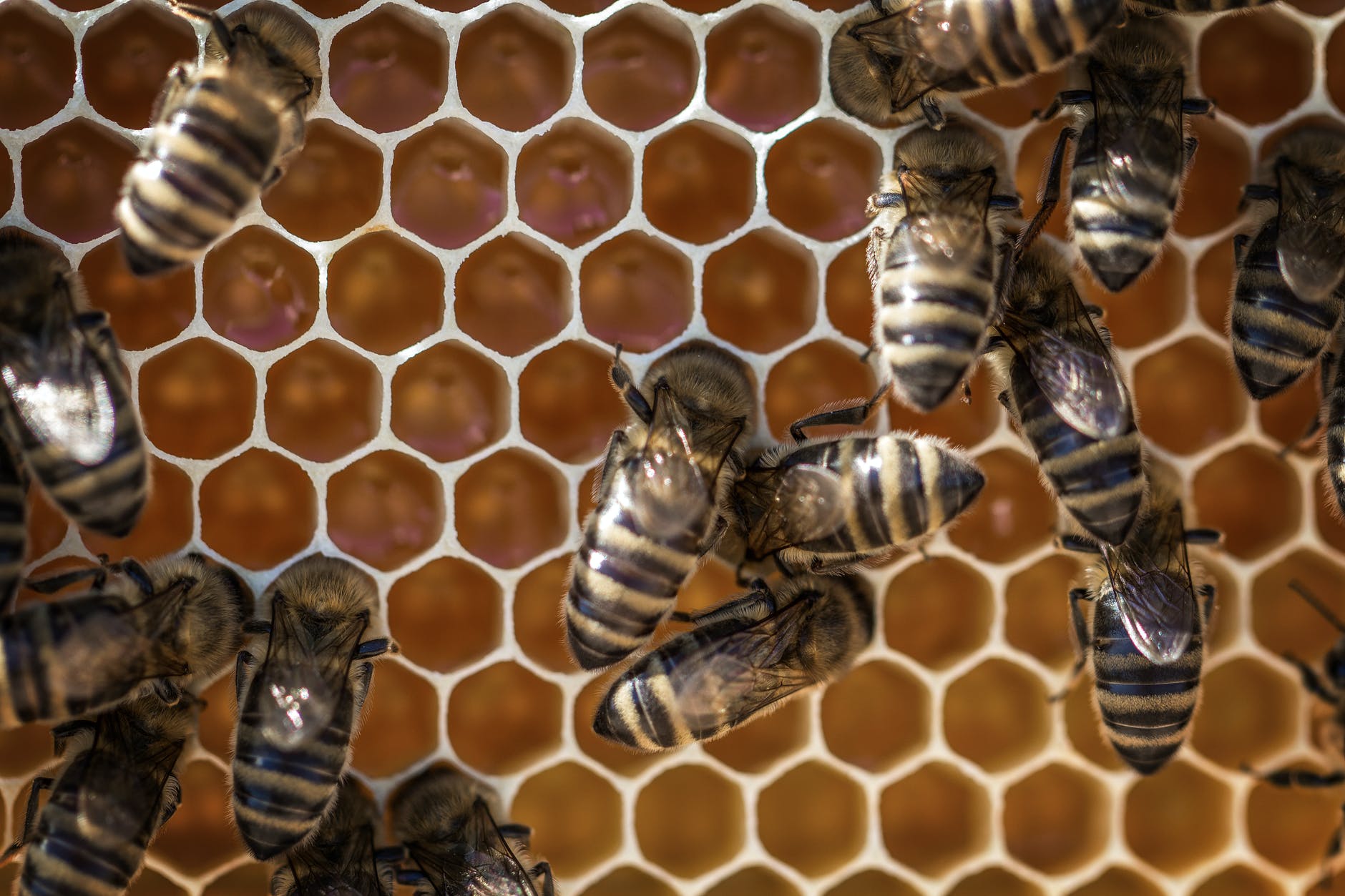
I’ve been trying to think of the best way to describe this new sensation, this freedom that seems to be taking up more space than I thought was available. The way large, leafy weeds don’t just take up the space allowed by the crack in the driveway pavement, they expand the space. But it feels more like my heart is a honeycomb that keeps being added on to by something busy inside me, and the result is I keep recognizing myself in different places. Do you ever have that feeling where you look at a photo of yourself and it doesn’t look like all the other curated images you or someone else has taken? You look at it and think there I am. Or, do you ever that moment, upon arriving at a location where something clicks into place, and you are suddenly relaxed and energized all at once, and you think this. I needed this. For me that photo was the one I took of myself at the pottery studio. And that place is usually by large body of water.

Photo by David Hablu00fctzel on Pexels.com

Lately I’m experiencing all of that, more and more. It feels akin to the existential wandering my soul did when I was a child. I have a very distinct memory (which I’ve written about, here) of trying to understand my self-ness within this existence, as if part of me could comprehend I was something larger and freer than what my current body was containing, and I wanted to have both, the knowledge of who I was in this time and place, and the knowledge of the larger self that was struggling to understand its physical containment in this vessel, this me. It’s like that now. It’s like I’m close to getting it. I am trying to relax and let it all align.

I used to think that maybe I had to let go of one thing—a past version of myself—before I could step into the next iteration. But maybe that’s not the case. Maybe we get closer and closer to being able to hold all the versions of ourselves in place at a time. Maybe we are the honeycombs, and the bees, and the honey all at once.

Love, Cath

On Slow Dancing and Wet Sand

By Catherine DiMercurio

Yes, but are you happy? is a question that we chase each other with. We want it for our loved ones, maybe more than we even want it for ourselves. It certainly means something different for each person. I have long wondered, is the “point” of life to be happy? Is it to have purpose, to make the world a better place? To simply survive it? Is it something else? This of course leads down a philosophical road. Depending on your larger belief systems about how we got here and what happens after, the question of the “point” of it all is going to be answered differently. But certainly happiness is something we all want.

Recently, after a period of feeling quite good for a long stretch, a collection of troublesome things happened and I found myself slipping toward the edges of the dark mental space that it can be hard to climb out of. Is happiness real if it goes away when life gets tough? Why does it feel so ephemeral for some of us, and others seem to find it wherever they go?

I used to think that happiness meant spending time with the people you love, but when the people you love exit your life, or they live far away, or the people are your adult children, building their own separate lives, you realize that if your happiness depends on time spent with anyone but yourself, you’ll never be happy.

So, then, is happiness doing the things you enjoy? Pursuing what you love? This seems obvious. Of course, we are happy when we are doing the things we enjoy, but how do we retain that sense of happiness when we are done doing the thing, when the hike has ended, the garden planted and weeded, the sunset on the beach viewed? How do we retain it when we are making dentist appointments or paying for expensive car repairs?

I am not saying that I expect or even want to be happy all the time. There are times when other emotions can and should be foremost in our hearts. I’m talking about happiness in terms of a calm, centered peace that we can hang on to when life gets bumpy, that we can find the path back to once we’ve dealt with some of the more serious things that life throws at us.

If happiness is that peaceful, centered state, is it accurate to say it is a reprieve from anxiety/fear/doubt? And how do we cultivate that? How does anyone, if daily there are battles with physical or mental health, or with financial woes, or any number of things that rattle the calm, that busy us and keep us buzzing and unable to be still and settled?

And some days, sadness feels like thick wet sand, cold, gritty, clinging.

I’m trying to learn how to process heavy emotions. To slow dance with them and listen to what they are trying to tell me.

Photo by Mathias Reding on Pexels.com

The trick is to know when to stop. My old habit when I’m feeling that deep down tug of sadness like there’s an anchor inside, is to sink, stay with it, fall into myself. Here in the dark, I can see that the enemy of happiness is not exactly sorrow, but fear of future sorrow. It is the thought that maybe everything won’t be okay after all.

I think of how future-focused I’ve always been. Not in a sensible way like retirement planning. But, I’ve always had the same question thrumming through me, for as long as I can remember: “But everything is going to be okay, right?” I suppose it is time I start asking myself what I meant by “everything” and “okay.”

This blog has been largely about my path forward since my divorce, the ups and downs of it all, single parenting, relationships. And since ups and downs are universal, I hoped that by writing about mine, you could think about yours, and we could connect that way, cultivate contemplation, and in so doing, co-create a more deliberate way of moving through this world and coping with its challenges and celebrating its joys. Help each other to feel less alone, which is certainly another kind of happiness.  And I have written here about the aftermath of marriage but I rarely talk about my marriage itself. I can tell you this: when I was married, whenever I asked that question to myself, “is everything going to be okay?”, I knew the answer. I knew everything would be okay because I was with the person I wanted to spend my life with.

Before I was divorced, I didn’t think too much about what it meant for people. It was something that happened to other people. So, when it happened to me, and in all the ways it happened—and it happens differently for everyone—one of the biggest inversions to my world view and sense of self was this idea that the future as I had imagined it was erased. And somehow, I felt erased, too. Everything would not be okay, at least, not in the ways I had imagined and hoped.

This past year, since my most recent breakup, I have realized that this part of my journey is trying to get that “everything’s going to be okay” feeling on my own. To take time to slow dance with that. Feeling like everything is going to be okay means that you have an absence of fear about future sorrow, or, more accurately, you have confidence that you will handle the future sorrow and make everything okay, in time. One of the things I’m trying to remember is that no matter how badly I want to figure out if future-me is going to be okay, there are things I can’t know, can’t predict. And the only way that future version of myself is going to be okay with whatever life throws at her is if I figure out how to be okay now. Because if I can do it now, then I can do it then. And what I fail to do so regularly is to realize that I have done it. I am doing it.

Sometimes I feel like the world gets meaner every day and I’m no match for it. Just me and my hokey dreams trying to feel like I’ve got things figured out enough to feel “okay.” But the more we talk about these things, the more we can help each other find paths to “okay” and “happy.” Maybe we can slow dance with the light emotions too, not just the heavy ones, slow dance with joy, slow dance with each other, feel the cool comfort of wet sand instead of a dark pull. And maybe we can create a ripple effect and gradually wash away some of the meanness and be a match for this cruel world together.

Love, Cath

On Elemental Lessons, Love, and Good-Messy

By Catherine DiMercurio

Sometimes the most basic lessons are the hardest to learn.

Sometimes I think the best in the shower. In my soul, I’m a water person, though this body can’t swim very well. But whenever I’m around water, I’m calmer. Recently, in the shower, it occurred to me that it is almost the one-year anniversary of the ending of a relationship. It was a relationship that was hard to let go of, in spite of the fact that it needed to end, and I got to thinking that I seem to have more anniversaries of things that ended than things that began. Not long ago, that thought would have sunk me, at least for a few days. I would have ruminated, and found ways to feel increasingly worse about myself. But standing there in the water, after a year of becoming more in tune with myself, my next thought was this (and yes, I do address myself in the second person sometimes): Wait. Are you really saying that you think you have more to mourn than to celebrate?

My immediate answer to myself was no, but part of me still wanted to tally, to dig into hurt and remember it. We get used to making ourselves feel terrible sometimes. For a lot of reasons. But I have spent the last year looking at those reasons, my past, my deeper past, and learning. And in this moment, I understood that it is natural for me to have a lot of emotions around this time of year about the ending of that relationship, and that having those feelings did not have to translate into a trip down the rabbit hole. That’s progress.

Some of that progress can be attributed to the pottery studio. I feel as though I’ve been on an incredible journey when I think of the first several classes back in January. I pushed myself way out of my comfort zone, not only in trying something new, but in hauling myself out of my cozy house in deep dark winter for a 7 to 10 p.m. class with strangers. I am definitely a morning person, so I knew one of my obstacles was going to be my own fatigue at this point in the day. Optimal learning and creative time for me happens much earlier in the day. And there were a lot of other obstacles, one being that physically, I am not very coordinated, and hand-eye coordination is pretty important when you are wheel-throwing.

I was not prepared for how challenging the experience would be, for how frustrated I would feel. I have no poker face, and even when I’m trying to have a neutral outward demeanor, it is plain for the world to see when I am struggling. Though the class was different from any that I’d ever taken, my brain slipped into student-mode where the usual process was: work hard, study, succeed. In the past, doing well in school meant that the people around me were happy (teachers, parents), and it allowed me the opportunity to excel at something, since it wasn’t going to be in the realm of sports, or anything social.

But, I struggled. Class after class, I felt clumsy and awkward and self-conscious. I had almost no control over what the clay was doing and trying to understand the relationship between the movement of the wheel and how my hands were interacting with the clay seemed like a mystery that I couldn’t unravel. There were too many factors—the wheel speed, the moisture level of the clay, the pressure, placement, and movement of each and every finger on both hands, my posture. I was certain the other new people were already better than me. I thought about quitting. A lot. I even bought a cheap-ish pottery wheel so I could practice at home. It is easier to fail without anyone watching. I wanted only to get a little better between classes so when I sat down in the studio it would be evident that I was making progress. I wanted so badly to be perceived as someone who worked hard, and if my work did not show evidence of that, how would anyone know?

And I did make progress, in my own epically slow way. But I was doing so out of some sort of ancient ache to prove myself, to insist on some kind of worthiness I wanted others to recognize in me even when I routinely overlooked it in myself. Part of my pottery journey has been to trace this powerful need, which has shaped (malformed) so many relationships, back to its roots. This work is not done, as the work of truly understanding ourselves and making peace with it all never is.

Even though I felt like I wasn’t progressing fast enough, my instructor was so good at underscoring how difficult it is to learn any new art form. I remember getting frustrated at the wheel, trying to accomplish something that wasn’t working out. I had a poorly centered lump of clay in front of me that I’d been able to open up enough to begin to pull up the walls. She was standing near, talking me through it, and I said something like, “I just can’t. . . .” I was unable to finish the sentence, because I felt like none of it was working. I couldn’t do any of it. And she replied, “And it’s what? Your third class?” She taught me to embrace wherever it was that I was in this journey. If something turned out wonky, and I could get it off the wheel, I could still practice trimming and glazing. It was all part of the process.

Photo by Regiane Tosatti on Pexels.com

That was kind of a turning point for me. After that, some fresh ideas began to make themselves known in my brain. Couldn’t I just learn and play and grow? Trying to force progress wasn’t working. And feeling tense internally was something that found its way into the clay. Everything was going to happen on my own timeline. And there was no grade. There was no metric by which to measure failure or success, only those that I imposed upon myself. Doors and windows flew open inside me. Soon, I began to feel energized and creative and good-messy, and suddenly, when I thought of all there was to learn, I saw the future blossoming in front of me, whereas only weeks before, when I thought of how much I didn’t know, I’d felt overwhelmed.

The whole experience thus far has reshaped the way I look at myself. It is shocking to me that learning how to throw and work with clay is revealing so much that has nothing to do with clay. I think because I was already doing some of this work, the experience simply shoved open doors whose locks I’d spent some time jimmying open.

To some friends and family, I’ve tentatively equated my evolving feelings about pottery to falling in love. I say tentatively because it seems a strange thing to admit. But what I’m beginning to comprehend is that what is happening is that I’m falling in love with myself. Sometimes it takes us so, so long to learn elemental lessons. And sometimes it takes the elements—earth, water, air, fire—to teach us.

Love, Cath

On Plans, and Doubts, and Dandelions

By Catherine DiMercurio

I awoke on a recent summery May morning to a cool breeze sighing through the open window and the smell of someone’s backyard woodfire still clinging to the air. It felt peaceful, but despite this fine context my first thoughts of the day were despairing ones. They were emotion-thoughts more than word-thoughts. I anticipated the coming day and recalled the previous one, wondering vaguely what I added to the world that had value. Thoughts like these result in anxiety and restlessness for me, and managing those emotions means I have to pep talk myself about what I contribute, what matters, what I’m grateful for, etc. It seemed a bit early in the morning for an existential crisis, but truth be told, I’ve been thinking about such things as long as I can remember. What is the point of all this, I wonder, often. Not just why am I here, but why are any of us? But given that we are, what should we be doing?

We live in a capitalist society in which many of us have internalized the notion that value and worth are tied to what we produce, and what we accumulate. To counter that, a whole culture has grown up around the idea that our personal value is tied not to those material things, but what we’ve done to make the world a better place.

Another way of looking at our personal worth centers on the love we’ve created in the world. Who we love, who loves us. For a while, this perspective really worked for me, but children grow up and move away, relationships dissolve, and there are plenty of people who haven’t felt loved, or haven’t had the opportunities to find and create love, and it doesn’t seem fair to tie personal worth to things that are often beyond our control.

Some people don’t question these things much because they have found answers in their faith. I was raised Catholic and my thoughts on why I’m not anymore could fill a book, which I likely will never write. A lot of people these days say they are spiritual but not religious and that means different things, depending on who you ask. It’s hard to say if it applies to me. I consider myself agnostic, meaning that for me, if there is anything divine in this universe, which I’m not sure of, the nature of it is unknowable. I do believe that energy cannot be created or destroyed, and this scientific principle seems more divine than anything else I’ve encountered. But the point of all this is to say, that I don’t believe there is a consciousness at the helm of all this, and certainly not one that has a plan for me, or anyone else. People also say things like “the universe is trying to teach you this or that.” It’s pleasant and nontheistic to think that, in a way, but that statement is not different from the “it’s all part of God’s plan” line of thinking and I’m not convinced the universe works that way. If the universe thinks I’m supposed to learn things, then it must be because there is a path it thinks I should be on. The whole notion of a plan—God’s or the universe’s—boils down to the centuries-old debate about free will versus determinism, and if theologians and philosophers have been playing this game for hundreds of years, I’m certainly not going to figure it out.

It makes me think of the University of Michigan football stadium at full capacity, with half the stadium yelling “Go” and the other half yelling “Blue.” It’s a battle of who can be louder, but it is also about the harmony of the message. Similarly, we seem to need to believe in both free will and fate. We want to believe we have choices, that it isn’t all preordained, but at the same time, we want to believe there’s a plan. When things happen that we don’t understand, people say it’s all part of God’s plan. Or when we are not where we expect to be in life, or have a setback, we are told it is because there are things we haven’t learned yet, and the universe will find different ways of sending the same lesson until we get it, and then somehow things will get better, or make sense. On any given day people believe what gives them the most comfort. On any given day, I see both chaos and order in the universe and I don’t know where I fit.

Everyone has advice. Find your purpose. Chase your dreams. Do what you love. Don’t overthink it. Others tell me that we are here to simply enjoy ourselves as best we can.

I think of all the philosophies I’ve embraced and either discarded or incorporated some parts of. I have sought clarity, but sometimes it accumulates as clutter. I often forget that moments can feel longer than they are, and time is like pulled taffy. Getting lost in ruminations about purpose, value, and identity is something my mind does every so often. But in other moments, I’m living less inside my brain, and I’m doing things I love, or just muddling through, and it all somehow makes enough sense. I don’t know if I’m on the verge of figuring things out for myself, and all the other things are a distraction from the work my brain wants to do, or if all the ruminations are the distraction, and real life and real meaning is in all the rest of it.

Photo by Pixabay on Pexels.com

Both, I realize in flashes of insight. It’s both. It’s the harmony between thinking and feeling, between doing and being, between contemplation and action. I do know that in all the advice I’ve internalized over the years, the phrase “be yourself” continues to ring true. This is the way my brain works, always has. But I think truly embracing the notion of being who I am might be the north star that I’m looking for. Maybe it is the way to recalibrate when I feel lost. Maybe it is the only way to understand our place in this mysterious universe. I just read something online about the dandelion, and how useful all its components are, and how resilient it is. A dandelion succeeds as an individual plant and has succeeded as a species for centuries because all of its parts work together to insure it thrives. It supports the lives of pollinators—it does good in the world—but it doesn’t exist in order to do so. It just is. It doesn’t need a plan, it just maximizes its resources: the sun, the rain, the wind that disperses its seeds (or the human making a wish).

I am this collection of cells and memories and have lived and evolved right up until this moment. I have a hard time believing there is a Plan beyond that, but that doesn’t mean I can’t make squishy, flexible plans for what I might want in the future. And letting go of things I had once planned for my future—things that I imagined were solid and fixed, things that will never come to be—that is some of the hardest and most necessary work I’ve done. But for now, it makes sense to be. Be myself. Maybe be a little like a dandelion.

Love, Cath