On Identity, Negative Space, and Sand

By Catherine DiMercurio

Sometimes I feel as though this world has pinched whatever eloquence I might have once possessed, and all I can do is write earnestly about the twists and turns of my own journey. I’ve been thinking a lot lately about how, in the face of such bizarre twists and turns of this current American reality, do we keep on keeping on, keep on living our lives and pursuing dreams to the extent that we are able. But at the same time, how do we do otherwise? One of the most meaningful things we can do is to keep on living meaningful lives, right?

Part of my own such quest has long focused on the pursuit of belonging and connection, and the way the natural world informs that journey. For many years, I’ve yearned to find a way to live closer to places that ground me, and that’s what I’m currently pursuing.

In line with that goal, I got to spend some time recently by Lake Michigan. It was a grey, rainy couple of days and I was there, in a little lakeside city, to do some research. At times, I am completely overwhelmed by the prospect of moving again. There’s no getting around how demanding, complex, and disruptive it is, no matter how much you’re looking forward to the destination.  I’ve made a good home in my current location, but it wasn’t necessarily a place I was in love with. It was a practical decision and the right one at the time. In some ways, it will be hard to leave. I have good neighbors. I’m relatively close to family and friends. Within these walls, I remade myself, as we often must do during various transitions in life. There are plenty of times where I think it would be easier just to stay.

But, it’s always easier to stay, isn’t it? I have a low tolerance for chaos, always have, and moving is nothing if not chaotic. And easier isn’t always the point. Sometimes we need easy, we need to rest, and regroup, we need to feel settled and calm and peaceful, and then, we’re ready to unfold in a new direction. We all unfold and stretch and grow in different ways and at our own pace.

There are huge unknowns. Though, most of life is that way, so that should not really dissuade anyone (myself included) from exploring new possibilities. Will I be able to find and build some sense of community there? Will I feel like I belong? Will it be a good place for my dog? Will I be able to find a pottery studio? Will I find a way I can contribute to my new community?

One of the many perplexing things about life is that it is short, and therefore we should leap into our dreams but also, we have bonds with people who we find ourselves leaping away from, and we don’t want to lose those either, the dreams or the bonds, and how is all that supposed to fit together? And all those people have their own dreams and bonds, their own journeys, and we can’t anticipate all the ways and reasons people move around in their lives.

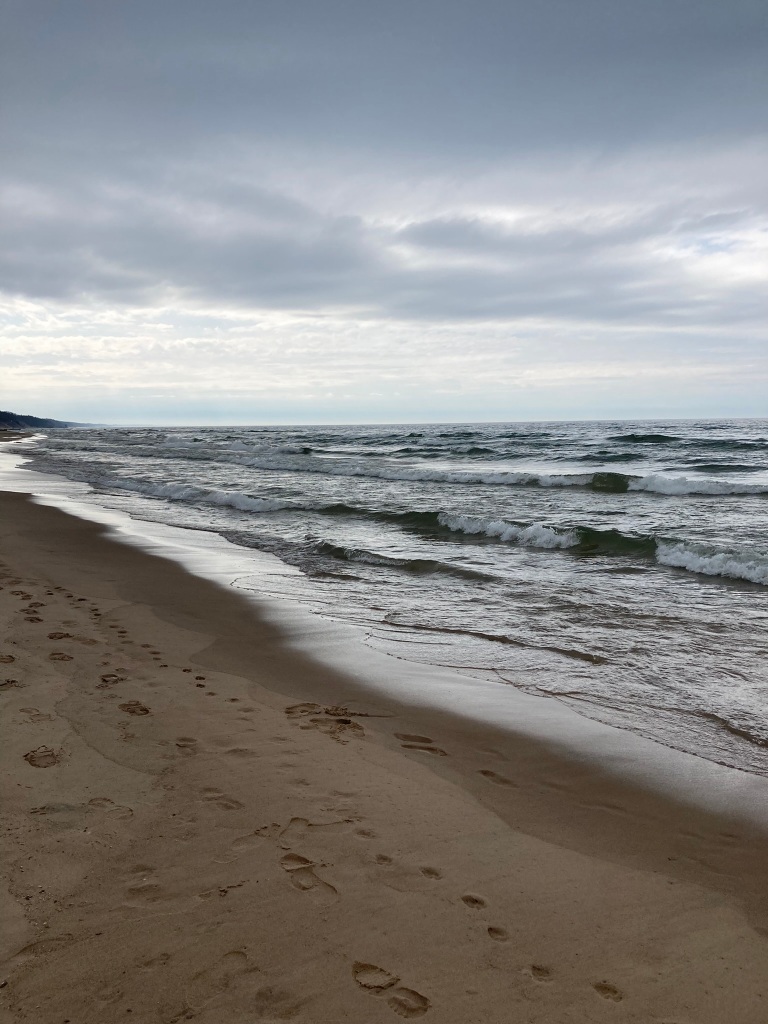
After a weekend near the lake, I have sand in my car. I like that. I like what it represents. I like the idea of living someplace with street names like Seaway and Lakeshore Drive and Beach Street. I love the frequent calls of gulls mixed in with house sparrows and robins. It sounds like a place I could call home.

I think a real sense of connection to place is hard to come by, at least it has been for me in the last several years, and I don’t know if I will have it there, in a new place, where I have no history at all, no people. I’m craving the feeling of having something fall into place and hoping to accomplish it by having me be the something falling into a new place.

Five years ago, I was preparing to move from the home I’d lived in for 20 years, where I raised my kids, and in many ways, where they raised me. I wrote a lot about the meaning and nature of home, and here I am again. At the time, I remember feeling as though the emotional work of the next part of my life needed to focus on learning to be at home with myself, wherever I was. In these last five years, I’ve tried very hard to do just that; it is an ongoing journey.

Here, in this house, I weathered the bulk of the pandemic. Here, I became an empty nester. Here, I ended a relationship. Said goodbye to the sweetest, most beloved dog, said hello, to another sweet, rambunctious furry soul. Spent a couple of years in relative solitude, on my own in all these new and different ways. At times the most lonely I’ve ever felt, at times the most free I’ve ever felt. Here, I started a new relationship.

People talk about finding yourself as if it is something you’re supposed to do when you’re young, or something people crash into doing at middle age because they never did it when they were young, but all of that is wrong. At least, we should acknowledge that it is something that can and should be ongoing our whole lives. More than anything, it is a mindset, rather than something that always requires big actions. It’s about looking, about cultivating an awareness of how we experience the world and who we want to be in it, who we are in it.

Shouldn’t we be out there looking for ourselves every day, in each little action, getting truer and truer as we go along, and finding our way back to ourselves if we get lost? We probably have to get a little lost here and there. Sometimes it is the accumulation of wrongs that points the way to what’s right for us.

My first-born is an artist, among many other things, and right now I am looking at a linocut print they made of a snail, and marveling at the way such a beautiful image is built line by line, the way with linocut, the image is revealed as a result of what is removed, the way the negative space that is created allows what remains to receive the ink.

It’s the same with the continuing process of learning who we are, and relearning that as we change and grow. What is removed from us through loss or through getting lost, or whatever life takes out of us, keeps revealing a new image of who we are now and who we are becoming.

I didn’t think I’d have sadness about leaving this place; when I moved in I did have the sense that it would be transitional. It was what I needed at the time. Things are different now. Things are always different now.

As I’m getting this house ready to sell, I think of all the ways it has held me, and all that I have put into it. All the living it has contained. And how I don’t really have to leave if I don’t want to. But just because it is hard, and just because there’s sadness, and just because I could stay if wanted to, doesn’t mean it’s not time to go.

I go over it all in my head, crunch the numbers, crunch the reasons, trust my gut, find the way. On the one hand, what’s the big deal, right? I’m just moving across the state. On the other, it’s another leap, farther than the last one. I’ll no longer be 30 minutes from where I used to live. In some ways, this feels more akin to moving away from home for the first time than it does to any of the other moves I’ve made in the past.

When I was at the lake two weeks ago, I plunged my feet in the icy water, ran barefoot along the beach, drew hearts in the sand with my toes. I felt the way the lake unlocks something in my chest, allowing me to breathe deeply and feel a big sense of centeredness I can’t seem to feel too often anywhere else. Later, I brought my dog down to the water. I know how much people like to let their dogs run on the beach, and Zero and off-leash dogs don’t mix, so I was hesitant, went early on a rainy Sunday morning. The waves were loud, but not overly large. We were only by the water a few moments, because I could see people with a dog further down the beach and didn’t want to take the chance that the dog might give chase. Zero wasn’t keen on getting too close to the water. He’d take a couple of steps toward it while the waves receded, and then dart away when the waves rushed in. I don’t know if he’ll ever be a beach dog and that’s okay. I’ve probably got enough beach dog in me for the both of us.

I observed Zero’s hesitancy as he surveyed the unknown terrain, the way he looks at me sometimes with both trust and concern. It’s as if he’s embodying what’s in my head, the part of me that’s not so sure and the part of me that trusts that I’ll get this right. Sometimes I wonder if he and I are extensions of one another, and then I wonder if we all are. It’s easy to feel that connection, to everything and everyone, even when I’m alone at the lake with my dog who kind of isn’t sure he wants to be there; he just wants to be with me.

Stay connected, and keep looking for yourself.

Love, Cath

On Burros and Butterflies, or How to Hold on to Your Dreams

By Catherine DiMercurio

When you are snuggled up with yourself on a towel with a thermos of coffee next to you after you’ve dipped yourself in a chilly lake on a cool, grey morning, you forget. You forget about all the things in your life that you needed to forget about for a little while. The things that seem un-figure-out-able. Those are the things that cause me the most daily stress, and having some relief from them was a gift. Lake Michigan is always a gift.

That was one of my favorite moments from my solo camping trip—the overcast day, the cold lake water, the hot coffee. Perhaps I could even call this trip a retreat, in that I retreated from the overwhelming stress of what my job has been like the past couple of months. I hiked and journaled and did some watercolor painting and read a lot and sat on the beach and looked at the water, and swam whenever I wanted. I made campfires. I listened t0 bumblebees in the silver linden tree. I watched butterflies flit through spirea blossoms, through a field full of staghorn sumac, milkweed, ox-eye daisies, black-eyed Susans. I sought calm and coziness.

Returning to the shores of the lake is for me like returning to the first sound you ever knew, your mother’s heartbeat. And it never fails to unlock something in me, this return. Still, this, itself, is part of one of my un-figure-out-able things. I haven’t figured out how I can rearrange my life, or afford, to have a lakeside life. I tried not to think about that on this trip, tried to simply immerse myself as much as possible.

When I’m in proximity to the lake, I don’t think about the not-belonging I feel almost everywhere else. I feel less out of sync with my environment than I have in most of the places I’ve lived. What does it mean to belong to a place, anyway? It is hard to find language that captures it. In some places, you simply feel connected. A place can speak to you—a house can, a lake can, a town can, a tree can—and you understand somehow. It feels like you. It’s a familiarity, in the sense that you recognize something of yourself in the landscape. It feels like home, a returning of you to you.

I’ve written a lot about belonging over the years in this blog. I thought about it a lot when I left the home I’d raised my children in and moved to this nearby township. It’s my fourth summer here and I don’t feel as though a strong sense of belonging is developing. I’ve made it my home, certainly, and my neighbors and I are friendly with one another. It isn’t a bad place to live by any means. But it is a long drive to a body of water. And in light of the dog attack I’ve written about and the number of loose dogs I have seen in the neighborhood, a new sense of hostility has developed. After the last incident a few weeks ago—another large dog was loose, but I spied him before the dogs noticed one another and I turned and we made it home—something in me closed a door, said it was the last time. The last time I risk another attack. It is another un-figure-out-able thing, my love of morning walks with Zero, and my inability to feel as if we can do that safely. I consulted a trainer, and I’m doing everything I can to make sure Zero is still getting exercise and mental stimulation. But it has been tricky. I have been very unsettled by the loss of our routine. And this sense of the neighborhood at large being hostile to us has been hard to shake.

I once had the thought, or the hope, that once I felt at home in my own skin, felt at last as though I belonged to myself, then I could and would feel at home anywhere. And I do feel that I have arrived at a place where I am more comfortable and content and at home with myself than I ever have been. But rather than this creating a situation where I feel at home wherever I am, it instead has intensified feelings of misalignment in terms of me feeling at home here.

And yet, for now, there’s nothing to be done, or if there is, I can’t see it yet. But, in most lives, there are un-figure-out-able things we live with all the time. We circle back to them, or, they circle us, like hawks or wolves. I’m trying not to think of these circling thoughts like predators, but I do feel an urgency about figuring things out. I wonder if I can make myself more patient by imagining them like butterflies or puppies instead. Though I suppose butterflies and puppies and all living things have some sense of urgency about them. Maybe, like everything else, it all comes down to self-trust. We have to trust ourselves to figure out the right thing at the right time.

There is some version of me that will know what to do, when to do it, and how to do it, and maybe I’m still evolving into her.

I think that a recent dream I had reflects how I’m really feeling about these stubborn, un-figure-out-able things. The dream centered on a stampede of wild burros. It was a chaotic scene, but the burros were beautiful—their hindquarters a golden honey color and their forequarters white with dark spots. Maybe, in the midst of trying to figure out what we want and how to get there, part of the process is cultivating an openness toward all the ways we receive clarity about our path. That is, there is some beauty in wanting, no? My quest for the lake takes many forms, but maybe until I land there, I need to (from the safety of some shelter) observe the beauty of the stampede of my dreams. That is, our wanting helps us flesh out the specifics of our dreams, helps us to pinpoint exactly what is important and why. My desire for a safe place to walk with my dog and enjoy experiences with him is leading me toward other ways of interacting with him and building our bond.

So much of mental health, or at least my mental health, is centered in reframing how I look at things: my fears and anxieties, my past experiences, and my own view of myself. My sister recently observed that we don’t hear rain; what we enjoy about the sound of rain is the sound of the impact of each drop—on a window, the pavement, our skin maybe. She made a point of noting that it is only through this striking of water against object that we note the beauty of that sound. It is up to us to interpret how we view the nature of that impact within this metaphor. To me, “impact” is a word with some inherent violence but it is unsurprising that I hear it that way. Sometimes even minor experiences can leave me feeling a bit shaken; I often experience the world as a little overwhelming (sound in particular). But we don’t have to see everything that way, hear it all that way. Lots of gentle things can be described as impact—clapping, any touch, the brush of a butterfly wing against a flower petal.

We do have to trust ourselves to know what action to take and when to take it, to assess the status of our dreams and our progress toward them, but we also can take smaller, gentler actions every day in the way we look at our lives and our hopes. Recharacterizing our perspectives, reframing our metaphors, can help us tame the chaos of our anxieties. And observing the subtle qualities of our desires can help keep us in tune with what we’re seeking. Sometimes I find it exhausting to hold my own hand and walk myself through something that has been troubling me or causing me persistent worry. But I’m glad I’ve learned how over the years. Kind of. And we have to help each other to do the same. It’s not always about listening to a friend or a loved one and offering advice on what to do. Sometimes we just need to hear one another and swap metaphors, share our dreams, create safe places from which to observe stampedes.

Love, Cath

On Magic, Tricks, and Magic Tricks

By Catherine DiMercurio

There’s something about being in a new relationship in your fifties that leaves you with a whole deck of new thoughts and feelings, which get shuffled around and presented to you, as if some sprite doing the universe’s work is trying out a magic trick. Is this your card?, they say with a flourish. And you study it, trying to figure out if it is, in fact, your card.

Photo by Israel Garcia on Pexels.com

What I mean to say is that all new relationships can leave you feeling a little perplexed. After a divorce, no matter how long after, and after other relationships that didn’t work out, no matter how many, when you’re in your fifties and feeling careful and cautious, you don’t immediately believe in the magic part of the magic trick. You’re kind of looking for the trick.

So, this summer, a year after I had reached out to a guy on eharmony and it hadn’t gone anywhere past an initial exchange, he emailed me. I’d had the foresight to give him my email address the prior year, knowing I was about to be done with dating apps. This past August, when I read his email, it took me a minute to connect the dots back to that initial exchange on the app. I then remembered why I had initially reached out: he was a fellow writer, and a professor (I’d joked with my friends about dating a professor. Where’s my professor? I’d ask). It seems he showed up. He also liked some of the same things I did, such as exploring the natural world, hiking. He was a parent, too. There were possibilities here. I had the sense that if I didn’t write back immediately, I would talk myself out of it, and part of me felt like I should give him a chance. I decided to write back before I could change my mind. I was candid about the fact that I was content on my own, and not sure I even wanted to date anymore.

After my last break-up, I had settled into a largely peaceful rhythm that involved following my interests and instincts, enjoying time with family and friends, and reveling in the absence of the particular anxieties my last relationship had wrought upon my heart and brain. Not that this period was angst-free, but when I poked around the notion of what if this is the way it always is—just me and my dog and writing and pottery and family and friends—I was largely okay with that. While I worried that at some point I would wish I had found someone to grow old with, I also was comforted by the idea that alone wasn’t truly something that I’d be, because I have a lot of good people in my life.

Still, I was curious. I suggested that we could email one another and get to know each other that way, as a start. He was agreeable.

We did this for a couple of weeks, and as writers, the format suited us. We sent long missives back and forth on a variety of topics—our pasts, our beliefs, our likes and dislikes, random observations, books, the writing process. It felt like during this period of writing long emails back and forth, we were in a way approximating the feeling of a developing friendship, one that might have taken place in the real world, had we met, say, at a bookstore. I admit though that during this time of correspondence, I was on the lookout for anything I might construe as a red flag, or anything I sensed might spell trouble or be a sign of incompatibility. When I could find none, much to my surprise, I suggested we meet for a hike.

Since that time things have progressed in a way that continues to be dissimilar to any experience I’ve had in the past. He lives over an hour away. There has been little opportunity to just meet for a bite to eat or something, so we squeeze in our time on the weekends. I was finding recently though that I missed the solo down time I used to have on weekends, so I requested we take a weekend off. My ability to make this request speaks volumes. In past relationships, I would have found it very difficult to say something that the other person might perceive as a pulling away or a pushing away. I would have worried that to ask for time for myself would have resulted in their loss of interest. But in this relationship, not only did I feel confident enough of our connection to not worry about my request being misperceived, but I was also keenly aware that I needed this time for myself. I have worked diligently and purposefully toward the goal of being able to recognize and respect myself and my needs, so being able to advocate for myself feels like a necessity, not an option. I know I am a better person and a better partner when I am taking care of myself, not only trying to take care of the relationship. The fact that he received and understood my request without hesitation or negativity was a relief, though not unsurprising when viewed within the context of what I’ve come to know about him.

Still, this is all unfamiliar. It feels healthy and good but the way in which it hasn’t followed the patterns of past relationships has been at times both affirming and unsettling. Hence the aforementioned sprite with the deck of cards and the magic trick. My brain often reverts to questions that seem to assume a norm, a standard. I ask myself: is this how it’s supposed to be (i.e., am I doing this right)? But of course it won’t feel like the past. Not only were there a lot of unhealthy aspects to those past relationships, I am a different person now and am bringing a completely different energy to this relationship. There’s less urgency, less anxiety. I have the sense that we are building something with different tools and materials than what either of us have used in the past. And of course it is going to look and feel different from what other people have; every couple has its unique origin story and history. I love the feeling that we’re building our own story, figuring out the next phase and phrase as we go.

And yes, this is going to mean that at times we pause, looking for the trick. When you’ve had the rug pulled out from under you a couple of times, you tend to be careful of your footing. Or skeptical about the magic trick that seems to be happening in front of your eyes. My instinct is to slow things down, watch mindfully the way it’s all playing out. But sometimes you can’t spot any trickery. Sometimes maybe the magic is just the magic.

Love, Cath

On Vantage Points and Variables

By Catherine DiMercurio

My blog pace has slowed somewhat in recent weeks, which happens when I’m deep into processing new things or big things or sometimes, recurring things. But occasionally, life offers a little sidestep, a time and place away from the rush of everyday life to think, or not to think.

Last weekend, the weekend of the autumnal equinox, my sister and I took a camping trip to Michigan’s Leelenau Peninsula. We were anticipating a cool fall weekend, but it ended up being more like summer. Michigan loves to play those kinds of games. We weren’t complaining. The nights and mornings were chilly enough for campfires and sweaters, while the warm, sunny days had us wading, or dunking ourselves, in Lake Michigan.

I have three sisters and a brother, and I wish I could take a solo trip with each of them, but this trip was for me and the sister closest to me in age; we are 14 months apart. We shared a room our whole lives, until we left for college. Our high school boyfriends were best friends. People often thought we were twins. This is all to say, we’ve always been close.

Well, not strictly always. I mean, it was always there underneath, but we have ebbed and flowed with our life events, as people do. But we always find a way to return to each other. I wish life made it easier. But I love that we made it happen for these brief days near September’s close.

We had a beautiful campsite, a literal stone’s throw from Lake Michigan. A cluster of cedars demarcated the perfect place for our tent. We’d set up camp to our liking and made dinner. As we sat down to eat, someone ran by the campsite warning of a storm blowing through in nearby Northport. We could look out over the water and see it brewing. So we threw what we could back into the car, and hurriedly threw up some tarps over the tent as an added layer of protection, though, I’d just re-waterproofed it, but still. No one likes a soggy tent. We could feel how quickly the weather was changing and though we finished before it did more than sprinkle, it had turned into a “team building” exercise. Did we occasionally squabble? Of course. But with my sister, these things melt away. I’m glad things still melt away.

One of the things I’ve come to understand after a couple of years being single is that I’ve been prone to deprioritize lots of other relationships when I’m in a romantic relationship. These last couple of years, I’ve made an effort to refocus on friendships and family connections that I found hard to attend to while I was in the midst of past relationships. As I’m [suddenly and surprisingly] embarking on something brand new, one of the promises I make to myself is that I’ll do better this time. I will pursue balance. I won’t let go of so many things that are important to me as I’ve done in the past. The amazing part is that I’ve already talked about this with the new person in my life. What I mean is that I’m amazed that I am comfortable enough now with myself to have conversations I would have previously avoided, and that me being me is already so well received.

I was grateful, on this camping trip, to find the close bond with my sister was at the ready, not rusty or eroded, despite the toll of the past few years, the events in our lives, Covid, etc. What I wanted to offer was the same thing I seek in my own close relationships: a safe place.

The best relationships—family, friend, romantic—provide this, but not only safety as in, a place free from harm, though that is the cornerstone of any healthy relationship. But also, safety, as in, a place to grow. A place to be supported, a place to nurture dreams, a place to push that border between peaceful comfort and sometimes painful progress. Because let’s face it, growth is often uncomfortable.

As a parent, I remember thinking some mornings that my children grew measurably overnight. I would be standing in the kitchen making lunches, and morning hugs with the kiddos would suggest limbs and torsos newly stretched. The sleep tousled hair on their sweet noggins was somehow nearer my chin. You grew. You keep doing that. This sudden gain of a centimeter was accompanied by aches and pains, and a new but short-lived clumsiness as their brains tried to catch up with their bodies. So much non-physical growth is like that too. We often feel off-balance as we try to catch up to what our inner-selves are doing, how they are adapting to changing circumstances.

I think this is why, as I’ve started dating someone, I feel a discomfort that has nothing to do with this kind, smart, and earnest man who wants to spend time with me. With him, I feel at ease. In the in-between times, there are all sorts of recalibrations happening within me. Some of it is the anxiety I’ve always lived with. Some of it is the what-iffing that is completely natural when entering into something new. But beyond that, it’s as if I’ve been trying to solve an equation without enough information, and with each of our interactions, I’m given the quantity of one of the countless variables, so the figuring begins anew. (Math people – forgive what is likely a faulty metaphor!) This is the self-protective part of me, and I am watching her evolve and adapt. (Initially, she wanted nothing to do with meeting anyone new, but the curious part of myself and the self-protective part negotiated.) She enumerates the ways closeness has yielded loss in the past. And, there is this frantic figuring. Solving, or trying to, exactly how things will go, and what will happen, and how we can magically be prepared for it all.

It is hard to find the right way to explain to her that sometimes safety is in the action of leaving, rather than hunkering down. Whether it is leaving a bad situation or leaving one’s comfort zone to explore a new situation that has good written all over it, leaving is sometimes the way we move toward growth. It is not the safety of stillness (though this too has its season and should never be undervalued); it is the safety of becoming more and more ourselves, of embracing the strength this movement and growth entails. It is the safety of balance, in a way, of learning how to regain it when the unknown happens, when we move toward or away from something and stumble.

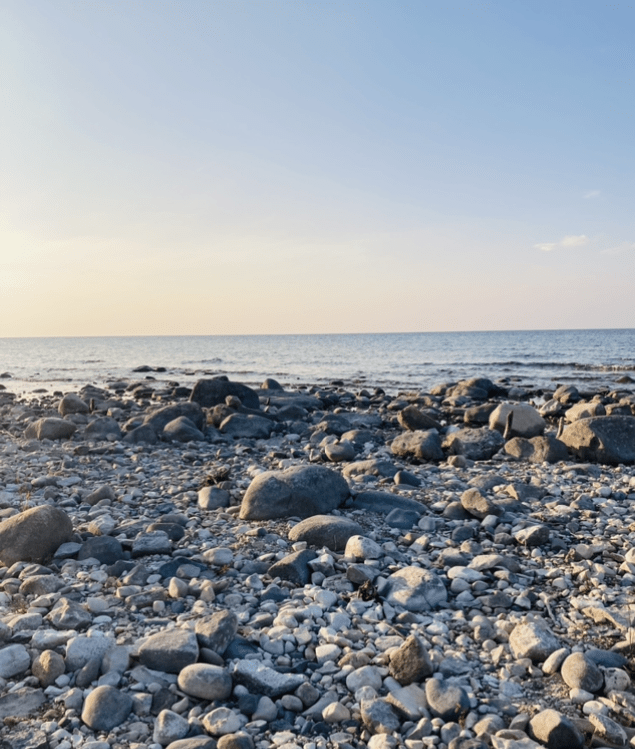
As my sister and I hunched over the rocky shoreline near our campsite, pecking around for pretty stones, we talked. About heavy things and about light things. I watched the way she sought out round, flat stones, the way she stacked them in little cairns everywhere we went. We visited several beaches, and she left these in her wake everywhere we went. I could see in them the precision and care that has always been part of her character, the artistry in both the selection of stones and their deliberate placement, their balancing. I could see the way this activity both calmed and delighted her. I loved the way we were able to fashion for ourselves this time in which to be calmed and delighted near each other, by each other.

The way the campground is situated at the tip of the peninsula meant that we had the perfect view of both sunrise and sunset, partially over the water, and partially over the rocky shoreline. I think about that now, this perfect positioning, this sense of being precisely between one thing and another. Certainly, it means something different for everyone who finds themselves there. For me it was a vantage point, from which to consider what’s next, as I move between the safety of stillness toward the safety of growth, even though I know I can never solve for all the variables.

Love, Cath

On Connection vs. Alignment

By Catherine DiMercurio

On a recent frigid Saturday, I gave myself permission to write all day and to not have to worry about anything else. I planned on it all week. I looked forward to it Friday night before I drifted off to sleep, the puppy snuggled against my legs. I woke early, made a big pot of coffee. I threw on some sweatpants and shrugged myself into a sweater. Hours later, when I happened to look in the mirror, I had to laugh at how I’d buttoned it, all askew. I can’t tell you how many times I’ve buttoned my sweaters this way. It started me on down a path though, thinking about alignment, because I can’t unsee metaphors when they jump out at me that way.

Clearly, my desire to write, my writing goals, my writing life—none of that feels aligned with the day-to-day structure of my life. At present, there’s no way around it. Maybe one day there will be away to live differently, where a full-time job with benefits isn’t so necessary, but I’m far from that now. As it is, I’m lucky to have a job where I’m interacting with books for a living. There are worse jobs a writer could be doing.

But I was also thinking about the idea of alignment in terms of relationships. As I’ve discussed here in recent posts, I find myself no longer clear about what it is I want, which comes as a surprise to me. I keep asking myself, do I even want to be in a relationship now, ever again? I saw someone on social media saying that men think they are competing with the top ten percent of other men for women’s affection, but they are really competing against the peace a woman feels in solitude. I know a number of women for whom this is true, and it definitely struck a chord with me.

Whenever I test the waters, start exploring how I might be feeling about the possibility of trying dating again, I invariably think about past relationships. One of the things I have prized most when I’m in a relationship is sharing a deep sense of connection with my partner. I’ve heard myself saying this to friends, whenever I dip into lonely and maybe, that it is this, perhaps, that I miss the most. Connection. I’ve said it so much that I have finally started asking myself what I truly mean by connection. I think, in a romantic relationship, it has several components. Chemistry is one. That feeling you get when you meet someone and feel like something instantly clicks. But that is only a small, shallow part of it. There’s also the intense bond that begins to grow as you share more and more about yourselves, your beliefs, your past. I find the tenderness of vulnerability to be deeply appealing. I have always been more attracted to vulnerability than confidence. In many men, you can see it underneath a surface bravado, like bright, beautiful, curious fish swimming under a surface of thin, clear ice. And I have romanticized this, the idea that I will be the one to tap into that. I think Gen-X women in particular were taught to do this in pretty much every teen movie that came out in our youth, the sweet guy lurking beneath either the bad boy or the cool kid image. The thing is, a lot of men were taught to be this way too, to hide part of themselves away. Maybe some of them believe the “right” person will be able to see them for who they are, maybe some of them just kept building up layers and not letting anyone in.

Photo by Maria Orlova on Pexels.com

Still, as I thought about this more, recalled conversations where I believed a connection to be building and deepening, I began to understand that my desire for this type of connection was something that could be, and had been, easily manipulated. While I was opening myself up, ready to share honestly and deeply, the men I dated were more spare in what they shared of themselves, doling out confidences in doses designed to keep me interested, and themselves in control. It’s hard to say what was intentional and what was simply a learned but unconscious behavior, but it created an imbalance that always left me wanting more. And I thought that was the point, that energy, the craving, I thought it all meant we had this intense connection. But, I think that everything I believed connection to be, everything I wanted it to be, was standing in for something that I truly hoped for but have never found: alignment.

I don’t know if my understanding of alignment actually aligns with how the word is sometimes used in some pop psychology/relationship circles. It’s often discussed as shared values and having the same vision for the relationship. I think there’s a little more to it than that. The notion of shared values is a tricky idea. If you’re really into someone it is easy to interpret behaviors as evidence of a shared value, or to think, “close enough!” and shove that square peg in a round hole and call it aligned. What I’m thinking of goes a little deeper. What I hoped for in relationships, what I allowed a type of connection to stand in for, was a common way of being.

I got this wrong too, in the past. I thought after marriage to a mostly extroverted person, that dating mostly introverted people, people like me, meant that I was finding people who approached the world the same way I did. And again, I allowed that to confuse things, allowed myself to believe that there was a connection that was deeper than it truly was.

But those things are different than my way of being in this world. I’ve been trying to pin down with language the way I would describe how I see myself interacting with the world. Where does the “too sensitive” label that was always attached to me arise from? Is it empathy? I do think of myself as an empathetic person. I was the type of kid who felt personally injured whenever I knew someone else’s feelings to be hurt. But, that wasn’t quite exactly the full story.

I’ve been drawn to men who seem to possess qualities compatible with my empathy, men who wanted to make the world a better place, or who had a gentle way with animals, or who were deeply loyal to their friends or family. But as I got to know them better, I also saw other things. It wasn’t that they didn’t behave in kind or empathetic ways. In fact, it was glimpses of those traits that made be attach myself more eagerly to them. But something was missing. It was different for each of them, but I think as I look back, I can see that they all shared some similarities, a conviction of their own rightness in how they looked at the world, as well as some kind of determination to keep a part of themselves closed off from me. There was a lack of curiosity about the way other people, myself included, approached the world, and a lack of openness to other perspectives, to me.

Yes. Openness. And here we are. I feel like I’ve just come full circle, writing this. No wonder I named this blog Chronicles of the Open Hearted. This is it, how I approach the world. My way of being in it. Openness. Empathy is a part, but not all of what I’m talking about. I am not guarded, though I have tried to be. In new social situations, though my introvert self feels quiet, and easily overwhelmed, my empathetic self is eager to find something in common, to make the situation feel less awkward, and invariably, I feel like I’m a little too much myself, too open, sharing too much. Ironically this tends to make things more awkward because people don’t often know what to do with someone that seems incapable of being glib and guarded until you get to know someone better.

I guess what I’m realizing now is that I want to see those bright and beautiful fish right away, without having to glimpse them through a layer of ice. I want heart-on-your-sleeve. I want true vulnerability and earnestness, not a performance of it. I want curiosity and openness, to me, new ideas, the world.

So, what is your way of being? Are you and your partner aligned in this way? If not, how do you make it work? If so, how does that feel? What challenges do you face? If, like me, you’re unpartnered, have you begun to realize, like I have, that you have built friendships with people who share aspects of your alignment?

I can see now how all the things I attributed to connection—chemistry, heady conversations, emotional vulnerability—all these things felt good, but they also created a cloud of sorts, a fog that kept me from seeing what was missing. I was hyper-focused on developing the connection because I believed that to be the foundation of a good relationship. It certainly doesn’t hurt, but both partners must be trying to build it. Still, it shouldn’t be standing in for alignment. At least, not for me. That’s not what I want. I’ve tried it over, and over, and over again and it does not work.

But, it feels good to have arrived at a better understanding of myself. And five years in, I’m understanding this blog a little better. It is about me wanting to connect with you, and always has been. It’s about wanting both of us to feel less alone. But it’s also about openness, because I don’t know how else to be, where to put all these ideas that crowd my brain. It’s my own curiosity, an exploration of ideas as a way of (hopefully) starting conversations, maybe even just the one you have with yourself in your own head.

Love, Cath

On Love Letters and Pancakes

By Catherine DiMercurio

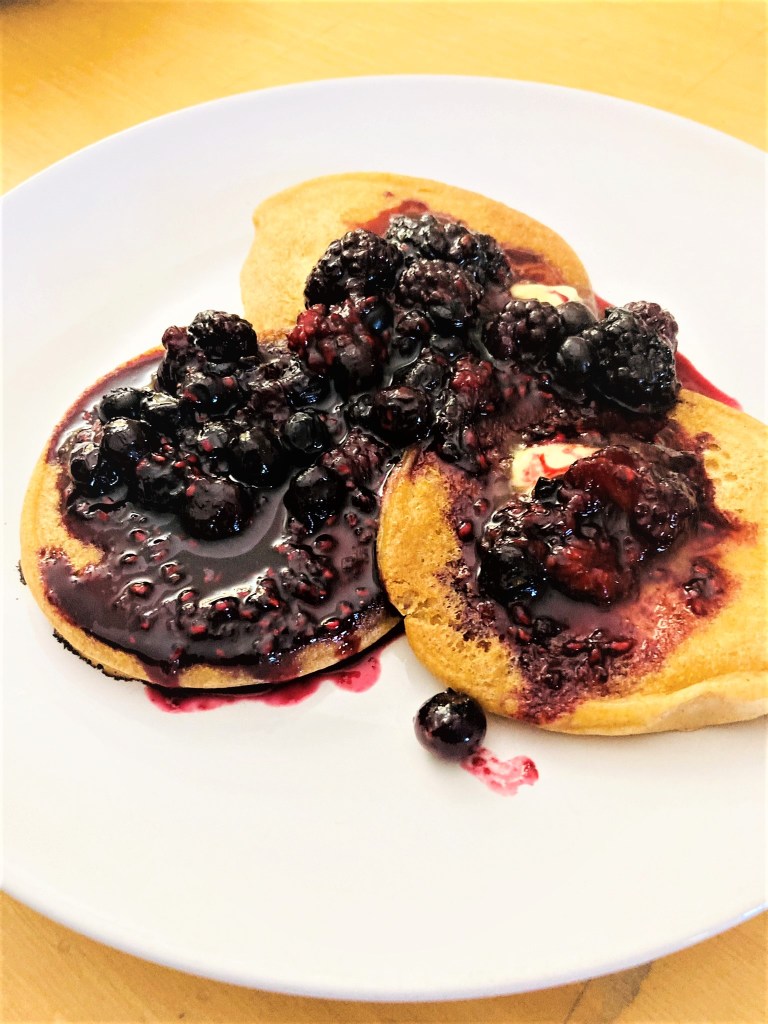
Pancakes are love letters I write to myself on weekend mornings. Yesterday’s were slathered in vegan butter and a syrup made from mixed berries and turbinado sugar, since, shockingly, I was out of maple syrup. I have a long history with pancake-as-love-letter. I used to make them for my family when the kids were little. It was a favorite treat. Every once in a while, if I was up early, I’d make them on a school morning and the kids would be surprised and delighted to have a break from their usual school morning fare of toast and tofu, cereal, frozen hashbrown patties hastily heated, smoothies, or whatever else we threw together. When we’d have neighbor kids over for a sleepover, I could easily be cajoled into making chocolate chip pancakes. All of this was a way for me to say, let me do this for you, make you feel welcome and delighted and full-bellied. Comforted and loved.

Messy but tasty.

Once, when my marriage was building toward its demise, and it seemed like my husband had gradually evolved into someone I didn’t know, who didn’t know me, I made pancakes on a Saturday morning and called the family to the table for breakfast. He sat down, reluctantly, in front of the steaming plate of love letters I’d placed in front of him. “I don’t really like pancakes,” he said. He didn’t even say “anymore,” as I recall. It was as if he was telling me that all along, he’d never liked them, and all along, he’d let me labor under the delusion of my delight in feeding him this treat. All along, what I knew and what I thought I knew were different things. Some seemingly mundane moments like this etch themselves into your soul and you try and talk yourself out of letting them mean too much, but later you are able to understand why it hurt so much more than it “should” have.

Later, after the divorce, after the rebound boyfriend summoned from my college days (for whom I made gluten-free pancakes), my first real new boyfriend spent the night for the first time while the kids were away. I made him pancakes in the morning. I delighted in how much he enjoyed them, how pleased he seemed to be in my space, sitting at the dining room table with me over pancakes and my syrupy love notes. I fell in love easily then, though that relationship did not last long, nor did the one that followed. I have a pancake story for that one too, but like most of the love notes I offered then, the reception was lukewarm.

Now I make pancakes for myself and it still feels like a special treat. Yesterday, I needed to feel taken care of, so I made myself the aforementioned pancakes. It started out just as something that sounded good but as I began mixing the batter, I thought of how satisfied I felt whenever I bothered to make myself a good meal instead of just scraping something together because it’s “just me.” So I completed the task with more deliberateness, thinking about why I was feeling the need for care in this moment, and also being grateful for being tuned in to what I needed. Even just months ago, it was challenging for me to consider both what I needed and figure out a way to get it. It was no easy task to make myself feel loved. To allow myself to feel loved. By the people in my life, by myself. Being partnerless felt burdensome, heavy, huge. It felt like an enormous cloud that shadowed my life. I felt that, theoretically, I loved myself, but I sort of waved away the notion that such knowledge could do anything to assuage my grief or loneliness. Now, I’m able to enact that love in different ways, to sit with emotions that need attention, to take comfort in a thoughtfully made meal, to pull myself away from the damaging loop of anxiety-thoughts by going for a walk or heading to the pottery studio or playing with the dogs.

It’s taken me so long to learn how to connect all these dots. For most of my life the messaging around me was that there was something wrong with prioritizing oneself. We don’t really learn how to do it. I didn’t. Or that we can, or should. For me, it has been so much easier to do now that I haven’t been in a relationship for a while. A year ago, I would not have imagined that I would come to think of the ending of my relationship as a gift. At the time, I felt I was making a healthy decision for myself but it was still a painful process and a grieved ending. It has taken me these many months to get to the point where, beyond knowing what I want in the next relationship (when/if that happens for me), I know myself so much better. Further, I know myself better for the sake of myself, not for the sake of any past, present, or future relationship. In the years since my divorce, I’ve been doing this work, but having this time entirely to myself for the past year has allowed me to further those efforts, to be more conscious, aware, and deliberate about my wants, needs, choices, preferences, and so on. To be clearer about my motivations and my triggers.  

Obviously, as a human, I still desire external validation, connection, conversation, etc. I’m learning what it means to feel wholeness and peace and at the same time desire connection and community. They aren’t mutually exclusive. I also have bad days where nothing seems to help. I’m still a work-in-progress. We all are, and there is so much beauty in that. The people I’m most drawn to are those who possess that same awareness. 

Pancakes are not the only love letters I write to myself. When I look around my space and see houseplants in every room and jars of found objects—pinecones, driftwood, rocks—I see all the ways in which I bring nature inside so that it is all around me, because it calms me and centers me. Every little stone I’ve ever pocketed or tucked inside my beach bag was a way of me saying to myself, trust me, you’re going to need this later.

So, if you’re reading this, take a moment amidst all the loud clatter and chaos that seem to be the norm of the world around us most of the time, and think about what little love note you could give yourself today. Is it cooking a comforting meal, writing an actual note, going for a walk, picking up a lucky penny? Maybe it is pouring coffee into your favorite mug, and stepping away from work for 15 minutes outside. What are the ways you’ve expressed love for others in the past that you can offer yourself now, like me and my pancakes? It’s worth thinking about. You’re worth it. I am.  

Love, Cath

On Slow Dancing and Wet Sand

By Catherine DiMercurio

Yes, but are you happy? is a question that we chase each other with. We want it for our loved ones, maybe more than we even want it for ourselves. It certainly means something different for each person. I have long wondered, is the “point” of life to be happy? Is it to have purpose, to make the world a better place? To simply survive it? Is it something else? This of course leads down a philosophical road. Depending on your larger belief systems about how we got here and what happens after, the question of the “point” of it all is going to be answered differently. But certainly happiness is something we all want.

Recently, after a period of feeling quite good for a long stretch, a collection of troublesome things happened and I found myself slipping toward the edges of the dark mental space that it can be hard to climb out of. Is happiness real if it goes away when life gets tough? Why does it feel so ephemeral for some of us, and others seem to find it wherever they go?

I used to think that happiness meant spending time with the people you love, but when the people you love exit your life, or they live far away, or the people are your adult children, building their own separate lives, you realize that if your happiness depends on time spent with anyone but yourself, you’ll never be happy.

So, then, is happiness doing the things you enjoy? Pursuing what you love? This seems obvious. Of course, we are happy when we are doing the things we enjoy, but how do we retain that sense of happiness when we are done doing the thing, when the hike has ended, the garden planted and weeded, the sunset on the beach viewed? How do we retain it when we are making dentist appointments or paying for expensive car repairs?

I am not saying that I expect or even want to be happy all the time. There are times when other emotions can and should be foremost in our hearts. I’m talking about happiness in terms of a calm, centered peace that we can hang on to when life gets bumpy, that we can find the path back to once we’ve dealt with some of the more serious things that life throws at us.

If happiness is that peaceful, centered state, is it accurate to say it is a reprieve from anxiety/fear/doubt? And how do we cultivate that? How does anyone, if daily there are battles with physical or mental health, or with financial woes, or any number of things that rattle the calm, that busy us and keep us buzzing and unable to be still and settled?

And some days, sadness feels like thick wet sand, cold, gritty, clinging.

I’m trying to learn how to process heavy emotions. To slow dance with them and listen to what they are trying to tell me.

Photo by Mathias Reding on Pexels.com

The trick is to know when to stop. My old habit when I’m feeling that deep down tug of sadness like there’s an anchor inside, is to sink, stay with it, fall into myself. Here in the dark, I can see that the enemy of happiness is not exactly sorrow, but fear of future sorrow. It is the thought that maybe everything won’t be okay after all.

I think of how future-focused I’ve always been. Not in a sensible way like retirement planning. But, I’ve always had the same question thrumming through me, for as long as I can remember: “But everything is going to be okay, right?” I suppose it is time I start asking myself what I meant by “everything” and “okay.”

This blog has been largely about my path forward since my divorce, the ups and downs of it all, single parenting, relationships. And since ups and downs are universal, I hoped that by writing about mine, you could think about yours, and we could connect that way, cultivate contemplation, and in so doing, co-create a more deliberate way of moving through this world and coping with its challenges and celebrating its joys. Help each other to feel less alone, which is certainly another kind of happiness.  And I have written here about the aftermath of marriage but I rarely talk about my marriage itself. I can tell you this: when I was married, whenever I asked that question to myself, “is everything going to be okay?”, I knew the answer. I knew everything would be okay because I was with the person I wanted to spend my life with.

Before I was divorced, I didn’t think too much about what it meant for people. It was something that happened to other people. So, when it happened to me, and in all the ways it happened—and it happens differently for everyone—one of the biggest inversions to my world view and sense of self was this idea that the future as I had imagined it was erased. And somehow, I felt erased, too. Everything would not be okay, at least, not in the ways I had imagined and hoped.

This past year, since my most recent breakup, I have realized that this part of my journey is trying to get that “everything’s going to be okay” feeling on my own. To take time to slow dance with that. Feeling like everything is going to be okay means that you have an absence of fear about future sorrow, or, more accurately, you have confidence that you will handle the future sorrow and make everything okay, in time. One of the things I’m trying to remember is that no matter how badly I want to figure out if future-me is going to be okay, there are things I can’t know, can’t predict. And the only way that future version of myself is going to be okay with whatever life throws at her is if I figure out how to be okay now. Because if I can do it now, then I can do it then. And what I fail to do so regularly is to realize that I have done it. I am doing it.

Sometimes I feel like the world gets meaner every day and I’m no match for it. Just me and my hokey dreams trying to feel like I’ve got things figured out enough to feel “okay.” But the more we talk about these things, the more we can help each other find paths to “okay” and “happy.” Maybe we can slow dance with the light emotions too, not just the heavy ones, slow dance with joy, slow dance with each other, feel the cool comfort of wet sand instead of a dark pull. And maybe we can create a ripple effect and gradually wash away some of the meanness and be a match for this cruel world together.

Love, Cath

On Communities, Solitude, and Situational Goals

By Catherine DiMercurio

Sometimes belonging is complicated.

During a terrible storm this weekend, the thunder woke me. The dogs were restless. I was awake for hours and I went through the list of things that might go wrong because of the weather, and the logical part of my brain reminded me I could handle it, and the anxious part suggested otherwise. In the middle of traversing this terrain of highs and lows, I found myself returning to the same plateau where I told myself: You don’t belong here.

Sometimes anxiety amplifies a message we don’t want to hear. And sometimes it confuses it. We can’t always tell the difference.

I worried from the beginning that I wouldn’t belong in this house, in this town, but there were compelling reasons to be here. There was a need to jump off of one path and onto another. It wasn’t a big move; I didn’t move across the country. But I left the familiar and headed in the risky direction my heart hoped was the right one.

I never considered myself the type of person to take things for granted. When I was married, I had a deep sense of gratitude for my family, for the life we’d built. But I also felt that my relationship was immune to the troubles other people experienced. That it was unassailable.

Since my divorce and everything that followed, through my recent move, I have taken for granted the notion of community. I knew I was leaving a tight-knit community, but because so much of my community-history was woven together with my marriage-history, I longed, in some ways, to be in a place that had no such history. Besides, I was moving to a house where I’d be closer to my boyfriend, so it seemed that this would balance out the loss of proximity to my neighborhood friends, with whom I vowed to stay connected with.

But when that relationship ended, I began to feel stranded. I work hard to maintain connections to friends from the old neighborhood, but busyness and the lack of proximity is a challenge on both sides. Building a sense of community with my new neighborhood has been an effort compromised by the pandemic. There is a tiny bit of progress. Yet, it isn’t the same.

My writing community is another story. Being part of a low-residency MFA program meant that I’d be making friends I wouldn’t see in person all too often. It was baked into the system. I’ve been lucky enough to keep in close contact with a few of those friends over the years, and to have a lifeline to opportunities like the workshop I’m now a part of. And lifeline is not a hyperbolic description. Through my writing community I have been able to embrace a part of my identity that for a long time struggled to breathe: I am an artist. I sought out this community once I could no longer shush the part of me that had been standing around clearing her throat, hoping to get noticed. I sacrificed a lot to pursue it and now I don’t know what I would do without it.

What I’m learning from my experience with my writing to community is that all community must be pursued and developed, right down to the micro-communities of our families. Now that I am single and living alone, I am realizing how much I benefited from ready-made communities I was a part of when my children were growing up. It was all right there, in my living room, in the halls of my kids’ school, in the walk to the grocery store, in the Memorial Day parade. People I knew and cared about were always gathering, and I could dip into that whenever I needed to.

Now, I am learning so much about myself and I am grateful for that. Yet I had not anticipated that everything that feels like connection was going to involve focused effort on my part to pursue. It isn’t as if I’m the only one making the effort, but the majority of people I’m trying to maintain connection and community with have other humans in their physical orbit on a daily basis. But I have not been within hugging distance of anyone since Thanksgiving. (It did not seem appropriate to hug other the repairman or the grocery clerk.)

I also have some things that a lot of people who live in a busy household have told me that they envy: peace, solitude, time to think, freedom from anyone else’s schedules. And I treasure these things. I have wondered if the pleasure I take in such things means that I don’t even want to find a relationship anymore. I used to think it had to be one thing or the other. Now I see that goals can be situational. If I am single, I want it to look this way; if I am in a relationship, I want this kind. Sometimes I’m actively seeking, sometimes I take a step back.

And it isn’t any different with communities. Sometimes we feel we belong and sometimes we have to keep looking for new places to belong. It’s okay to need multiple communities. Someone once told me, “there is no right way to do this.” There is not even one right way to do this for me.

In a few weeks, I’ll get a new community, my pottery community. Again, a community which I sought out, sacrificed time and money to be a part of. But one that I anticipate will be very valuable to me. It takes work as an adult to find new connections. Belonging within a community is one of the things I thought would be easier.

Yesterday, I was supposed to hike with a friend from my old neighborhood, but she was unable to make it. I tried to find someone else to go with at the last minute, since I was already bundled up against the December chill, but nothing panned out. I almost didn’t go. I have an intense fear of getting lost and tend toward well-marked trails with a friend. But I got in the car before I could change my mind. Drove to the state park where my friend and I had hiked once before, several months ago. I walked with a careful eye on my surroundings and the trail markers, noticing the way my walking, when I’m unsure of the way, mirrors my handwriting when I’m unsure of my thoughts. There is a tidy deliberateness to my movement that is absent when I’m feeling sure of myself or lost in my imagination.

I didn’t get lost, and my return path was brisk, comfortable. This was a baby step, a decently marked path in a well-traveled wood. It struck me again, the trade-offs between solitude and community. I missed my friend. I miss being face-to-face with humans I care about, who care about me. I miss hugs. At the same time, this solo hike did me some good, too.

I am surprised by so many things these days. Realizations that come to me in the middle of the night. My task is accepting the things that didn’t work out, and pouring my energies into a new relationship with myself and into appreciation of communities, old and new.

Love, Cath

On Safe Havens

By Catherine DiMercurio

Sometimes we figure out what we need.

Some transitions take longer than others; or, I am slow to acclimate to change. I think about where I belong and where I don’t and have not come to any conclusions except that sometimes it feels like nowhere, or at least, not here.

A few weeks before my house began a revolt with its perpetually problematic furnace, I finally got out of it for a couple of days. I’d booked a cabin in the woods in a state park not too far from home. I’d painstakingly arranged for care for the dogs, though I worried about my absence being difficult for them. My plan was to go away to write in solitude, but when one of my sisters, who was in need of some solitude herself, asked to join me, I was happy to say yes. She volunteered to take care of all the food, and let me write, and when I needed breaks we’d be able to enjoy each other’s long-missed company, and walk in the woods. Few things are ever exactly what you need, but this was. It felt soft and safe. It felt like the childhood safety and freedom from worry she and I had enjoyed together. It was laughter and peace. And I did get a fair bit of writing done. And we rambled through the woods in the late-September sun.

Back at home, I tried to hold on to that sense of peace and security, but I was also faced with what I had left—living in a house and in a town that I’m still acclimating to after a year, a place that resists feeling like home. Part of it is that in addition to my son leaving for college, the relationship I thought I’d be cultivating here had ended and I have found it difficult to create a sense of belonging to a place that did not have my people in it. For decades, home had been about family. Adjusting to a lack of a human population within these walls has been a bumpy ride.  

It’s a strange thing to make peace with an object as big as a house, and one that at times has seemed like it has wanted to eject me. Look, I say. We just have to make this work. Yet, you are not what you pretended to be. Things I loved about you when we first met all need to be repaired or replaced. Other things I loved about you that no longer matter: you kept me close to someone who mattered.

You were supposed to be a safe haven. But then I remember, that’s my job, not yours.

Safety, in all its forms, is both complex and simple. So easy to lose, so hard to get back. I think many of us experience this loss of a sense of safety at various points in our lives, whether it be in the aftermath of trauma large or, smaller but chronic, or an ongoing familial or financial crises that takes its toll.  We look back and try to remember what it was like to feel safe. Maybe it was so long ago you can hardly remember, or maybe it was a recent loss, sudden or gradual. Or a combination of all these things.

I believe it is also true that many people who feel anxiety or stress are unable to identify its true source as the absence of a sense of personal safety. It is difficult to pinpoint the source of trouble within ourselves, and it is easy to write off a deep, unsettled feeling as “stress.” But I have been wondering if it is actually stress that is the source of the anxiety I often struggle with, or something deeper.

In the course of these past couple of months of adaptation—to the loss of a relationship, to my newly emptied nest, to solitude that wears a different face every day—I have tried to explore troubled feelings when they arise. One of the things I’ve come to recognize is that a chain reaction of harm is occurring, and it is eroding my ability to be what we all need to be for ourselves: unassailable safe haven.

When I have a setback—expensive home repairs, a rejection of a writing submission I was really hopeful about, the text that erases the budding hope for a new potential relationship—my first thoughts are not those that self-soothe and comfort. They are those that self-criticize. Worse, they sometimes wound even deeper, mirroring the act of shaming that others have done to me in the past. What’s wrong with you? How could you let this happen?

How can we ever feel safe with someone who is makes us feel less than, who prods us about things we should have known or done, or belittles us for “bad” decisions, or for outcomes beyond our control? If we told a friend that someone we cared about was treating us this way, they might say, “that’s awful, that person does not love you.” What might our response be? Would we defend? Insist that they are only trying to protect us? What do you do when the person hurting you and tearing you down is yourself?  

There is undoubtedly a part of us that thinks it can protect us by pointing out things we could have done differently, things that didn’t work out well before, in order to try and keep us safe from further harm. There is a part of us that wants us to do better, be better. This critical voice pushes us because it loves us, and when we have pushed ourselves before, when we have tried harder and achieved, it may have seemed that this did make other people love us more. We may have told ourselves that. That people love us better when we can demonstrate that we have achieved certain external success. And that means a lot when we have been unable to create that love and safety within ourselves.

Did we even know we were supposed to? I’m not sure I even knew that as a concrete thing, that it wasn’t going to be enough to let my sense of safety be housed within my relationships instead of myself.

Sometimes we learn too well from all those who have been critical in the past, individuals and institutions that have used shame as a tool to control us. And when we use the same tools on ourselves the result is anxiety and self-doubt and depression. But how can we self-soothe, how can we turn inward for comfort when times are tough, if we have cultivated an inner critic whose voice is louder and meaner than anything else inside us?

For some of us, this all results in a situation in which we feel more at peace with a partner than on our own, because in solitude we have not been able to create a space in which we feel completely safe. This has been true for me. Yet I felt entirely comfortable providing that safety that I withhold from myself to someone else. When it works, when it is mutual, it can beautiful, and some healing can happen there, to feel that your heart is being cared for so tenderly by someone else. You might even begin to learn how to do this for yourself. But if such care is withheld, what often kicks in is not an instinct to self-nurture. Rather, it is the voice that tells us that we were never worth it to begin with.

I think all this is why writing feels so important to me—I can transcribe not just the darkness and hurt, but also the light and the balm, and I can create, in an imaginary world, things that I struggle to create internally. I try to teach it to myself, by showing what works and what doesn’t. This, not that, please.

It is also why rejection in all forms is so difficult. When connection feels like safety, then being told we aren’t someone’s cup of tea, or our creative work is not a good fit, or good enough, can be demoralizing. There is no magic to feeling okay with any of that. However, practicing and learning how to be a source of connection and safety within and for ourselves is the key, and not just to handling rejection. It is the path to being able to cope effectively with all that life throws at us.

We must be able to believe ourselves when we say I am safe. We must be able to give that gift to ourselves. I must. I’m working on it, now that I have finally figured out that this is what I should be doing. If this is your work too, I wish you love and luck.

Love, Cath

On Feathers and Full Moons, Equinox Rain and Wheel Barrows

By Catherine DiMercurio

Sometimes we find lost things and lose sleep.

On a recent early, early morning when I couldn’t sleep, I pulled out a notepad to try and capture the things that were making me anxious and unsettled. I often can’t sleep around the time of a full moon. When I return to such notes, I’m often saddened and alarmed at how amplified my worries can be at this dark hour, how they reach and seep, inky and dark. For me, so many of the things that keep me awake at night hinge on the notion of self, on what I believe I am and am not capable of.

I think of the line from the William Carlos Williams poem: “So much depends / upon a red wheel / barrow.” So much depends on how I view myself, so much depends on the idea that I can be depended upon. On the longing to depend on myself, and the fears of falling short. So much depends upon the notion that I must be useful, effective, sturdy as a wheel barrow waiting to carry the weight and do the work.

How quickly when something isn’t going well my brain shifts all its patterns to shame. Many of us worry that we will be perceived as weak, unable to handle this or that. Not worthy of the work, not useful, not effective. Why is it, when we acknowledge that we struggle, that we are compelled to feel shame or embarrassment? I see how readily people judge one another on social media, how prevalent the notion of shame is in our society, a hungry mouth fed by religion and class or other similarly contrived ideas about worth.

I often wonder how to let go of expectation – mine and yours. Is it an act of will or fatigue?

What I wrote on that sleepless notepad was this: If hope is the thing with feathers (as Emily Dickinson suggested) then I must be doing it wrong, because there is no downy softness, no lightness, no promise of flight. And I have felt it leaving me sometimes, like a lover in the early morning. I have wondered if hope is more thorn than feather, but maybe I’m getting it mixed up with something else. Expectation, maybe.

Sometimes I try and think about what connects us all, and I think about love and loss. We have all loved and lost in so many ways, yet we get stuck in our own heads. I do. I get stuck. It’s easy to do, isn’t it? So much of life is pulling oneself out of the muck. For some of us, it takes a lot of endeavoring to cleave to the higher ground, to keep our perspective focused on what moves us forward instead of what is wrong, what has gone wrong, what might go wrong. Our accumulated griefs are heavy and they conspire against us in the form of fear of future pain. We anguish over the possible fading of strength and loss of will to do heavy work, to carry and pull our weight.

Photo by Sourav Mishra on Pexels.com

The persistent rain outside my window has erased the steamy summer days that preceded it. It is an equinox rain and you can feel autumn in the space between the rain drops. I have set things in motion to look forward to this fall – a writing weekend away, a pottery workshop, a pile of books that I vow to turn to instead of collapsing in front of the television at the end of a workday. I know that when I feel as though I’m falling, I have to throw myself a rope here and there in the near future. Maybe that can be another thing that connects us.

A few moments ago, I heard a bird singing in this downpour. I thought it strange, wanted it to seek shelter. But also, I considered the rest of Dickinson’s opening stanza:

“Hope” is the thing with feathers –

That perches in the soul –

And sings the tune without the words –

And never stops – at all –

And then some magic drew me into its circle again. It is often like this for me when the changing season corresponds to a personal transition. Things feel weighty and moods shift in pendulum parabolas. It is a time of deep thinking, of reflection on where I’ve been and where I’m going. This is my way. I’m not sure I truly was cognizant of it before now, the way sleeplessness coincides with full moons, and a deep sense of reckoning coincides with changing seasons.

This is what writing does for me. It crystalizes things, translates and distills it all, so I know what to focus on. Some people find this through nature, prayer, meditation, physical exertion, this clarity. But I think we all seek it, each in our own ways, which is another thing that perhaps connects us.

This rumination begins in the middle of a stream of thought and seems to go nowhere when I read it through, but at the same time, it is doing what I need it to do. It pins down a moment, arrests a thought in flight long enough to view it a little more closely. And it reflects where I am and where I suspect a lot of us are in these turbulent times. We are uncertain, not confident, wondering what we are made of and what we will be when we grow up and into the next part of our lives. We are at once in the middle and at the end and at the beginning again, waking from a hazy dream during a full moon in the middle of the night. We are listening to a few notes of birdsong in equinox rainfall.

Wishing you wisdom and clarity.

Love, Cath