On Joyful Moments, Good Light, and All Our Selves

By Catherine DiMercurio

Sometimes I reflect on how this blog began, and the name of it. My dog had just died and I was about a year and a half into a new relationship. I was feeling broken hearted and open hearted at the same time. The relationship ended several months later. I took a few months off from dating, then hopped back into something new, which also lasted about two years. Now, that relationship is two years behind me. I didn’t hop back into anything, and another of my sweet pups has passed.

Since that death there have been times over the past two months when it has felt as if things are slowly sliding down a muddy slope. I have struggled to get my footing and little and big things seem to be going wrong. I look everywhere for signs, for tiny joyful things, so I may imprint those things on my heart in an effort stop the mudslide, give me something to hold on to. I know from experience that it is an effective practice, but like everything good for you, it takes consistency and hard work to keep looking. And the more things that go wrong, and the bigger the things, the harder it is to see anything else, harder to feel open hearted in a world full of sharpness.

One of the good things about me is that I like routines. I’m trying to make sure I’m moving more and I bought a pedometer to better monitor myself. Sitting at a desk for 40 hours a week not only has its own detrimental effects but has dulled my ability to gauge how much or little I’m actually moving. Now, my habit is to walk the dog in the morning, take a few breaks to get some steps around the house throughout the workday, then walk again, solo, in the late afternoon or evening. I feel so much better when I do this.

But being a lover of routines has a downside too. It can be hard to try new things. There are a million reasons why I adore the safety and predictability of routines, but basically it’s a combination of how I’ve always been, and what I prefer in the aftermath of some of the roller coaster relationships I’ve been in. Routines keep me writing every morning, keep me and my dog healthy. But breaking them to try other things can be a challenge. Though, trying the New, Big Thing of pottery a year and a half ago was my proof to myself that I can change up the routine and it can be really good for me. And it still feels like a New Big Thing, even though it has been incorporated into my routines.

Routines can also lead us to so many happy moments. My writing practice never fails to ground me, to keep me connected to my self, and to big ideas I want to explore. The quest for little happy moments was most recently undertaken in the aftermath of a storm that resulted in some expensive roof damage. I had been feeling particularly low. But on a routine walk with my puppy Zero, we were led to a beautiful toad. The toad moved in such a lopsided fashion, a half slide, half hop into the grass at our approach that at first I thought it was a wounded bird or something. A good portion of my joy at discovering the toad was seeing that it was an alive-and-well someone instead of a wounded someone.
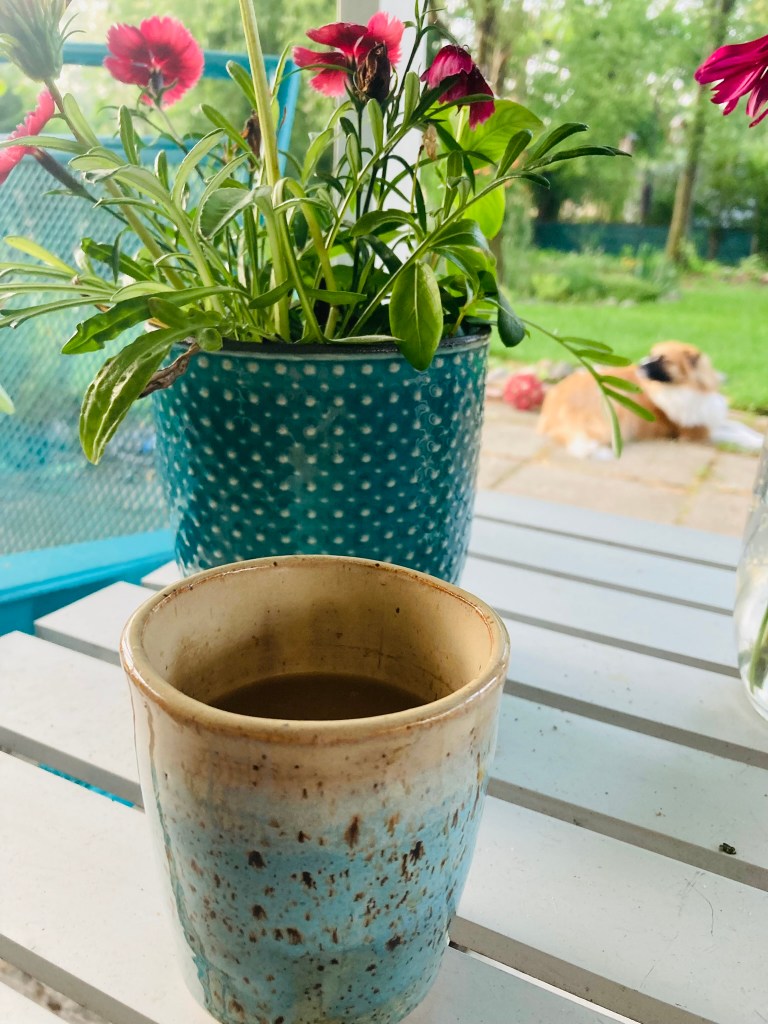
Other little happy moments that happened recently also occurred as my morning routine unfolded. I typically begin the day with a cup of coffee on the patio when I let Zero out. Yesterday, I was drinking coffee from a mug I threw and trimmed and glazed myself. The coffee contained a drizzle of cardamom simple syrup, as I’m obsessed with cardamom these days. I was surrounded by flowers, including a pretty pot of them given to me by a good friend. It was one of those moments, one I wanted to capture and imprint upon my memory for when times are tough, so that I could draw it like a card from a deck and say See? You felt good and happy and peaceful that morning. This morning too, as I stood on the patio looking out into a pale and hazy morning sky, I was surprised to see an enormous waning gibbous moon. I once wrote about that particular moon phase being my favorite, and it was a delight to see it there, perched and oddly bright in the morning sky. It was such a strange, good light, and I’m glad I took the time to bask in it.

I feel like our brains are constantly shuffling the deck of memories. A song will retrieve a memory so long ago and so good that it bruises you to remember how lost and faraway it is. A smell will bring forth another memory of a kitchen full of people you love, and you will smile. The tough memories get added on their own without any effort. I’ve read that our brains imprint—sear?—bad experiences into our memories as a protective mechanism, but good memories are not written in the same fashion. Though, what greater protection from bad memories is there than good ones? It’s a strange way for our brains to work, but if we want to make protective charms of the good memories, we have to do that work ourselves.

One of the beautiful parts about these little happy moments that we’re trying to imprint upon our brain as memory is that there is a lovely now-ness to them. Somehow noting them as they are happening opens up a pocket of time-space and lets the moment exist for longer than normal. Such moments are as much about future enjoyment of the past as they are about the present. Isn’t it amazing how they can exist and extend in all those different directions?

Still, when things are bad, at least for me, my tendency is to resist seeing things, anything, in a good light. I have to heavily lean into the part of myself that knows what to do, to trust her to pull us out. To take us for a walk, to reach out to a friend, whatever it takes. When I feel clearer-headed, I can see that the part of me that knows what to do knows because she fought for this knowledge. She worked like hell to build the scaffolding for us, to make sure we always had a way out. She helped get us out of bad situations and the unhealthy mindsets that went along with them. When things start to get bad, my thoughts become a mantra of “I don’t know what to do.” But, we have always figured it out. I hope, as I’m building this muscle memory, I can catch myself sooner and sooner each time and remember to trust and work with myself instead of against, to have all the disparate parts of myself pulling together and being a team. One part of my brain looks for the good, joyful moments, another does the research and finds the answers, another knows when we need to get out of the house or talk to a friend. And they all comfort the scared part that is worried about all the bad things that could happen.

Sometimes I wonder what it’s like to have a brain that operates as a singular unit, not a crowd of selves constantly in dialogue. But this is the brain I’ve got so we’re going to keep learning, keep talking, and keep growing. I’m off to jump into my next routine of the day. I hope you have a good one, full of happy, collected moments and good light.

Love, Cath

On Synthesis and Momentum and Messiness

By Catherine DiMercurio

I’ve been single two years to the day. Since the breakup that started this chapter of my life, I’ve spent a lot of time exploring my history and finding patterns and doing long-delayed work. I’ve focused on writing and pottery and self. I’ve mourned old things that it was too hard to fully manage before and I’ve mourned new things and I’ve found unexpected joys in solitude. Despite the periodic bouts of loneliness there’s a lot that simply feels better now. I have worked at discovering what wounds have followed me from childhood and into all of my adult relationships, and have explored many different ways of tending to such things. I’ve found ways to provide for myself things that were missing in a lot of relationships, like emotional safety and respect.

Still, there’s a part of my brain that seems exclusively devoted to tallies. It counts and categorizes the things that have hurt me and the things that helped me to grow. It tells me to keep writing and throwing clay and wandering in the woods. It reminds me of how good it feels to be near a lake and suggests we don’t forget about the plan to move closer to one. It encourages growth and development, but in the ways least likely to cause me pain. It’s very practical, this part.

There’s another part of my brain that unfurls itself like a flag in the wind, singing to me about being in love, and don’t I remember what that’s like, and don’t we want that again? The other part of my brain taps a pen against its clipboard and says something like, “according to the data, this course of action would not be a wise investment of resources. . . .”

They are at odds, and so am I. So for now, I check in with them to see how we’re feeling but stay busy with all the other things. Busy is an easy way to be, between a full-time job, pursuing writing as a serious endeavor, and pottery as art and hobby, maintaining my house and yard, caring for my dog, and trying to exercise and eat well and sleep well, and to generally stay healthy. That all gobbles up a lot of available energy.

At the same time, after my older dog died a few weeks ago, I spent a lot of time just sitting in the sun and watching the irises bloom. Sometimes everything needs to pause. It’s been nearly a month somehow and I’ve been trying to regain my footing. I feel as if I’ve been moving slowly and carefully through the world these last couple of weeks, trying to make sure nothing else breaks.

All this is to say that you get to a certain point and you get to feel very self-protective. I used to feel braver, at least when it came to putting my heart on the line. My loneliness outweighed everything else and it felt like I’d already been through a pretty rough heartbreak, and nothing could be worse than that, so I kept throwing my hat into the ring. But it doesn’t work the way I thought it did. A breakup after a two-year relationship can hurt just as badly as a breakup after a two-decade relationship. They just hurt differently. Hearts seem to have a lot more surface area than you’d expect and can break in a lot of places. And you keep mending it until you have this beautiful piece of art, mended with the gold of all your best efforts at healing, but you tend to get more careful with it. Mended, it’s strong, maybe even stronger than it was in the beginning, but you’re less likely to want to test out that theory.

I think this is why so many people turn to art. It can still break your heart in mighty ways, but they are easier to bounce back from. Art—specifically, my writing—has saved me and picked me back up time and time again. The physical act of it. My pursuit of it, following through with a low-residency MFA program in the middle of a divorce. The people I met, and the community I found. And I swear when I started pottery it was just like falling in love, full of angst and euphoria, and settling into the beautiful harmony between exhilaration and calm. And now there are so many different ways to grow and explore, it can feel overwhelming at times and at other times, I find so much relief in the knowledge that I could study and practice for a thousand years, or at least, the rest of my life, and still have more to learn. And again, I have found a new community.

Sometimes, when I’m not practicing one of these art forms, or actively engaged in one of the other activities that both soothes and invigorates—hiking in the woods, baking, hanging out with my dog, having coffee with a friend—I slip into rumination, or find it hard to stay engaged with work that needs to be done, whether it be my job, or housework, or other routine and necessary things. I’m trying to figure out how to find both joy and contentment in the mundane too, since that occupies a bigger proportion of my time most days than the other things. It was easier to not get so lost in my head when I didn’t spend quite so much time alone, but between working remotely and the kids having moved out and the breakup, it’s been a quiet two years. This time has allowed me plenty of time to do both productive work and to descend into rabbit holes I then have to work to clamber out of.

Photo by Vansh Sharma on Pexels.com

I’ve often looked back on the moment of impact that changed my life and felt as though it separated me from my shadow, and she became something more substantial, as if an outline had been drawn and filled in with tangible darkness. When times are tough, she seems to gain strength, and when I’m feeling good and strong, she retreats. And what I’ve been thinking a lot about lately is integration. Of attaching that shadow back to me the way it’s supposed to be; of the artistic with the mundane; of joy with responsibility and routine. Maybe it’s more synthesis than integration but there has to be a way it all fits together, for fragmentation to gently morph into wholeness.

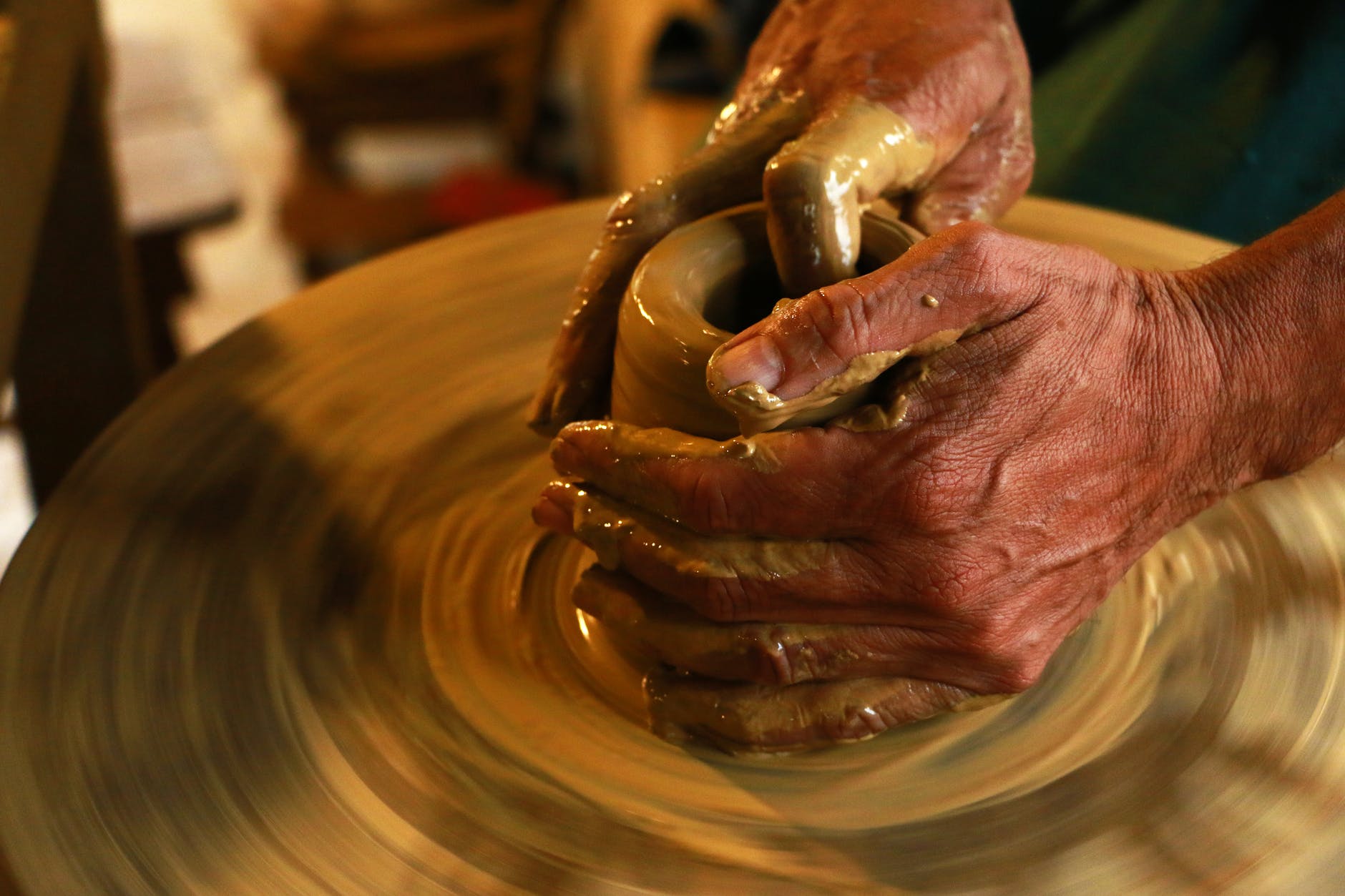
When we center clay on the wheel we talk about the way this process encourages all the particles in the clay to move in the same direction, and we learn ways to shape the clay that works with its momentum, and that isn’t at all about forcing it to look the way you want it to. I think that’s a good goal for me too, working with my momentum, and gently encouraging all the disparate parts of me to start moving in the same direction, and enjoying the messiness of the process. It’s all a good reminder too that growth is multidimensional, not linear. It can look like you are spinning your wheels, but you are actually creating something extraordinary.

Love, Cath

On Rage and Other Big Things We Don’t Like to Talk About

By Catherine DiMercurio

I took my rage for a walk the other day because the only thing that made sense was tiring it out. I wondered if it was more like a toddler in tantrum or like a puppy full of energy to spend. But the rage—my rage—was unlike either of those things. It wasn’t innocent frustration opposing the structure of its world and it wasn’t joyful and bored and antsy. It was more sophisticated and self-aware, and I couldn’t think of it in a way that made it seem cute and small and not very dangerous. It was not cute, and it felt volatile and intimidating.

On my drive out to the woods, the rage quieted. Simmered. Waited. I was tired of trying to talk myself out of it, just because I didn’t know where it came from. I was tired of trying to figure out all the reasons I felt so full of this surging and unpredictable reactive energy. But I did it anyway. Was it because of the world at large and all the ways it is hateful and crumbling? Was it frustration with life and how there’s no way off this treadmill of working to pay for a roof over your head and having little time or resources to ever do much else? Was it this new and uncontrollable bristling I feel when I encounter inauthenticity? Or was it the powerlessness I feel when I witness people abandoning themselves the way I once did, in service of people or situations that were hurting them? Or was it simply grief’s companion, still flailing over all the things that still hurt?

I don’t know that I learned how to properly self-soothe as a child. People tell you to calm down but they don’t tell you how. I’ve spent a lot of time figuring out what to do with myself when emotions feel too big for my body. When my kids were young, I would tell them to not do anything with their hands when they were angry because we’re so much stronger when were mad. Mostly this was to keep them for hurting each other when they were upset. We talked about different things they could do when they felt that way. Scream into or punch a pillow. Jump up and down. Take deep breaths. But we probably didn’t talk often enough about all this. I was still learning myself, but I suppose a lot of parenting is like that.

Now, as I began walking a trail covered in snow, several inches deep but packed down by other feet and frozen into other shoe shapes, my own boots slipped and slid. I had decided by then to just let myself be angry instead of trying to figure out why it had appeared out of the blue without an obvious trigger. I tried to not be resentful this time. Fine, be mad, I sometimes told myself, all the while feeling a meta-anger, that sense that I was mad about being mad.

This time, I tried to be agreeable about it all. Okay. Today we’re going to be mad, I guess. It’s okay to be mad. I tell myself this now. Because it is, even though I don’t like how it feels inside my body. And I did try to impart this to my kids, too, that it’s okay to be mad but it’s not okay to take it out on other people. But whenever I tried to apply this lesson to myself, I kept trying to talk myself out of my feelings. Maybe I was told too many times that I didn’t have anything to be mad about.

I have this idea that as an adult I’m supposed to be calm and in control of my emotions all the time. I have a habit of judging myself for the “negative” emotions that take me over. In a way, trying to figure out all the reasons I might be mad felt like an attempt to justify, to counter the “you don’t have anything to be mad about” charge, like part of me was yelling, yes I do! It’s as if I’ve been seeking permission from myself to be angry. I have embraced sorrow. When it visits, I let it stay as long as it needs to. I feel it, I talk to it, I cry. I let it have its say, and that seems to matter. But I’ve been afraid of doing this with rage. It feels too big, unstable, uncontrollable.

As I hiked through the snow, I turned on the path that leads to a loop through a big, open, hilly field. It’s a less popular trail and the snow was fresher here, less hard-packed by the few hikers who had passed this way before me. It was deeper to trudge through, and it felt good, pushing through the snow. I checked in on my rage and it felt like it was diffusing a bit. By the time I’d finished five miles, I felt tired and refreshed. The rage had loosened its hold on me, glad perhaps that I didn’t try to tell it to go away, that it didn’t have a right to be here.

On the other side of rage, it is sometimes easier to see that it’s often about fear and things we have no control over. I always want to understand it because I’m afraid I’ll miss something. People say that you should listen to your anger because it’s trying to tell you something, point you in the direction of something that needs healing.

But the tricky part about healing is that it doesn’t mean something stops hurting. At least, not so far.  Sometimes we’re pointed in the direction of our pain and all we can do is recognize and honor it, just like we do with the emotions that brought us there. We self-soothe as best we can. We cry, take a hot shower, go for a snowy hike, scream into a pillow, ask for help or a hug, snuggle the dog. Sometimes we simply must take a deep breath and get on with our day.

Maybe healing is simply showing up for yourself, again and again, without judgement. Without criticizing yourself for having grief, or rage. I think all of us are all the time trying to heal, from big psychic wounds that we never saw coming and stay with us for decades, and from all the little things that gouge at us more recently.

For a week I was not able to pinpoint what it was that had made my insides churn with a rage that seemingly had nothing to do with my life at the moment. Everything had been relatively calm in the days preceding and then I woke up and the rage just hit me. I’ve spent the week thinking about it, and telling myself to stop thinking about it, that the why doesn’t matter. That I did the right thing in finding a way to let myself feel it safely. Anger is a big emotion and it made sense to enlist the woods and the solitude and snow to help absorb it, and that worked.

Photo by Kris Lucas on Pexels.com

But it still bothered me that I couldn’t pin it down. This morning, a week to the day, I woke up, and as my amorphous thoughts gathered into language like raindrops on a windowpane melting into one another, I thought, I’m mad at myself for still feeling grief. I don’t want to feel this way. I don’t think I should. But I do. As I walked myself back through the previous week I realize it all started with a dream. I’d woken up, been frustrated that my subconscious was still nursing old wounds, but I didn’t give it another thought. Then as the morning wore on I realized this rage had seeped in from someplace, seemingly all of the sudden. My dream had been forgotten. And I didn’t put it all together until now.

Our minds and hearts operate in strange ways. In the calm and safe world I’ve built for myself, my brain works on things while I sleep, in ways I do not understand, but in waking life, I’m left to process it all along with the residual emotions. I suppose it is all happening the way it should. The part of me that has waited for me to be ready to do this part of the work is nudging me. But sometimes it feels like a war between two voices inside me, one saying you don’t get to be mad at yourself because things still hurt, and one saying, just watch me.

Maybe it’s my job to be the peacemaker. To tell myself that my anger is a valid response, especially since, if I pick it apart, I can see that it isn’t solely anger at myself for still hurting, it’s anger at the people who hurt me, and anger at myself for “letting” them. In peacemaking, I can allow safe spaces for the anger to exist and expend itself, to rise up when it needs to, just like I’ve learned to allow with the grief. Maybe my anger just needs some time alone with me, away from grief.

I don’t know if it will ever all dissipate, or if all these disparate parts of myself will peacefully coalesce, like those raindrops on a windowpane. For now, though, there’s not much I can really do except keep listening, and making space when the big emotions show up and demand attention. Maybe healing is simply showing up for yourself, again and again, without judgement. Maybe life is.

Love, Cath

On Music, Muscle Memory, and Mattering

By Catherine DiMercurio

One of my earliest memories is of sitting next to my maternal grandmother, my Busia, on the bench in front of her shiny, black piano. She was a beautiful pianist and she was teaching me to play. I don’t remember much about how I felt about the music, but I loved being next to her. I felt safe and good. With her soft, dry hands she would position my fingers over the keys.

Photo by Bryan Geraldo on Pexels.com

The essay I thought I wanted to write came to me all at once, and it began there, on my grandmother’s piano bench. It was about the way the ensuing lack of music education in my life shaped me, the way some absences do. And while this version of my history is not wholly untrue, something felt . . . out of tune.

At home, we had a piano in the basement, and I remember not wanting to go down there because it was cold and I didn’t like being by myself in the basement, but that’s where I had to practice. I plunked away at “Michael Row the Boat Ashore.” But it wasn’t the same, sitting there by myself. And then, we moved to a small apartment, and we couldn’t take the piano. We still saw my grandparents frequently, but somehow the piano lessons drifted away.

Later, I wanted to get into the school band program. At my school, fifth grade was when students could select an instrument and join the program. My sisters before me had elected to do so, with one on the clarinet, and the other on the trumpet, but they didn’t continue for very long. I longed to play the saxophone. Instruments were, and are, expensive and my sisters’ instruments were used. M y family suffered a financial setback, and buying another instrument, for me, wasn’t in the cards. (My younger brother would go on to play the saxophone, and my baby sister, born after I was in college, would excel at the flute.) Somewhere along the line, I turned to writing. Cost was not a factor here. I began with a diary and a journal full of poetry.

I think, in that almost-essay, I was looking for my “origin story,” as a writer, and believed I had found it once I began excavating these memories of my desire to pursue music and how I turned to writing. But the fact is, I didn’t find writing because of a thwarted musical pursuit. I think if I had connected with music more, I would have gone after it again and again and again, which is what I did with my writing.

As an adult, I have periodically tried to teach myself piano, with the help of a keyboard my ex-husband and I bought for the kids one year. No one played it much, the kids gravitating toward stringed instruments and excelling in their middle and high school orchestras on the violin and cello. Trying to teach myself piano was a struggle. So many things are easier to learn when you are young. Still, I sing around the house, old songs that get stuck in my head, little songs I make up on dog walks. I sing in the shower and in the car. It isn’t as if music-making is completely absent from my life.

But all this thinking about the way music wasn’t a part of me the way it might have been underscored something else that I’ve been feeling lately. It’s as if I’m caught between two things: wanting my existence right now to have been imbued with a history that it wasn’t, and trying to figure out how to make the future what I want it to be. I wonder which dreams it’s too late for, and which are the ones to pursue.

There is a poem by W. S. Merwin, “Separation,” that reads: “Your absence has gone through me / Like thread through a needle. / Everything I do is stitched with its color.”

I read that and I thought about several things at once. One was music. I romanticized the absence of it in my life. And though I have truly felt that absence as a pervasive presence in my life, I think I was using the music thing as a cover. Was I actually feeling the pain of a different absence? I thought about my past romantic relationships. I don’t feel the way Merwin describes in his poem about any of men from my past. When my marriage ended, I did feel that way, but not about who my ex-husband was at the time. I was mourning who he used to be, what we’d once been to each other, and that’s what stitched its way through everything that I did for some time. Still, that feeling has dissipated to a faint echo over time.

But I wonder now if the reason that poem resonated so much with me is because I gave so much of myself away for so long. To the world, when I wanted to be accepted, to the men in my life, when I wanted to feel as fully loved as I was loving them. Maybe the true absence that has threaded its way through everything was me, the me that was loving everyone else so fiercely because I never even knew that you were supposed to love yourself. And by the time I learned how important that was, I had no muscle memory for it, just like I have no muscle memory for piano. A few piano lessons when I was very young did not etch themselves within me, nor did any innate self-love I possessed survive what the rest of my life was teaching me, that selflessness was a virtue, that pride was a sin, arrogance unattractive. Many women of my generation had a similar experience, where we heard mixed messages: you can be anything you want, but also, cultural and religious messages told us not to be too bossy or smart or sexual or strange or confident. Reveling in one’s self-ness was selfish.

An old friend and I were talking recently about enough-ness, about a self-identity not constructed out of purpose and mattering. There are [rare] times when I believe with my whole being that regardless of anything that I’m pursuing or achieving, I am enough. That be-ing is enough purpose in my life. But more often than not, I feel compelled to demonstrate worth, to feel like I’ve accomplished something, to have a larger purpose. To matter. But isn’t it enough to be the central thread stitched through my own story?

It’s no wonder then, that something in me wanted to push toward an origin story, to shine a light on something that underscores who I am, and what I want to continue to be. There is a type of coming of age story, a subcategory for coming of age as an artist: Künstlerroman. I wanted that story. I’ve talked to other writers who identified music as an artform they pursued before they found writing. They mention ways in which a serious musical pursuit was thwarted for them, so writing both filled that artistic need and opened new doors for them. Maybe I wanted a little bit of that, something like an artist’s journey, as if my sitting in my bedroom with a little grass green notebook—which I still have—penciling in poetry was not the beginning of a story that mattered.

Yesterday I took the day off work. I was feeling myself spinning out and away like a loose spool of thread, coming all undone. I made sourdough pancakes and listened to BBC world news while I ate breakfast. I stared out of the window at leaves I have no intention of raking anytime soon. I hoped the dogs would continue to sleep quietly and not need anything from me so I could just be. Self-love can be as difficult to learn as the piano, but I have learned enough to know when I need to regroup. I’m trying to hold on to being over mattering, to enough-ness. I’m focusing on being a bright thread stitching its way through everything, instead of letting my own absence weave its way through my story. Maybe one day I’ll develop more muscle memory for it, and my heart will know how to do it as effortlessly as my fingers can fly over this keyboard, typing out these essays, which are really just a kind of love letter, from me to you, and me to me.

Love, Cath

On Stories, Journeys, Maps, and Signs

By Catherine DiMercurio

Sometimes, all we want is a sign.

Recently, I wrote a short story with a happy ending. Or, more accurately, I finally wrote the happy ending to a story I thought I was done with. I write a lot about broken relationships and wounded people who are trying to find their way toward new versions of themselves or new love. I write about them in various stages of this process. I’ve imagined people in their 20s and people in their 80s struggling with different versions of this same journey. The stories end not hopelessly, but with some acknowledgment that the journey is long, and not over.

I’d been revising this particular story, taking a fresh look at it the beginning of it for a workshop. As I worked deeper into the story, I suddenly began to see a richer ending taking shape, one that moved the characters past the moment of not being able to connect with one another. As I read the last scene I’d written, I sensed what was supposed to happen next, able now to imagine these two people drawing on the bravery they both possessed in order to be emotionally honest with one another and finally move toward one another. Maybe it’s less artful now, with its happy ending. So many short stories end in ways that leave you thinking and wondering, and maybe I still won’t be able to place it with a literary journal. It’s too soon to tell. But, either way, I feel as though I achieved something with this story.

I was not capable of writing that ending to the story before now. I could not have written it one year ago, and I certainly couldn’t have written it eight years ago. It’s not that I couldn’t envision such an ending, but I felt stuck in a way, or, unable to unstick the words from my throat. Confused about how to unravel the fibers, comprehend them, and knit them back together into meaningful sentences, though I felt all the fine threads in my hands. There were insights that eluded me, and that I didn’t know were eluding me. How often do we feel that way, that everything is right in front of us but we can’t see what we need to? So often, we make do with what we can. We show up with everything we’ve been able to make sense of and everything we haven’t, because, what else can we do?

Journeys take a long time, and often long stretches happen in the dark. It’s no wonder we want to look for signs that tell us we are on the right path, that things are coming together, that we are getting unstuck. It is easy to notice things that we hope are signs, once we are looking.

(A yellow butterfly crosses your path while a meaningful song is playing. You once again happen to glance at the clock and the time is your birthday. As passcode for a two-factor verification comes up as 123456. A moth patiently waits for you to save it from death by lightbulb and you do. On a dating app, you see a picture of a man with a crow behind him on a fencepost. You see this picture just after you’ve finished writing a story with a happy ending, a story that happens to prominently feature a crow. [Yes, I commented on his crow picture. No, he did not message me back.])

Photo by Alfonso Ramirez on Pexels.com

Often, I find myself believing that there is no “right” path. And if that’s the case, what need have I of signs to verify that I’m on it? There is no timeline, nor a single trajectory that you follow to get from one point to another, from the point of hurt to healed, over it, better. Still, sometimes we feel a sort of peace settling in over scars, like gold dust or starlight, and we feel soothed, sometimes even shining and spectacular. We can notice that things feel aligned, or balanced, or magical, if only for a moment. We can take all of this as validation that we are doing something well, even if there is no right path, no one way to go.

This bears repeating. I find my self craving answers sometimes to specific questions: should I do this thing or that? Is it the right time to take this step? And though I agonize over the details of these questions in my head, when my heart raises its voice through all that clatter it asks am I doing this right? Is this okay? Am I on the right path? Deep down, essentially, all I really want is to know what I already know. I’ve got this. I’m doing this right. Everything is going to be okay. And the feeling I get when I see the things that feel like signs to me is one of peace. The voice I hear is one telling me you’re doing well. I think I’m not actually looking for a sign that I should get back on Bumble or whatever. I simply want to know that the decisions I make – about anything – are well-fashioned out of awareness, and contemplation, and self-trust. Sometimes, what we really seek is the validation that we are doing/living/being well, and that this path or that, while not inconsequential, matters less than trusting ourselves to do what feels true and good for us.

The way forward after the low points in our lives is a blue-veined map across the surface of our souls. We follow paths that make sense at the time, and find our way back to our heart, and we leave again, replenished but uncertain about where we’re supposed to go next.

Autumn is a good season to pause, consider your surroundings. The days are getting shorter but for the moment, there is a pleasant balance between activity and restfulness, at least for a little while. When you think about the next steps you want to take, consider whether you need some time to get to know your own heart again. Take a visit back, refresh yourself. Consider too, if you’re heading out once more, that there’s no one right way. You don’t have to pursue whatever it is the world has told you should have by now. You get to do it your way, and if you find yourself looking for signs maybe it’s because you already know whatever it is you’re trying to validate.

But it’s okay to want the sign. It’s okay to crave the sight of crows settling in trees at dusk, or cardinals leading the way on your morning walk, or days when your favorite number keeps popping up everywhere. Dreams of pets who have passed, or the same old song turning up on different radio stations multiple times a day, the butterfly that lands on your shoulder or the cricket that has hitched a ride in your car. Whatever it is that strikes you as special, unusual, take in these signs and cherish them. Then figure out what it is that your heart already knows. Maybe it’s just waiting for the rest of you to catch up.

Love, Cath

On Playfulness and Practice

By Catherine DiMercurio

In the days that have passed since I returned from the camping trip I wrote about in my last post, I have struggled with exactly what I feared would happen. When I was spending my days in the woods or on the beach, feeling my anxiety get up and take a long walk away from me, I wondered what would happen when I returned home to the things that typically trouble me. Would I be able to hang on to that feeling of being both weightless and grounded, or would I get pulled back under the worry? I wondered if my mindset on the trip meant that I had turned a corner, arrived at someplace new, someplace I could stay and set up camp, so to speak. Or was it temporary, just vacation brain, and nothing more?

While I believe I sort of “leveled up” in my thinking, in my ability to acknowledge my full self and to lean into self-trust in a way I haven’t been able to fully embrace for a painfully long time, I have also realized, in the days since my return, that living in that mindset takes practice. Now that I’ve been there and know how it feels and understand how I got there, I realize that it will take effort to find my way back to that way of thinking sometimes.

I’ve been thinking a lot about practice lately. With pottery, it is easy to understand the importance of practice. At any point you might have a day where it feels like you never learned a single thing. Once I began to be able to center my clay on the wheel consistently, for example, I thought I had reached a certain level. I had this, my muscles had developed the memory they needed to always be able to execute the task. But, I learned quickly that it doesn’t work that way, and that practice is as much about building muscle memory as it is about teaching yourself how to fail. How to not get thrown when you can’t throw. How to make practice feel like play. When my brain insists that I need to accomplish something right now, so that I can prove to my instructor, my classmates, or myself, that I’m learning, that I deserve to be here, that I am a potter, I get frustrated with myself. I create pressure and urgency that impacts my ability to throw the way I want to. I get embarrassed if anyone notices, or mentions that I seem stressed. Then the embarrassment (shame by another name) compounds that feeling of failure. It is difficult, but I am learning that I must practice changing my mindset before I reach that point of frustration. And I do know how to do this, even if I’m not always able to execute. When I haven’t created a sense of urgency for myself, I’m able to say, after messing something up, oh, well, it’s just practice. And I believe it.

A writing friend and I were talking about this recently too. I realized that playful practice is the point of the writing prompts we’re experimenting with. It’s about being open to creativity, and urging your brain to set aside the frustration. You just write without judgement. You are not writing for a deadline or a purpose other than exploration. It’s just play. And unless you are trying to win something that’s all practice needs to be.

The only reason why I have created pressure around the notion of practice is out of habit, out of a cultivated perfectionism predicated on a lot of wrong ideas about love and worth. The benefits of practice, in terms of progress toward your goal, are more easily evidenced in the absence of urgency. At least for me. As soon as there is the pressure of time—I need to learn this faster, be able to demonstrate progress sooner—whatever I’m practicing gets worse instead of better.

Do we practice to improve, or do we practice because we enjoy something, and improvement is a side benefit?  

And how does this relate to being able to maintain a healthy mindset and sense of identity like the one I found/embraced/earned when I was camping on the shores of Lake Michigan? Cultivating that mindset is something else that benefits from playful practice. It’s hard not to think about consequences. If I have a bad throwing day or write something that’s terrible, it does not matter at all. But if I fail to approach my mental health in the right way, the consequences are more serious. My anxiety starts to call the shots, and it changes who I am, how I want to be. If I don’t approach it with a light touch, all I can think of are the consequences, the what-ifs: what if I can’t get back there—to myself, to self-trust. What if I forgot how?

Here again, play is the answer. Play is the way back. Play is how I found myself. All I did after the “work” of setting up camp was to listen to myself and do what sounded fun. The challenging hike was something I was anxious about at first, but aside from the bear scare, it was an uplifting and joyful experience. So was waking up to the sunrise over the lake and listening to the waves. So were campfires, and games of solitaire in the tent while it rained, and reading book after book on the beach, and swimming, and rock hunting, and more woodland wandering.

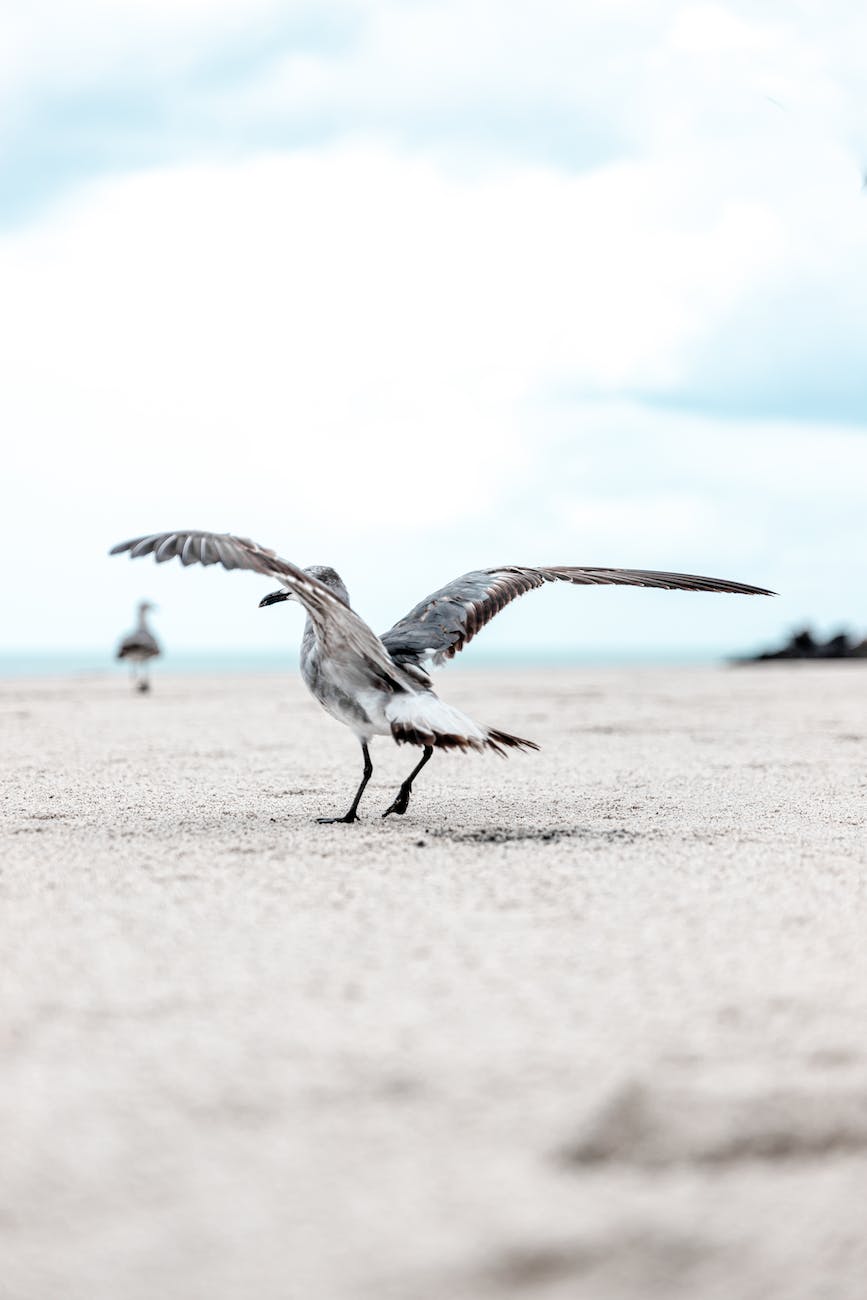
Being playful is something I need to practice. So today, after a stressful week, I decided that nothing bad would happen if I didn’t sweep up the dog hair or clean the gutters, and I took myself to the beach. I read my book. I ate marshmallows and toasted almonds. I swam and waded and people-watched. i watched the clouds and the sea gulls.

Photo by Nick Nu00fau00f1ez on Pexels.com

I have spent so much time over the years doing “the work.” That is, trying to understand and to heal and to grow. I’ve had experiences that seemed like detours or roadblocks, but they were all part of the process, in their own way. But in all that time in my head, thinking and reconsidering and exploring new perspectives, it was easy to overlook the point of being playful. I try to be open to and observant of joy, but I don’t always make opportunities to welcome it, to seek it, grow it. I’ve always had a bit of a Cinderella mentality in that I usually feel like I don’t get to do something enjoyable unless I’ve finished my chores, been productive, done my work. But it is in play, in doing the things we find enjoyable, however silly or small, that we can get in touch with a safe and happy place within ourselves. And when we feel safe and happy, we trust ourselves, we are buoyant, relaxed. There is no anchor of anxiety pulling us down and holding us back, holding us under.

Who would have thought that you would have to practice being playful? Not everyone does, but if you’re learning or re-learning this too, I see you. Have fun! Your very own kind of fun.

Love, Cath

On Lake and Forest Magic, and Self-Reliance

By Catherine DiMercurio

Sometimes, water and woods work magic on your soul.

I planned the vacation I could afford. Camping, no hotel room. Driving far, but not so far that gas prices made it unfeasible. Wonderful family and friends to watch the dogs, so I didn’t have to double the vacation price by paying for dog sitters too. I have traveled alone but this was my first time vacationing alone. I have camped before, but this was the first time I camped alone. I have hiked alone before, but this was the first time I was navigating unfamiliar territory alone. This is all to say that as I headed out for the trip, I had some concerns. My anxiety was stacked up inside me like the clothes in my slightly overpacked duffel.

After a seven-ish-hour drive that included some stretches of blinding rain, I set up camp at a Michigan campground in the Upper Peninsula on Green Bay, where I was about thirty minutes from Wisconsin, in a different time zone, and perfectly situated to watch the sun rise over Lake Michigan. As I set up, not long after a downpour and just before a light sprinkle, I felt deliberate, focused. Later, I would recall what was absent from my mind at the time: reminiscences about past trips, those I had taken with my kids, and before that, those we three had taken with their father, before the divorce.

Those memories did bubble to the surface, but they were more like documentary images and less like melancholy stories. There were certainly moments throughout the trip where I fondly recalled other trips the kids and I had taken, moments where I did miss them. But even these moments were drained of longing and rumination. My brain had begun to work differently than usual. I guess that’s why it’s important to break out of our routines and habits sometimes.

For the first couple of days, I found that relaxing was different when I pursued it and chose it, instead of crashing into at the end of a workday when it feels like I can’t do anything else. I chose activities that I was drawn to in childhood summers—like reading big stacks of library books, and playing solitaire; I chose activities that I knew I liked but associated with a past relationship and that I wanted to reclaim as mine—like doing crossword puzzles; and I chose things that I’ve enjoyed for as long as I can remember—like hanging out at the beach, swimming, looking for rocks, lazing in the sun, and going on rambling woodland hikes. I ate when I was hungry, I slept when I was sleepy.

I was, however, anxious about the longer hike I was planning. Navigating the trails at the campground, despite some confusing signage, was relatively easy, as it was situated between Lake Michigan and M35, the state highway. It was always easy to know where you were in relation to those things. But the state forest campground was different. The Cedar River equestrian campground consists of a handful of rustic sites with paddocks and a small network of trails through the state forest. On the third day of camping, I  followed a dirt road to the gravel lot at the entrance to camp/trail area, and found the parking lot empty. I checked that I had what I needed in my pack and set out, having studied the trail map one more time. There was a gravel road into the campsites, and beyond the camping area, the woodland trails began. It was on that roughly ½-mile stretch that led from the parking lot that I noticed what I thought to be bear scat. I had read a bit about what to do in the event that you see a bear, and I had read that encounters were rare. A little prickle of panic ran through me. I had stuffed my keys, which I carry on a lanyard, into my pack, but at this point I pulled them out to wear around my neck, hoping that the jangling noise would alert the bear, if there was one, that I was around, and keep him or her away from the path.

My noisy rambling did startle some deer, who crossed the path in front of me. It had recently rained and their footprints were everywhere. And some horse poop here and there. The trails didn’t look like they got frequent use, but they had had recent use.

As I came upon each trail marker, I snapped a picture of the marker and took a screenshot of the time. The trail map indicated mileage, so I had a rough estimate of how long it should take me to make it from one point to another, so I figured that would be a useful gauge if I ever started to feel like I had taken the wrong path. This was largely unnecessary, but it was a precaution that comforted me. Unlike some of the well-used nature areas I hike closer to home, these trails were not intersected by numerous side paths that typically make me wonder if I’m on the right one. Nor were the markers so spread out that I ever felt as though I’d taken a wrong turn. In that regard, it was good, confidence-building foray into solo hiking. The only part that gave me pause was when I reached the section of the trail that extended into a large grassy area. The grasses were long and the trail very hard to make out, as they had been mostly grown over. I also didn’t love the idea of traipsing through knee-high grass and possibly having to deal with a crazy tick situation. It was quite warm and sunny that day and the cool shady forest seemed much more appealing than the broad, exposed grassy plain. I turned and backtracked, and tacked on a couple of the interior loops instead.

I was feeling a lot of things at this point, all of them good. The anxiety I’d had about the hike had melted. I felt strong and capable, peaceful and curious. The Cedar River itself was dark and still. The pines and cedars produced such a clean, sweet scent. I could not identify the birds by their calls, but there were plenty of them, some singing and chirping, some squawking. Eventually, as I made my way out of the woods, I once again passed what I was now sure was bear scat. I’d seen enough of the horse poop in the woods to confirm what I’d suspected from the beginning. A few minutes later, I heard a loud crash in the trees. I had seen no other people on the trail or in the camp, and it was not a windy day when a branch might have fallen, and deer don’t make that much noise. I froze and looked carefully around me but did not see any movement in the woods. I remembered reading that if you do encounter a bear, you shouldn’t run, nor should you turn your back on it. All I could really do was pick up my pace and try to make a lot of noise as I headed out of there.

At the car, I kept an eye on the woods and changed out of my hiking boots into a pair of comfortable sandals. The black flies had come out so I didn’t linger long at the car. As I drove away, I had the sensation of something heavy inching itself off of my chest and slinking away. Something heavy that had been there for a long, long time. Deep breaths felt different. More expansive. Sweeter, as if I was still inhaling what the trees had exhaled. I know that compared to what a lot of people do, this six-mile hike alone in the woods was no big thing. But for me, it was about facing a collection of fears, and I had done it successfully. I felt at once elated and grounded. It is a feeling that I’ve had in the past, but only with other people, typically with men I’d once been in love with, when I experienced a feeling both of being safe and exhilarated. Being able to cultivate this feeling on my own, to give this gift to myself, was significant, and I couldn’t remember the last time I’d felt that way by myself. The whole trip made me feel this way, but it ignited on this hike.

We all experience challenges in our lives differently, so I’m not sure how relatable this experience might be. But because of some of the events of my past, I have over the years developed such self-doubt and self-criticism that life has been very confusing and painful at times, both in relationships and out of them. I’ve worked so hard to dissect it all. To understand all the reasons this came to be, and to try and untangle these knots. To have this experience of feeling safe within my own skin, comfortable and pleased with myself, happy, eager, curious, and calm in my headspace, my heart . . . I wasn’t sure if it was possible for me. Long ago, I read Emerson’s Self-Reliance, in which he says, “Trust thyself: every heart vibrates to that iron string.” Is this what it felt like? How long had it been since I’ve had this feeling? I couldn’t remember. This wasn’t just about trusting your gut, this was about trusting who you are.

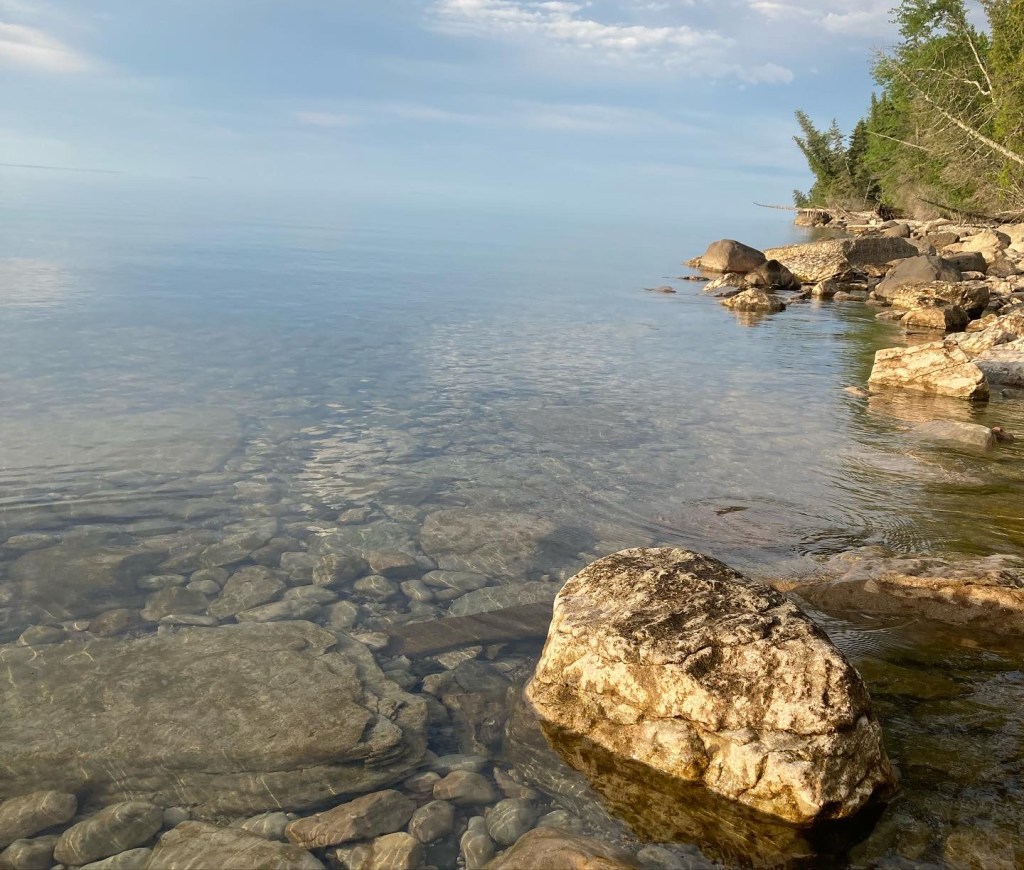
And as the trip continued, my brain continued to empty itself of anxiety. It pulled away from me the way the waves crashing against the rocks near my campsite were pulled back into the lake. At the beach, the water was clear and cold, and I had the sensation of it taking something from me that I didn’t need or want anymore. The lake was big enough to hold it without hurting anyone, this prickly darkness I’ve carried. I felt both the warm water near the surface and the colder, deeper water that came from far away.

I’m not a great swimmer and deep water is at once fascinating and scary. I like to be near it but not too immersed in it. At this beach, and all public beaches on Lake Michigan, and the other Great Lakes as well, there are signs about dangerous currents. This beach had a flag system so that the safety, or lack thereof, could be communicated to potential swimmers by someone reading the conditions. There was another sign about the fatalities that had occurred. In short, I did not take the risks lightly. Maybe it was for these reasons, though we only had green flag days, that the beach was often deserted. Maybe it was because the temperatures were a little cooler than most people like for beach days. But I reveled in the lake, grateful the waves were calm enough that the beach remained open. I would hike a mile and half from my rustic tent site, past the modern campground, to the swimming beach most days of the trip, and hang out for hours, reading my library books, doing crossword puzzles, and jumping into the water whenever the sun warmed me too much.

The lake is magic. I felt like a creature with dormant or depleted powers who was close enough to the source to have them rejuvenate. I know that sounds crazy and I’ve been reading too many books about witches and fables. But I haven’t felt that myself in so, so long. When I took pictures of myself, I could see it in my face, the recognition, as if I had returned after a long, blurry journey. It was as if I’d happened upon an old, familiar friend I hadn’t seen in a while.

I don’t recall if I’ve ever spent a birthday alone before, but I turned 52 on a sunny Sunday morning sitting on a rock, gazing at the lake, and enjoying the sun. I felt good. I made decadent birthday pancakes for lunch, after spending the morning at the beach. I chocked them full of chocolate chunks, leftover from chocolate bars I hadn’t used for s’mores. I topped them with vegan butter and maple syrup and cherry jam.

This trip was a meditation, in a way, or, how I imagine mediation should be. I want to say it was effortless, and it was, after a few days. But at first, I had to work at it, just like when I sit down on my yoga mat and try to let my thoughts drift by, acknowledging them but not attending to them. Most of the time it feels so effortful, and often ineffective. I had to keep asking myself what I wanted to do next, keep checking in. A hike? Sit by the water? Read? Eat? As the week progressed, I soon found myself moving toward one activity or another, or no activity, and having fewer conscious thoughts about what I was going to do. I found my rhythm. Things felt natural. Familiar.

So much has changed in my life since my divorce, has kept changing. I’ve had major shifts and false starts, and trying over, and over. And so often, in the course of adapting and readapting, my circumstances felt so unfamiliar, and I felt so unfamiliar. I’d remain in relationships flawed in all the wrong ways for far too long, hoping that at some point we’d arrive at the place where it felt familiar. Safe. I kept looking for myself in the face of other people.

I’ve learned that that which is familiar is not always healthy or safe. I also realize now how vital it is to continue this journey toward feeling familiar and safe to myself. To be the source of that. I’ve always tried to provide that in relationships and always expected it in return, never realizing the impact its absence was having within me. I don’t know if I’m there, because everything shifts and changes so rapidly, and progress gets eroded. But I feel as though I’m closer than I have been in a long, long time.

Love, Cath

On Weeds and Water and Honeycomb Hearts

By Catherine DiMercurio

When I started this blog, I described it this way: “This is the chronicle of a journey many of us find ourselves on — the search for meaning in all the things that break our hearts and all the things that make them whole again.”

All my life, I’ve had this sense that searching for meaning and purpose was something I needed to do. Something I did do, whether or not I wanted to. It just happened. Just like some brains are intrinsically focused on the mechanics of how things work, mine is and was focused on what things mean. Not just what do they mean for me, but what do they mean cosmically. As in, why is the world this way instead of that way, or what does this particular detail mean within the larger context of the world, the universe.

The grasping toward our understanding of our place in the universe necessarily encompasses a grasping toward an understanding of the universe itself. I am ill-equipped to do this, save for a couple of philosophy courses in college.

Helpfully (?), the world we have built as humans is focused on goals and milestones, so that my perpetual and at times frantic efforts to understand the cosmos were redirected toward practical things like education, marriage, parenthood. I poured my search for larger meaning into finding granular meaning in my choices and pursuits. When I became a mother, though, I felt as though these two separate, higher- and lower-level searches had merged. Everything clicked, in a way. I felt cosmically connected to these two souls, and also, in a very real way, I was responsible for their physical, emotional, mental, and spiritual well-being. Motherhood was rarely easy, and I remember being surprised and disappointed that it didn’t come more naturally to me. I thought I would understand intrinsically how to soothe a crying baby, or make peace with a frustrated toddler, or advise an angsty teen. But the work, as challenging as it was, felt hugely important. I never regarded the children themselves as mine but they were in my care; the work was mine; the honor of raising them was mine.

I was writing too, during these years, and got a novel published when the kids were six and four. I felt like this was it. Life was what it was supposed to be. I was doing it: pursuing a meaningful creative/professional goal and being a good mom and a good wife.

Later, after I became a single mom, the way I parented changed, but what hadn’t changed was that the kids were my number one focus. They were fourteen and twelve at the time of the divorce. There was a lot of parenting left to do. But last summer was the last time the last child lived at home. The day he left, my frantic search for meaning ignited again. It just happened. I knew that I was still needed by and connected to my kids as their mother, but everything was different now. And we all knew it.

I’ve spent the past year trying to better understand who I am now, and who I was, and who I want to be. I’ve tried to fashion that into my purpose. I’ve focused on my writing, I’ve focused on dog training, I’ve focused on learning a new skill/art with my pottery. All of these are good things, and I’ve grown and I will continue to pursue them.

But at the same time, all these things feel more like places to channel my energy but less like the sense of purpose I possessed when mothering was a daily activity.  

I am trying to be patient with myself.

I know that now that the twenty years of nitty gritty parenting are over, I tend to suffuse that time with a certain glow. Still, I haven’t forgotten all the difficult parts: when I felt like a horrible mother and that I was ruining everything for everyone; when I just wanted to leave for a little while because it was too hard and I never got a chance to even finish a thought or have three seconds to breathe alone; days when I was quite certain that one or both of the kids hated me and always would; times when I didn’t know how any of us would ever feel healed and whole again, and the terrifying realization that we could all drown if I could not figure out how to inflate the raft with my exhausted, heart-broken breaths. No one has forgotten how hard it was.

But still, looking back, I see how the sense of deep purpose I always felt—that strange, alchemical comingling of love and purpose, duty and wonder—helped get us through. I say helped because I did not do it alone. I had friends and family I began to learn to lean on. And my kids are stronger and more resilient than I’ll ever be. I’m proud of them and all the work that they’ve done. And I’m proud of myself, and as a person who has struggled with self-confidence and self-trust, that is a huge thing for me to believe, to voice.

And now in this moment, there is a freedom here, and it is taking up a larger space than I expected it to. It isn’t just about time, as in, now I have more time for writing, or for exploring new things. It’s different, multi-dimensional, so unfamiliar and so full of something, power? that I feel uneasy stepping into it. Within, I imagine, is all the me-ness that there wasn’t much time or energy for before.

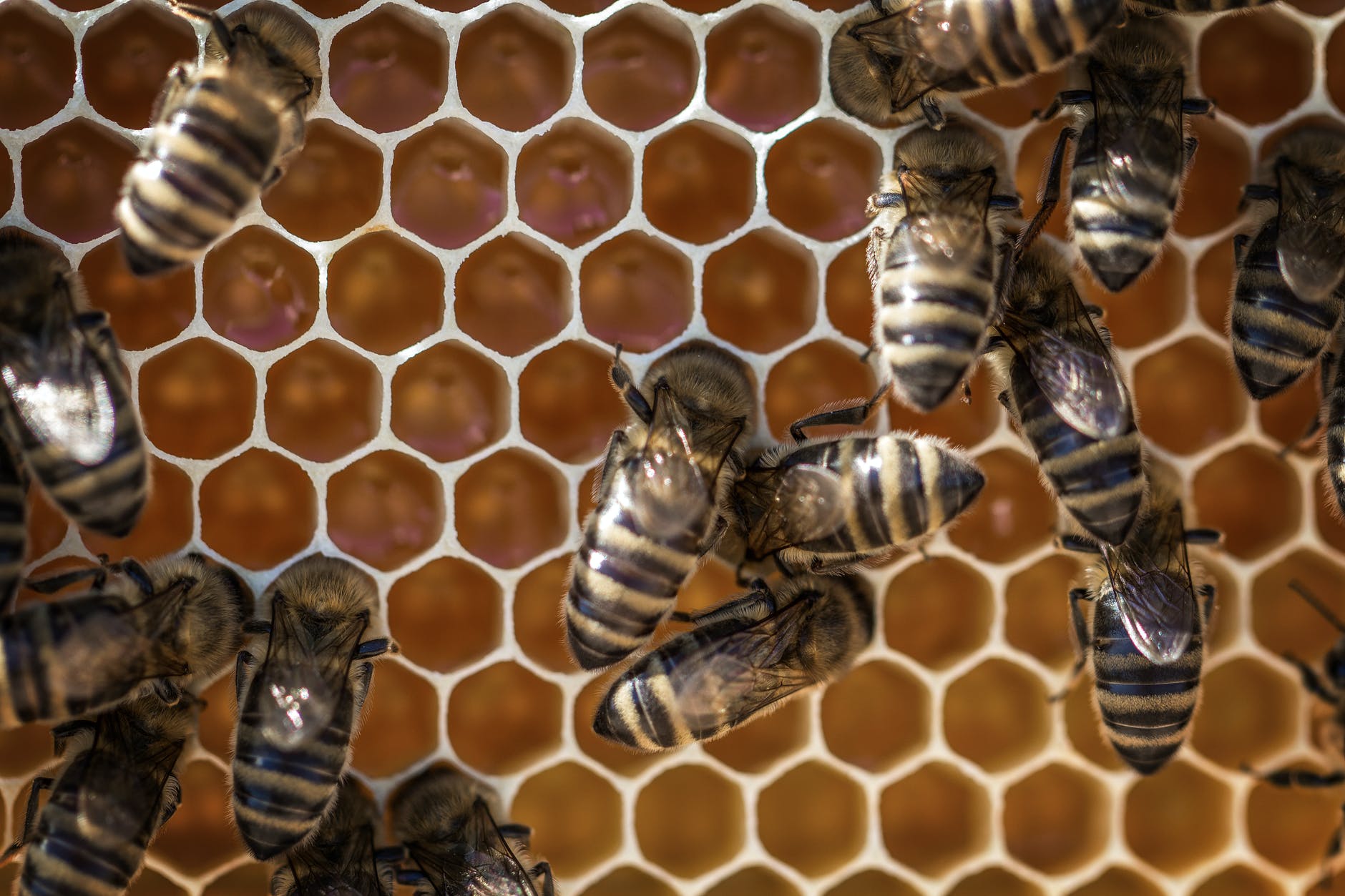
I’ve been trying to think of the best way to describe this new sensation, this freedom that seems to be taking up more space than I thought was available. The way large, leafy weeds don’t just take up the space allowed by the crack in the driveway pavement, they expand the space. But it feels more like my heart is a honeycomb that keeps being added on to by something busy inside me, and the result is I keep recognizing myself in different places. Do you ever have that feeling where you look at a photo of yourself and it doesn’t look like all the other curated images you or someone else has taken? You look at it and think there I am. Or, do you ever that moment, upon arriving at a location where something clicks into place, and you are suddenly relaxed and energized all at once, and you think this. I needed this. For me that photo was the one I took of myself at the pottery studio. And that place is usually by large body of water.

Photo by David Hablu00fctzel on Pexels.com

Lately I’m experiencing all of that, more and more. It feels akin to the existential wandering my soul did when I was a child. I have a very distinct memory (which I’ve written about, here) of trying to understand my self-ness within this existence, as if part of me could comprehend I was something larger and freer than what my current body was containing, and I wanted to have both, the knowledge of who I was in this time and place, and the knowledge of the larger self that was struggling to understand its physical containment in this vessel, this me. It’s like that now. It’s like I’m close to getting it. I am trying to relax and let it all align.

I used to think that maybe I had to let go of one thing—a past version of myself—before I could step into the next iteration. But maybe that’s not the case. Maybe we get closer and closer to being able to hold all the versions of ourselves in place at a time. Maybe we are the honeycombs, and the bees, and the honey all at once.

Love, Cath

On Elemental Lessons, Love, and Good-Messy

By Catherine DiMercurio

Sometimes the most basic lessons are the hardest to learn.

Sometimes I think the best in the shower. In my soul, I’m a water person, though this body can’t swim very well. But whenever I’m around water, I’m calmer. Recently, in the shower, it occurred to me that it is almost the one-year anniversary of the ending of a relationship. It was a relationship that was hard to let go of, in spite of the fact that it needed to end, and I got to thinking that I seem to have more anniversaries of things that ended than things that began. Not long ago, that thought would have sunk me, at least for a few days. I would have ruminated, and found ways to feel increasingly worse about myself. But standing there in the water, after a year of becoming more in tune with myself, my next thought was this (and yes, I do address myself in the second person sometimes): Wait. Are you really saying that you think you have more to mourn than to celebrate?

My immediate answer to myself was no, but part of me still wanted to tally, to dig into hurt and remember it. We get used to making ourselves feel terrible sometimes. For a lot of reasons. But I have spent the last year looking at those reasons, my past, my deeper past, and learning. And in this moment, I understood that it is natural for me to have a lot of emotions around this time of year about the ending of that relationship, and that having those feelings did not have to translate into a trip down the rabbit hole. That’s progress.

Some of that progress can be attributed to the pottery studio. I feel as though I’ve been on an incredible journey when I think of the first several classes back in January. I pushed myself way out of my comfort zone, not only in trying something new, but in hauling myself out of my cozy house in deep dark winter for a 7 to 10 p.m. class with strangers. I am definitely a morning person, so I knew one of my obstacles was going to be my own fatigue at this point in the day. Optimal learning and creative time for me happens much earlier in the day. And there were a lot of other obstacles, one being that physically, I am not very coordinated, and hand-eye coordination is pretty important when you are wheel-throwing.

I was not prepared for how challenging the experience would be, for how frustrated I would feel. I have no poker face, and even when I’m trying to have a neutral outward demeanor, it is plain for the world to see when I am struggling. Though the class was different from any that I’d ever taken, my brain slipped into student-mode where the usual process was: work hard, study, succeed. In the past, doing well in school meant that the people around me were happy (teachers, parents), and it allowed me the opportunity to excel at something, since it wasn’t going to be in the realm of sports, or anything social.

But, I struggled. Class after class, I felt clumsy and awkward and self-conscious. I had almost no control over what the clay was doing and trying to understand the relationship between the movement of the wheel and how my hands were interacting with the clay seemed like a mystery that I couldn’t unravel. There were too many factors—the wheel speed, the moisture level of the clay, the pressure, placement, and movement of each and every finger on both hands, my posture. I was certain the other new people were already better than me. I thought about quitting. A lot. I even bought a cheap-ish pottery wheel so I could practice at home. It is easier to fail without anyone watching. I wanted only to get a little better between classes so when I sat down in the studio it would be evident that I was making progress. I wanted so badly to be perceived as someone who worked hard, and if my work did not show evidence of that, how would anyone know?

And I did make progress, in my own epically slow way. But I was doing so out of some sort of ancient ache to prove myself, to insist on some kind of worthiness I wanted others to recognize in me even when I routinely overlooked it in myself. Part of my pottery journey has been to trace this powerful need, which has shaped (malformed) so many relationships, back to its roots. This work is not done, as the work of truly understanding ourselves and making peace with it all never is.

Even though I felt like I wasn’t progressing fast enough, my instructor was so good at underscoring how difficult it is to learn any new art form. I remember getting frustrated at the wheel, trying to accomplish something that wasn’t working out. I had a poorly centered lump of clay in front of me that I’d been able to open up enough to begin to pull up the walls. She was standing near, talking me through it, and I said something like, “I just can’t. . . .” I was unable to finish the sentence, because I felt like none of it was working. I couldn’t do any of it. And she replied, “And it’s what? Your third class?” She taught me to embrace wherever it was that I was in this journey. If something turned out wonky, and I could get it off the wheel, I could still practice trimming and glazing. It was all part of the process.

Photo by Regiane Tosatti on Pexels.com

That was kind of a turning point for me. After that, some fresh ideas began to make themselves known in my brain. Couldn’t I just learn and play and grow? Trying to force progress wasn’t working. And feeling tense internally was something that found its way into the clay. Everything was going to happen on my own timeline. And there was no grade. There was no metric by which to measure failure or success, only those that I imposed upon myself. Doors and windows flew open inside me. Soon, I began to feel energized and creative and good-messy, and suddenly, when I thought of all there was to learn, I saw the future blossoming in front of me, whereas only weeks before, when I thought of how much I didn’t know, I’d felt overwhelmed.

The whole experience thus far has reshaped the way I look at myself. It is shocking to me that learning how to throw and work with clay is revealing so much that has nothing to do with clay. I think because I was already doing some of this work, the experience simply shoved open doors whose locks I’d spent some time jimmying open.

To some friends and family, I’ve tentatively equated my evolving feelings about pottery to falling in love. I say tentatively because it seems a strange thing to admit. But what I’m beginning to comprehend is that what is happening is that I’m falling in love with myself. Sometimes it takes us so, so long to learn elemental lessons. And sometimes it takes the elements—earth, water, air, fire—to teach us.

Love, Cath

On Seedlings, Rip Currents, and New Things

By Catherine DiMercurio

Solitude is one of those gifts that doesn’t always feel like one. There is much delight in self-discovery, but the responsibility to make the most of this time can be troubling. Yet in the absence of other humans to react to and with on a daily basis there is a freedom to observe ourselves, to re-learn what makes us tick.

For me, this prolonged period of solitude has provided the opportunity to ask questions. What does being me look like when I am not in the mode of daily parenting or in a state of being partnered? In a way, being in solitude is like being the control group in an experiment about my own identity.

Here, I have the time and space to observe what affects my mood, my sense of well-being. What stressors alter the course of my day, how do I respond to them? How did I respond differently when I lived with my children, when I was with a partner? What do I like about the way that I live and think and feel, and what would I like to improve?

Here is something I’m learning about growth. Imagine one of those old, time-lapsed photography videos of a germinating seedling, the way it pushes through the dirt up to the warm sunlight and begins to unfurl. I wish my growth was like that, unconscious and inevitable, rooted in the instinct to move toward the light. When a human chooses to pursue growth—emotional, psychological, relational, etc.—they bump up against obstacles that can feel more troublesome than the soil a seedling faces. We must move through them somehow to get to where we want to go. It is not an instinctual movement with a clear direction. For many, growth requires confronting fears, and most fears stem from old wounds, from past relationships that reach all the way back through our childhoods. Our growth often requires that we dig down before we can inch up.

Photo by Gelgas Airlangga on Pexels.com

One of the things I have learned about myself is about the way I pursue things, or avoid pursuing them. Sometimes I can’t sink my teeth into something that intimidates me until I have run out of all the excuses to avoid trying. Sometimes I can’t truly let go of someone—even after the relationship has ended—until I have exhausted myself trying to figure out why it didn’t work. Things take as long as they take. Especially because we have to live life at the same time we are doing this work.

We owe ourselves these searches, these explorations of wounds to be done grieving, of lessons to be learned. But it’s hard and we need to take breaks. And the work does not have an exclusive claim to our time. We have other things to do. I have a full-time job, writing goals, hobbies, dogs who are strangely like best friends half the time, and mysterious toddler-like creatures with a never-ending set of demands the other half.

Some people seem better equipped to live in the moment. I feel as though I’m almost ready for whatever moment I find myself in, I just have to think about a few more things first.

In having all this time to myself, I decided it was time to learn something new. I had two aims in mind: learn the new thing, and, to learn something about myself in the process. One of the reasons I wanted to learn the new thing is that I have begun to understand the extent to which I have lost myself in past relationships. So, I am exploring the lost self, the remaining self. Further, I have a duty to undertake this exploration openly and honestly, to side-step self-criticism, and to nurture myself through this process with as much care as I would treat anyone who is going through transition or transformation.

The new thing, if you’ve read any of my recent blog posts, is pottery. It is an artform rich in metaphor. It is an artform where proficiency is elusive. Developing even rudimentary skills is challenging, more so than I ever imagined. Instead of being able to feel relaxed, or excited, or joyful, or curious about learning this new thing, I have found with dismay that I’m often frustrated or anxious. It is a disappointing reaction. I try not to be disappointed. I try to dig. Anxiety tries to point us in certain directions. Just like pain is our body’s way of telling us something is wrong, our anxiety is a way of our brain telling us that something is off. Certainly, there is nothing much actually dangerous about pottery, so why was I reacting this way, with so much worry? Was it more than just wanting to do well and struggling to get there?

I was about to head to the pottery studio and my anxiety was jangling so loudly it felt like I could hear my teeth rattle. Instead of ignoring it, or trying to distract myself, or telling myself to knock it off, I decided to talk myself through it. I asked myself a series of questions that kept whittling down the issue to a couple of difficult past experiences (long past!) and the years of emotional residue they left. I let myself experience the emotions those memories brought with them.

Sometimes anxiety makes us feel as we are in current danger even though our brains are remembering something else. So, this time, I tried to be aware of what was remembered, and feel it, and understand it, and forgive myself and the people around me. Miraculously, the anxiety that had gripped me so tightly evaporated. I didn’t realize it at first. I just found myself packing my tools, and I sensed that I felt better, calmer. I went in and spent three hours making a lot of mistakes on the wheel and when I was finished, I didn’t feel terrible about the mistakes as I had done in the past. I thought, this is great; my hands are getting used to how the clay feels, how it behaves. I was able to enjoy the process of failure.

If you’ve ever swum in Lake Michigan you may have seen the signs posted about dangerous rip currents, and how they pull unsuspecting swimmers away from the shore. The signs instruct you, should you get caught in a rip current, to swim parallel to the beach, so that you can get out of the rip current, before heading back to shore. Though I have never experienced a rip current, this is what anxiety sometimes feels like. There is no current (immediate) danger, but there is current danger (danger of getting pulled under and away by the current). The moment when I started asking myself questions about the anxiety that I felt was key. I took it seriously and didn’t panic. I realized that while I was not in imminent danger physically, I was in danger of the anxiety taking over, pushing me under. My questions allowed me the opportunity to swim parallel to the shore. Arriving at the studio in a calm state was much better than having to fight the jangling the whole time.  

While pottery is the new thing I am using to try and learn about myself as I learn about the art itself, life is going to give us all other new things. I think it is important to try and understand ourselves so that when things come our way, we know what to do with them, how to handle them, what holds us back, what pushes us under, what moves us forward.

I have a Post-it note stuck to my computer monitor. It reads: curiosity. I’m trying to let that guide me. To be curious rather than skeptical about new things and to wander through this part of my life with the open-heartedness with which I started the blog in the first place. Happy wandering! May your next new thing be good to you.

Love, Cath