Coyotes and Sketches and Dreamy Trees

By Catherine DiMercurio

I have today off, and during my dog walk, I had a strange experience that led to a series of strange thoughts, which I sketched out with the pencil of words as quickly as I could when I returned home. It felt the same as waking up in the middle of the night to write down a dream because it seems so full of meaning and you do not want to forget. Maybe it will make sense later and maybe it won’t, but it feels important to try.

This morning, I walked the dog a little later than usual, because I had that luxury today, the luxury of time, and no set schedule. It was sunny, but cold, about 22 degrees. My dog is reactive, a label that I really didn’t know too much about before I adopted him. There is a lot I could write, and have written, about my pup and how he responds to the world, but for now, it’s easier to just say that we try to avoid seeing other dogs while we’re out. A barking dog behind a fence or another dog on a walk can make him jumpy. He pulls, sometimes barks, and it can be difficult to move him past the situation. If another dog is walking on a leash away from us, and we do not follow him, he is actually calm enough to be still and observe, and this is progress, so I reward him with treats. This morning had been rather peaceful, despite the fact that a fenced boxer barked—loudly, and long after we’d past. But my dog calmed himself with some eager sniffing of the path ahead, and I meandered a bit before turning us toward home.

And then we saw a coyote.

The coyote was running in that distinctive loping way down the street that we were headed toward. We were about to turn in the direction the coyote was coming from. We stopped, my dog and I, and both instinctively froze. The coyote turned away from us, probably didn’t even see us, and headed toward the golf course, and the woods near it.

More than anything, I was relieved that my dog had the good sense not to bark or draw attention to us in any way. I didn’t know what to expect, had the coyote turned toward us. Maybe the animal was young and had belated realized he or she was out past dark. It was 9:20 a.m. Maybe they were just heading home, same as us.

It was an unprecedented treat for me to watch this beautiful animal running in front of us. Small, grayish brown, casually quick, hurrying but not sprinting through the morning sunshine.
As much as my brain then turned toward getting home as quickly as possible—I was a little spooked, and so was my dog—part of me turned immediately toward meaning-making, as it usually does when something unexpected like this happens.

I began following two trains of thought simultaneously—one focused on the way happiness is not so much fleeting (as in, quickly disappearing) but fleet of foot (as in, quick and decisive), and one focused on the way so many of us are always on the lookout for signs from the universe.

It is hard to not see an unexpected visitor from the wild natural world, loping through the domesticity of the suburban street, as a nudge. Pay attention, the universe seems to be saying. I feel as though I am always wondering if I’m on the right track, so when something larger than normal unfolds in front of me involving an ambassador from the natural world, I feel as though the universe is reassuring me. This is your sign that you’re on the right track. But what I’ve been wondering lately is that when we are looking for signs from the universe, is it more accurate to say that what we’re looking for is a sign from ourselves? And wouldn’t it be true to say that’s the same thing anyway? Are we not brimming with the universe and does it not expand within us when we make room? Maybe it is guiding us from an internal rather than external vantage point and maybe those are designations that are meaningless to the universe.

With regard to happiness: how like this coyote is happiness and the way it moves through our lives and hearts, deliberately, softly. I want to say swiftly but then I think that the coyote seemed swift to me, but from the coyote’s perspective, how swiftly was it really moving? Isn’t that the same with happiness? The speed is relative. We have an experience and we feel happy and then it is over and the happiness might linger but soon we don’t feel happy anymore and our instinct is to chase it and get it back. But in the now-timeline of the happiness, it is expanding in all its fullness and etching itself in our memory and while we have a sense of it being over quickly, in so many ways it is still expanding within us, but when we feel the now-ness of it dissipated, we imagine that it has darted off, that it is gone. And I’m here to speculate that maybe this is the wrong way to look at it. Maybe it doesn’t leave us as quickly as we think, and maybe we don’t need to chase it. Maybe it isn’t ours to get, it’s just ours to have for a little while, without acquiring. We are just stewards of it for a time, and we must make an environment hospitable for it.

My instinct is to dissect it all, pin it down, put it under a microscope, but instead what I’m trying to do here and in my own thoughts is to let these ideas move through me, and settle where they will, if they will, and enjoy the moments where I’ve been able to marvel at happiness loping through me and the universe stretching out and getting comfortable in the den of my mind. I worry that if I think about it too much and use language less ephemeral than metaphor it will slip through my fingers, through the bright but hazy instinctual way of understanding.

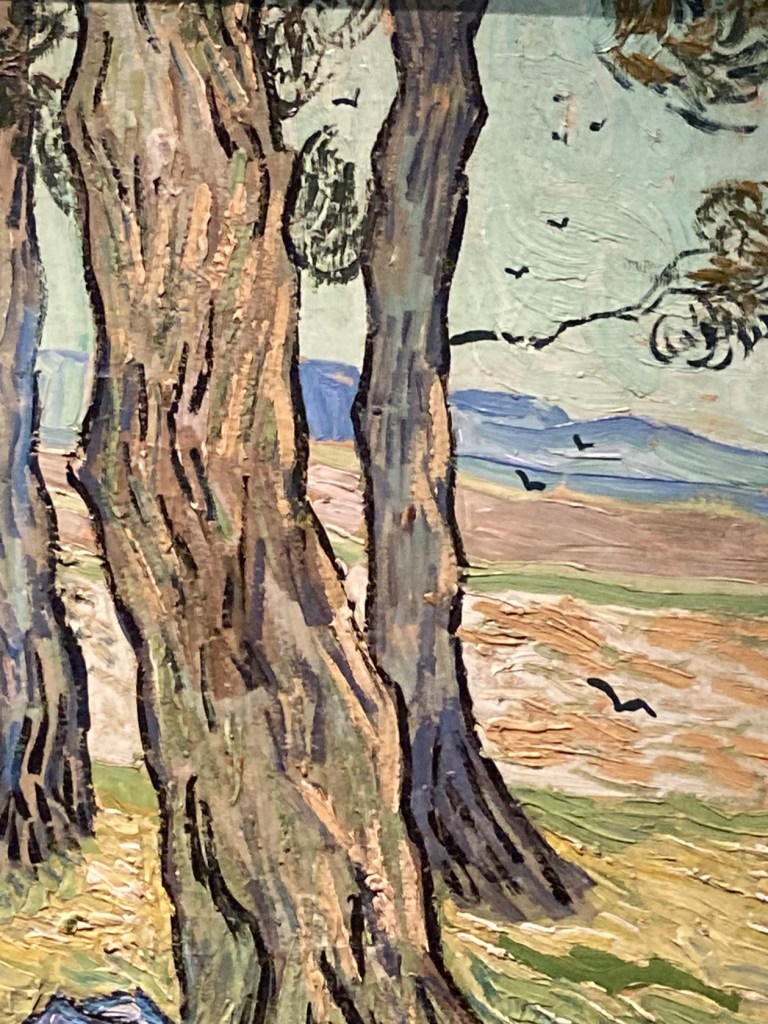
At the DIA this weekend with my honey I stared at the trees in Van Gogh’s The Diggers. What I love about those trees is that they both look like trees and they also look the way trees might look in a dream. Likewise this coyote was at once a now-coyote and something from a dream, constructed out of lines that hummed with color and life and meaning that you grasp only by not trying too hard to see it or hold it. It was something to wonder at.

What if our grandest purpose is simply to find ways to see and feel differently, dreamily, to lean into metaphor and let it shape us. In that way, do we become a part of something larger than ourselves? If we experience the universe in this way, can we understand our world, and our place in it better? And make it a better place? Imagine what it would be like if more people cultivated a sense of wonder instead of war, built a habitat for happiness in their hearts, so it had a home when it visited.

I hope something magical happens to you today, or soon, and you can feel, at least for a moment, the universe expanding within you.

Love, Cath
On Joyful Moments, Good Light, and All Our Selves

By Catherine DiMercurio

Sometimes I reflect on how this blog began, and the name of it. My dog had just died and I was about a year and a half into a new relationship. I was feeling broken hearted and open hearted at the same time. The relationship ended several months later. I took a few months off from dating, then hopped back into something new, which also lasted about two years. Now, that relationship is two years behind me. I didn’t hop back into anything, and another of my sweet pups has passed.

Since that death there have been times over the past two months when it has felt as if things are slowly sliding down a muddy slope. I have struggled to get my footing and little and big things seem to be going wrong. I look everywhere for signs, for tiny joyful things, so I may imprint those things on my heart in an effort stop the mudslide, give me something to hold on to. I know from experience that it is an effective practice, but like everything good for you, it takes consistency and hard work to keep looking. And the more things that go wrong, and the bigger the things, the harder it is to see anything else, harder to feel open hearted in a world full of sharpness.

One of the good things about me is that I like routines. I’m trying to make sure I’m moving more and I bought a pedometer to better monitor myself. Sitting at a desk for 40 hours a week not only has its own detrimental effects but has dulled my ability to gauge how much or little I’m actually moving. Now, my habit is to walk the dog in the morning, take a few breaks to get some steps around the house throughout the workday, then walk again, solo, in the late afternoon or evening. I feel so much better when I do this.

But being a lover of routines has a downside too. It can be hard to try new things. There are a million reasons why I adore the safety and predictability of routines, but basically it’s a combination of how I’ve always been, and what I prefer in the aftermath of some of the roller coaster relationships I’ve been in. Routines keep me writing every morning, keep me and my dog healthy. But breaking them to try other things can be a challenge. Though, trying the New, Big Thing of pottery a year and a half ago was my proof to myself that I can change up the routine and it can be really good for me. And it still feels like a New Big Thing, even though it has been incorporated into my routines.

Routines can also lead us to so many happy moments. My writing practice never fails to ground me, to keep me connected to my self, and to big ideas I want to explore. The quest for little happy moments was most recently undertaken in the aftermath of a storm that resulted in some expensive roof damage. I had been feeling particularly low. But on a routine walk with my puppy Zero, we were led to a beautiful toad. The toad moved in such a lopsided fashion, a half slide, half hop into the grass at our approach that at first I thought it was a wounded bird or something. A good portion of my joy at discovering the toad was seeing that it was an alive-and-well someone instead of a wounded someone.

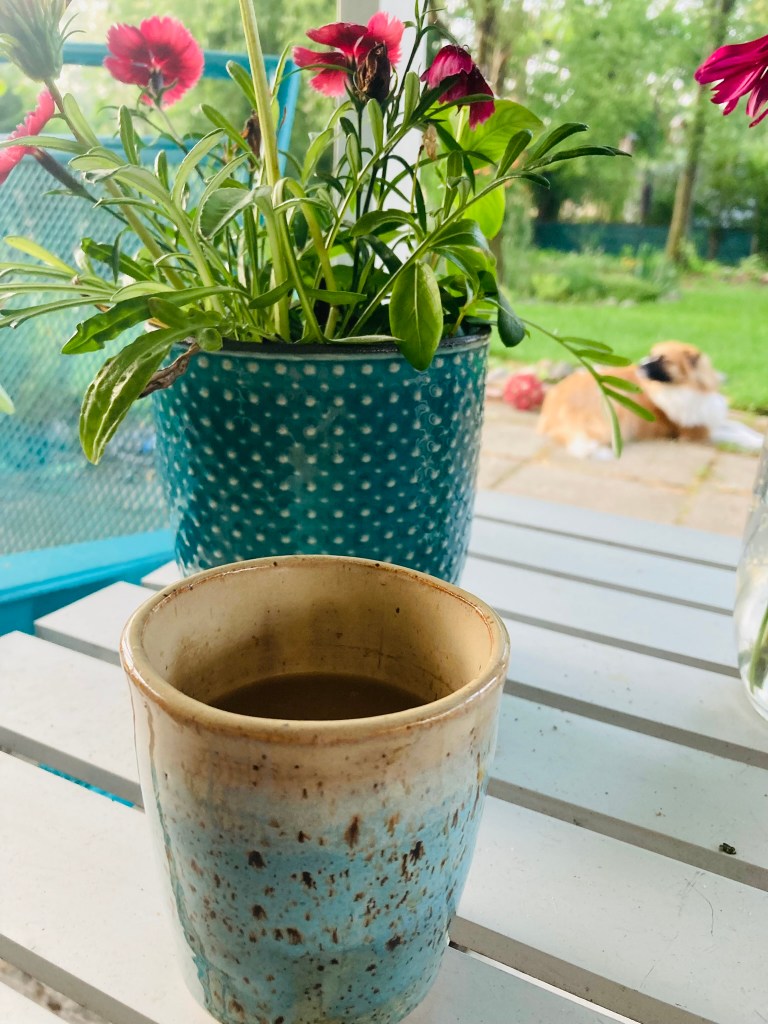
Other little happy moments that happened recently also occurred as my morning routine unfolded. I typically begin the day with a cup of coffee on the patio when I let Zero out. Yesterday, I was drinking coffee from a mug I threw and trimmed and glazed myself. The coffee contained a drizzle of cardamom simple syrup, as I’m obsessed with cardamom these days. I was surrounded by flowers, including a pretty pot of them given to me by a good friend. It was one of those moments, one I wanted to capture and imprint upon my memory for when times are tough, so that I could draw it like a card from a deck and say See? You felt good and happy and peaceful that morning. This morning too, as I stood on the patio looking out into a pale and hazy morning sky, I was surprised to see an enormous waning gibbous moon. I once wrote about that particular moon phase being my favorite, and it was a delight to see it there, perched and oddly bright in the morning sky. It was such a strange, good light, and I’m glad I took the time to bask in it.

I feel like our brains are constantly shuffling the deck of memories. A song will retrieve a memory so long ago and so good that it bruises you to remember how lost and faraway it is. A smell will bring forth another memory of a kitchen full of people you love, and you will smile. The tough memories get added on their own without any effort. I’ve read that our brains imprint—sear?—bad experiences into our memories as a protective mechanism, but good memories are not written in the same fashion. Though, what greater protection from bad memories is there than good ones? It’s a strange way for our brains to work, but if we want to make protective charms of the good memories, we have to do that work ourselves.

One of the beautiful parts about these little happy moments that we’re trying to imprint upon our brain as memory is that there is a lovely now-ness to them. Somehow noting them as they are happening opens up a pocket of time-space and lets the moment exist for longer than normal. Such moments are as much about future enjoyment of the past as they are about the present. Isn’t it amazing how they can exist and extend in all those different directions?

Still, when things are bad, at least for me, my tendency is to resist seeing things, anything, in a good light. I have to heavily lean into the part of myself that knows what to do, to trust her to pull us out. To take us for a walk, to reach out to a friend, whatever it takes. When I feel clearer-headed, I can see that the part of me that knows what to do knows because she fought for this knowledge. She worked like hell to build the scaffolding for us, to make sure we always had a way out. She helped get us out of bad situations and the unhealthy mindsets that went along with them. When things start to get bad, my thoughts become a mantra of “I don’t know what to do.” But, we have always figured it out. I hope, as I’m building this muscle memory, I can catch myself sooner and sooner each time and remember to trust and work with myself instead of against, to have all the disparate parts of myself pulling together and being a team. One part of my brain looks for the good, joyful moments, another does the research and finds the answers, another knows when we need to get out of the house or talk to a friend. And they all comfort the scared part that is worried about all the bad things that could happen.

Sometimes I wonder what it’s like to have a brain that operates as a singular unit, not a crowd of selves constantly in dialogue. But this is the brain I’ve got so we’re going to keep learning, keep talking, and keep growing. I’m off to jump into my next routine of the day. I hope you have a good one, full of happy, collected moments and good light.

Love, Cath

On Donkey Tails and Butterflies, or, an Alternate Theory of Happiness

By Catherine DiMercurio

When I was much younger, I used to think of happiness as something fixed, the donkey’s tail reunited with its waiting body at a child’s party. Life was the twirled and blindfolded eight-year-old, and when they pinned the tail, whether it found its way to the donkey’s nose or flank, it stuck. I used to think that it would stay stuck. I counted on it, as one does when one is young.

Still, even when it didn’t stay stuck, I assumed that there was always another chance, another spun partygoer who would make an attempt to once again affix happiness to my waiting existence, and it often worked this way. I felt lucky. And patient. I could wait it out. Wait for the next chance, and then prance ecstatically once again, when that magic reunion happened.

What I didn’t count on were the people in my life who were less optimistic about the return of happiness to our waiting bodies. They seemed to assume that once it had fallen away, that was it, game over. What they never understood was that the odds were in our favor. It would return, it always did if you believed it would. What I had to learn was that while there was chance involved, and luck, and optimism, you also had to make yourself an easy target. You have to watch the way everything is spinning and try and get out in front of it. Be hopeful and easy and trusting that it is on its way back around.

I lived that way for a long time, trusting and certain that happiness would make its way back to me. Sometimes it was just so easy, how could I not believe that? But when the person you’re with has a different philosophy, as a pair, the two of you become a less likely target. And then, when you’re no longer a pair, you find that you’ve begun to doubt your own beliefs. Life becomes less like a dizzy, capricious child at a party. Happiness is bestowed less easily and frequently. It becomes something you pursue instead, a quarry that seems to prefer remaining hidden, and life provides countless obstacles that make the hunt even more challenging.

Everyone is always trying to figure out how to find happiness, how to keep it, how to be it. But I remember that I once simply cultivated peace and contentment, and I enjoyed happiness when it found me. But I didn’t expect to permanently live in a state of it. I made myself an easy target for it. I practiced the good habits that made me feel healthy and whole, and when happiness found me, I was there for it. Ready to soak it up. There is a way to bask without grasping for it, without trying to bottle it up like so many fireflies.

I feel as though I have forgotten some of my former way of being, my pin-the-happiness-on-the-human philosophy. With the ebb and flow of life, with the stress, and the changes and the losses life throws our way, it seems sometimes that we are made of steel, that there is no soft surface any longer for happiness to be affixed to. It doesn’t help that a lot of the messaging we’re bombarded with tells us that happiness is something that we should be striving to fully embody at all times. That unless we’re able to say, I AM happy, simply feeling happy sometimes is somehow not enough. It’s easy to conflate being and feeling, especially when we’re young. It’s that notion of happiness being affixed, the idea that we have it now, as if there is permanence to it, which makes the losing of it harder to bear.

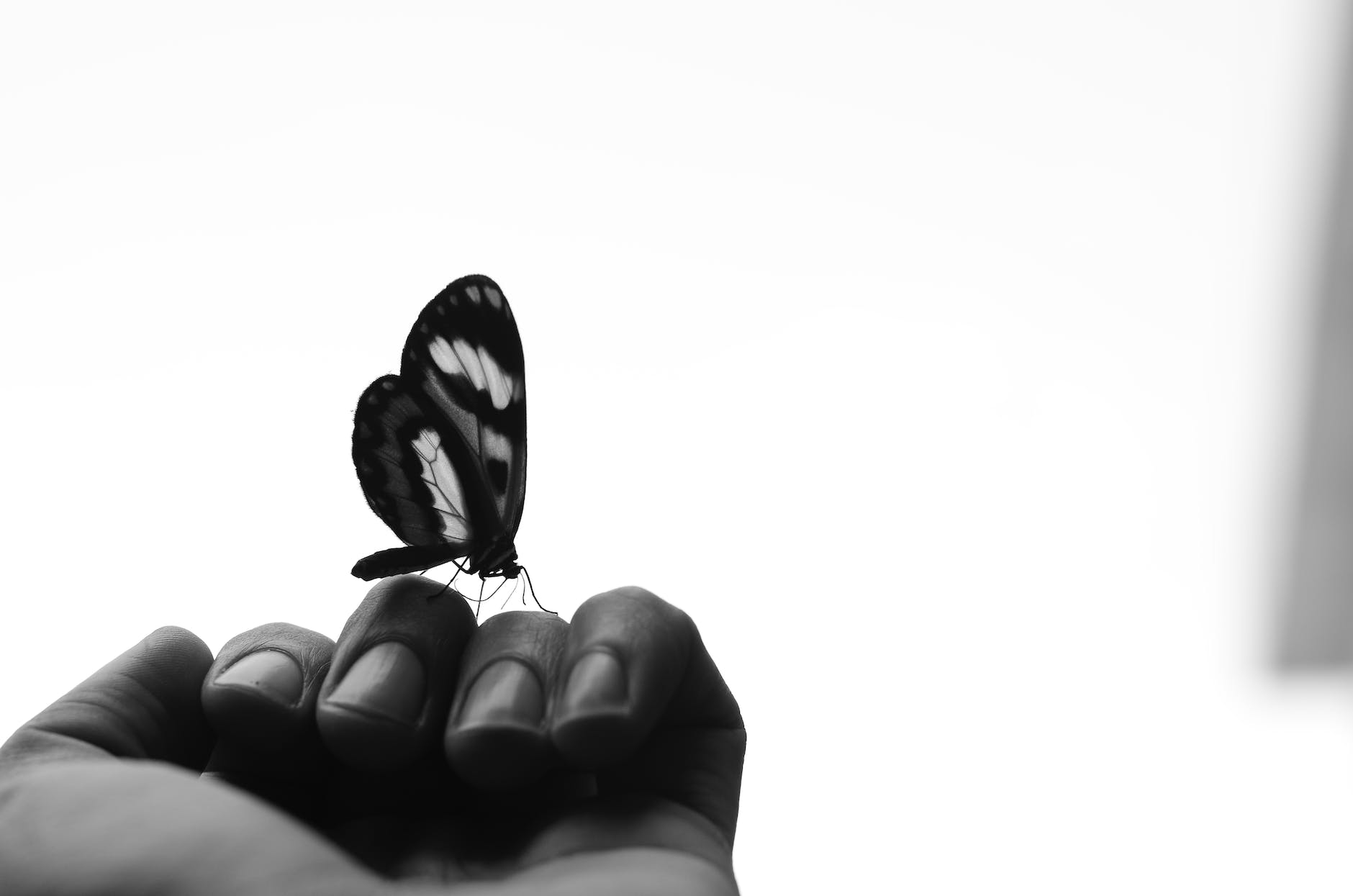
Photo by Hebert Santos on Pexels.com

But if we acknowledge that it is a transitory thing—something that lands on us when the conditions are right the way a butterfly lands on you when you’re standing very still in the sunshine and wearing the right color—the loss of it is softened. If we stop demanding happiness, searching for it, clutching it, then maybe when it finds us, we can enjoy it more fully, and when it flutters away, we’re not left with a shattering loss, but rather, the peaceful and contented state we have been cultivating, and which we were in, before the butterfly, or the tail, alighted upon us.

We attract happiness in the way we construct our lives, but that doesn’t mean we can live in a permanent state of happiness. To expect to do so invites disappointment and even despair. But we open ourselves to it, and we control what we can. We monitor and tend to our health—physical, emotional, mental, spiritual—and we are careful with those we surround ourselves with, drawing near to us those who encourage us to be our full selves, who don’t diminish us through word or action. Life has taught me that there is a high price to pay for being with someone who prefers a certain, constrained version of yourself to your actual self. And even after you realize it, the rebuilding of self takes a long time.

I have a theory that when the quest changes from how do I find and keep happiness to how do I cultivated peace and contentment, happiness finds its way to us with more regularity anyway. I also believe that peace is not arrived at through conflict avoidance but instead through a reverent attention to self-growth, self-acceptance, and self-respect. It’s different for everyone, I’m sure. But after a confusing decade filled with so much change and so many beginnings and endings, taking time to look inward has made the most sense to me. And doing so reminds me of all the earlier iterations of myself and what worked and what didn’t.

This morning I woke earlier than I have been lately, and it was still dark outside when I let the dog out. I recently strung fairy lights beneath the newly painted patio area. They are solar lights and I am often in bed reading before I really have a chance to spend any time beneath them in the evening, so it was unexpectedly joyful to have them still glowing this morning, when I was out with my coffee and the pup. I felt happiness rustling nearby and I let it find me, let it erase my grumpiness at having woken too early after a restless night. I created that outdoor space for just such an experience. It’s filled with flowers and comfy furniture, and though it’s rustic and imperfect and really needs to be rebuilt, it is doing exactly what I hoped it would do: setting the stage for the peaceful and contented mindset I’m trying to cultivate. And in this environment, happiness alighted, and affixed, at least for now, which is all that we can ask of it.

Love, Cath

On Slow Dancing and Wet Sand

By Catherine DiMercurio

Yes, but are you happy? is a question that we chase each other with. We want it for our loved ones, maybe more than we even want it for ourselves. It certainly means something different for each person. I have long wondered, is the “point” of life to be happy? Is it to have purpose, to make the world a better place? To simply survive it? Is it something else? This of course leads down a philosophical road. Depending on your larger belief systems about how we got here and what happens after, the question of the “point” of it all is going to be answered differently. But certainly happiness is something we all want.

Recently, after a period of feeling quite good for a long stretch, a collection of troublesome things happened and I found myself slipping toward the edges of the dark mental space that it can be hard to climb out of. Is happiness real if it goes away when life gets tough? Why does it feel so ephemeral for some of us, and others seem to find it wherever they go?

I used to think that happiness meant spending time with the people you love, but when the people you love exit your life, or they live far away, or the people are your adult children, building their own separate lives, you realize that if your happiness depends on time spent with anyone but yourself, you’ll never be happy.

So, then, is happiness doing the things you enjoy? Pursuing what you love? This seems obvious. Of course, we are happy when we are doing the things we enjoy, but how do we retain that sense of happiness when we are done doing the thing, when the hike has ended, the garden planted and weeded, the sunset on the beach viewed? How do we retain it when we are making dentist appointments or paying for expensive car repairs?

I am not saying that I expect or even want to be happy all the time. There are times when other emotions can and should be foremost in our hearts. I’m talking about happiness in terms of a calm, centered peace that we can hang on to when life gets bumpy, that we can find the path back to once we’ve dealt with some of the more serious things that life throws at us.

If happiness is that peaceful, centered state, is it accurate to say it is a reprieve from anxiety/fear/doubt? And how do we cultivate that? How does anyone, if daily there are battles with physical or mental health, or with financial woes, or any number of things that rattle the calm, that busy us and keep us buzzing and unable to be still and settled?

And some days, sadness feels like thick wet sand, cold, gritty, clinging.

I’m trying to learn how to process heavy emotions. To slow dance with them and listen to what they are trying to tell me.

Photo by Mathias Reding on Pexels.com

The trick is to know when to stop. My old habit when I’m feeling that deep down tug of sadness like there’s an anchor inside, is to sink, stay with it, fall into myself. Here in the dark, I can see that the enemy of happiness is not exactly sorrow, but fear of future sorrow. It is the thought that maybe everything won’t be okay after all.

I think of how future-focused I’ve always been. Not in a sensible way like retirement planning. But, I’ve always had the same question thrumming through me, for as long as I can remember: “But everything is going to be okay, right?” I suppose it is time I start asking myself what I meant by “everything” and “okay.”

This blog has been largely about my path forward since my divorce, the ups and downs of it all, single parenting, relationships. And since ups and downs are universal, I hoped that by writing about mine, you could think about yours, and we could connect that way, cultivate contemplation, and in so doing, co-create a more deliberate way of moving through this world and coping with its challenges and celebrating its joys. Help each other to feel less alone, which is certainly another kind of happiness.  And I have written here about the aftermath of marriage but I rarely talk about my marriage itself. I can tell you this: when I was married, whenever I asked that question to myself, “is everything going to be okay?”, I knew the answer. I knew everything would be okay because I was with the person I wanted to spend my life with.

Before I was divorced, I didn’t think too much about what it meant for people. It was something that happened to other people. So, when it happened to me, and in all the ways it happened—and it happens differently for everyone—one of the biggest inversions to my world view and sense of self was this idea that the future as I had imagined it was erased. And somehow, I felt erased, too. Everything would not be okay, at least, not in the ways I had imagined and hoped.

This past year, since my most recent breakup, I have realized that this part of my journey is trying to get that “everything’s going to be okay” feeling on my own. To take time to slow dance with that. Feeling like everything is going to be okay means that you have an absence of fear about future sorrow, or, more accurately, you have confidence that you will handle the future sorrow and make everything okay, in time. One of the things I’m trying to remember is that no matter how badly I want to figure out if future-me is going to be okay, there are things I can’t know, can’t predict. And the only way that future version of myself is going to be okay with whatever life throws at her is if I figure out how to be okay now. Because if I can do it now, then I can do it then. And what I fail to do so regularly is to realize that I have done it. I am doing it.

Sometimes I feel like the world gets meaner every day and I’m no match for it. Just me and my hokey dreams trying to feel like I’ve got things figured out enough to feel “okay.” But the more we talk about these things, the more we can help each other find paths to “okay” and “happy.” Maybe we can slow dance with the light emotions too, not just the heavy ones, slow dance with joy, slow dance with each other, feel the cool comfort of wet sand instead of a dark pull. And maybe we can create a ripple effect and gradually wash away some of the meanness and be a match for this cruel world together.

Love, Cath

On Vestigial Vigilance, Instinct, and Happiness

By Catherine DiMercurio

Sometimes self-protective vigilance masks our instincts …

Life has been busy. Good-busy, mostly. In the middle of it all, living, loving, and learning are all happening. Life unfolds in all directions the way fern fronds sprawl slowly out and askew in the spring, the silent and celebratory party favors of the season.

closeup photography of green fern palnt
Photo by Pixabay on Pexels.com

Yet, the part of me that maintains a hyperawareness, a vigilance about everything in this phase of my life is looking for trouble. It wants categories; it strains to sort. It wonders, are we now post-[post-divorce]? If so, do we need to call it something else? That vigilant consciousness is always on the lookout for chaos, ready to find a way to diffuse it. It feels like an anxious, hyperactive, working dog without a job to do is pacing inside my head, nervously chewing on shoes. But another part of me – maybe new, maybe long dormant and grizzly bear waking now – is wanting to learn the way to live differently. Without waiting for the other shoe to drop. Without needing to gnaw on something to feel busy and safe and purposeful.

Sometimes I wish we could extricate ourselves from the parts of our psyche we don’t need anymore. Perform surgery on a vestigial organ and bury it, entomb it, pharaoh-less, with no afterlife. I suppose, though, we worry that we might need it again someday. I suppose we maintain a sentimental attachment to it as a once-favorite thing. The vestigial and vigilant worrier warrior, the protector, was once more than a part of me. It was most of me. And though now I’d like to bury it or send it packing, sometimes it remains, fretting and pacing and making work where there isn’t any. Today I wonder if I can find another job for it to do. I wonder if it can be escorted off the premises, and if not, can it be given a makeover. It’s too bad I can’t simply assign it a different task. You don’t need to protect me anymore. I’m okay. Can you help me learn to play the piano instead? How are you at financial planning?

During tough, or worse, traumatic times, the vigilant worrier in all of us gets amplified, elevated to superhero status. It works overtime; it has to. When life calms, and chaos retreats, that part of us can be unwilling to relinquish its elevated status. Sometimes it seizes on any worry, no matter how big or small, and amplifies it, so the cloud of anxiety cloaks everything, things we didn’t even think we needed to worry about. The vigilance works against us. As if to say, you don’t recognize threats anymore; I need to remind you.

I think the worst part of this is two-fold. Though our psyche wants to protect us, it goes too far, and seeks to shield us from threats that aren’t there. But it makes it hard for the rational part of us to grow and get stronger and be able to see clearly. It also makes us question our gut. We wonder, what if all this anxiety, this worry, IS my gut. Is this what it looks like when it is trying to tell me something? Sometimes it is tough to know. But, if it is tough to know, then I suspect it isn’t your gut. Instinct doesn’t make us chase our tail or pace and fret at everything – experience does that. Instinct is a magnet that pushes us toward what’s good for us and repels us from what isn’t. It is strong and quiet and deep, not frantic.

For me the question has become, at this (post [post-divorce]) point in my life, how do I move past what my good-natured but often misguided vigilant worrier warrior is trying to do, and grow more in tune with my instincts? How do we move away from fretful what-if-ing and move toward calm, toward trust (both self-trust, and beyond)?

I think that answer is different for everyone. Sometimes I have to write my way to it, sometimes I have to pick at it, run toward it, run away from it and back again, talk through it over and over. Sometimes we wear ourselves out with worry and then, quiet and exhausted, we find our true way. I’d like to find the straight line there, the shortest-distance-between-two-points path rather then the endless circles I pace in first. But I suppose that’s part of the journey too.

All of this might sound a bit familiar, if you’ve been following this blog for a while. We tell ourselves the same stories in different ways, trying to make it all make sense. I also find that anxiety rises up most in periods of happiness, a pattern that is perhaps common to many of us. It’s easy to be wary, easy to wonder how will this be taken away (this time) or how will I mess this up (again)? Seeing others do this, I wholeheartedly want to reassure, to tell them, go easy on yourself, it’ll be okay, let yourself have this. It’s always more difficult to be generous and kind and loving with ourselves than it is to be with other people.

It’s a good time for all of us to try. Love, Cath


On Bargaining, Warmth, and Crickets

By Catherine DiMercurio

“March is a bargaining month. . . . How like happiness this is.”

Maybe it is because I live with dogs that I find myself, hound-like, snuggling well-loved ideas with familiar scents. I perpetually consider notions of happiness, transition, ambiguity, and identity—philosophical bones for these forty-something-year-old teeth to gnaw on. As March expires, I return to thoughts about negotiating with the past—and and the ghosts that hound us—in our pursuit of happiness.

Speaking of hounds, I look to mine for lessons, not really knowing what else to do with the half-wild thing I adopted a few months ago. We make tiny bits of progress and then leap back. I have written in other posts about his past, about how, during his most impressionable time he was kenneled, not learning, not bonding. I lecture myself about expectations and push away the feeling that I do not understand how to make this small plot of real estate a large enough home for this big-hearted, loud and loping beast. On my good days there is fresh resolve, an eager, well-meaning patience. On bad days, frustration boils, then quiets as I remind myself of his history, then simmers once again. I remind myself: past and present must some how find a way to live together.

We make bargains with the ghosts of our past. But often, we must learn to make them with ghosts and pasts of others, too.

I began writing this post a week ago and am returning to it on the last day of March. March is a bargaining month. I haggle with yard mud and slopped paws. Crocuses hem and haw, deciding when to take the risk. March begins a transition to spring that stretches through dreaded April snows. In Michigan, we do not fully believe it is spring until it is nearly summer. How like happiness this is.

It is easy to doubt that a joyful mood will live to see the light of the next day, and the next, until we realize finally that we’ve been happy all this time. How comfortable it is to doubt joy, given histories of endured loss. Sometimes, I decide to stop counting losses and try to only tally the wins—the joyful moments, the kitchen laughter, the soft morning kisses, the contented sighing of freshly walked dogs, the smell of spring rain, every sip of coffee, texts from teenage children checking in on me, on each other.

I decide to watch happy pile up around me. The losses will still come whether or not we are ready for them. Maybe, if we soak up enough sun we can take on the cold when it comes, take it on with a little more vigor and confidence. To always be steeling ourselves, waiting for the next trouble and trying to prepare for it, dilutes the joys we could be experiencing every day. Let the sun be the sun.

I know this: what today feels like a bump in the road would have felt like a steep and rocky mountain, nearly impassible, just a few years ago. Mostly. Sometimes obstacles still feel bigger than they are. Setbacks still sting—the broken appliance I can’t really afford to replace, another rejection from a literary journal, taxes, parenting stressors, the strange new noise the car is making—these are all still part of life, and can all gang up on me from time to time.

The practice of joy-tallying takes perspective, it takes meditative awareness, and is a conscious expenditure of psychic energy. And sometimes our zeal for it flags, and the cold seeps in even though the sun is shining. Sometimes we need to have another conversation with our ghosts. We need to make bargains about what we allow ourselves to remember, and to forget. In the end, it may be that what protects us the most from future pain is not, in fact, the memory of past pain. It may be that it is the willful act of forgetting that unthickens the skin and lets us feel the sun.

kal-visuals-682589-unsplash

Right now, hosts of crickets that have been wintering as eggs or nymphs (depending on whether or not they are fall field crickets or spring field crickets, apparently). They have been feeling the changes in soil temperature. Like all of us in Michigan, they are trapped between the end of the cold and the beginning of warmth. They wait to see when there have been enough consecutive warm days to call it spring. Then instinct kicks in, warmth is certain, emergence is imminent. Maybe we don’t have to wait as long as the crickets do, but sometimes we have to trust the instinct and seek the warmth. I suspect letting happiness soak in, one joy at a time, yields a stronger protection against the cold than developing too thick a skin.

Enjoy the warmth, whenever you find it. Love, Cath

(photo credit: Photo by Kal Visuals on Unsplash)

On Thriving and Neglect

By Catherine DiMercurio

Sometimes instead of pulling weeds, you focus on sunshine and water.

Most of us live in a world where resources—our time and our energy—are limited. Sometimes we feel a great sense of urgency to focus on areas of our lives or places in our hearts that have been neglected for too long. Currently there seems to be some huge collective urge to purge and simplify. Sometimes our homes need purging, sometimes our hearts do, sometimes we discover it is time to put away emotions or memories or thoughts we’ve held on to for long enough.

Being Open to Openness

I’m a firm believer in the idea that there is no “too long” with regard to the duration of time we take to work through emotions, ponder old wounds. Things take as long as they take. We react when we are damn good and ready. Sometimes if you have to ask whether or not something brings you joy, it is too soon to be considering the answer. I have learned to be patient with myself, to look for signs that I am ready to put something away, or rid myself of it. I’m learning how to recognize when I am ready to close doors, and to know when I’m truly open to opening them.

What is Thriving?

Sometimes, we have to step back to see what actually is already thriving. We need to recognize when to focus on the doors we’ve opened and those parts of our hearts that are pumping and churning in the background, rather than on the recently healed parts that we watch over protectively, or the wounded, hurting parts trying actively to unbreak. It’s harder to do, in a way, to focus on positivity and vitality. If something is working, even with marginal efficiency, the tendency can often be to let it hum along, doing its thing. Some things cry out for attention – messy rooms, old griefs, painful memories. It is easy to feel as though anxieties and worries have been quietly festering while we’ve been attending to the day-to-day business of life. So, we turn our attention to fixing things, we surge toward repair, toward improvement. This is important work, but it isn’t the only work. And it’s okay to back-burner it.

Knowing What to Neglect, and When

The good thing is that things like anxiety and worry do not thrive on neglect. They require our fevered, obsessed attention, which keeps them well-nourished enough to tangle and choke. Nothing of value thrives on neglect. Not happiness, joy, delight, peace, calm, gratefulness, compassion, empathy, love. They all need our careful, considered attention to flourish. It is easy to get caught up in the need to fix broken things, to clear away items no longer of use to us. But when we nurture healthy states of being, things like pain, trouble, and worry can, and do, get crowded out, like tomato plants in August refusing to give up ground to weeds.

pathway between tomato fruits
Photo by Artem Bali on Pexels.com

Resistance and Happiness and Magic

I think of the way, when threading a needle, the more you try, the more the thread resists, shrugging and fraying. Somehow it takes an odd combination of focus and nonchalance to get it. I have licked the split end to a point, found the good light by the window, but I don’t care if the thread makes it through, I don’t much want this button secured anyway. It’s almost that way when tending to such things as happiness. I see you, you need me. But too much direct, obvious attention makes it somehow pale and ghostly, as if it’s about to evaporate, a wish made at the wrong time and place, without pennies or fountains or the first star at dusk.

There’s a magic to it, but not tricks. There is magic in the sensing and noticing and breathing life into happiness while at the same time not chasing it, not reducing it to formulas, to mathematical if/then equations. Magic doesn’t work that way and neither does happiness. Some things, good things, are arrived at obliquely.

This is all to say, don’t forget on the thriving things too, not just the neglected things. Don’t forget to focus, but focus as in, staring at something with half-closed eyes, blurring the object but heightening the experiential sensation of sight, in that hazy Christmas light manner. This is to say, be patient. Be patient with that thread, the element of chance and change chasing the constant of the needle.

Love, Cath

Shifting Gears: On Routines, Resetting, and Rediscovering

By Catherine DiMercurio

Sometimes we need to escape the safety net of our routines and go seeking.

For the past several years, I’ve written steadily—mostly daily—writing and revising and rewriting and re-revising my novel, writing short stories and flash fiction pieces, and creating posts for this blog. I’ve been submitting my fiction and hoping something finds a home someplace. I’ll keep pursuing publication for those pieces, and I’ll keep writing. But right now, I’m wondering, is it beneficial to take a little break? Or do I remain committed to my daily writing habit? How do we reset and revive a practice—whether it be running, writing, yoga, or any other behavior we pursue to energize us and keep us healthy and grounded?

I’ll be taking some time off from work for a vacation soon, so it seems like a natural point for some shift to occur. I typically don’t like breaking a routine, particularly one that I’ve worked so hard to build. I’m also the type of person who finds regular routines comforting. Of course, I need breaks, but after some of life’s hard knocks, the predictability of routines feels safe. I think it takes longer for a routine to feel dull to me than a similar routine might make other people feel.

grayscale photo of road
Photo by Jan Kroon on Pexels.com

The Open-Ended Possibilities of the Road Trip

My children and I will soon be road-tripping across the country, headed to see the redwoods in northern California. Days of travel followed by exploration and camping will be pretty far from the normal structure of my life—wake up, write, work out or run, go to work, come home, spend time with the family, maybe do some light housework or yard work, and sleep. During the school year, the routine gets a little crazier, but with my daughter headed off to college, my son and I will be finding new patterns, and making adjustments as we go along, trying, as they say, to find and establish a “new normal.” There is a lot of transitioning ahead for all of us, so this road trip is welcome, not just for the break it offers from work and routine, but for the opportunity it will provide us to enjoy each other’s company—without the stress of everyday life intruding—and to rediscover each other.

I’ve thought a lot about how I want to handle the disruption this trip will have on my writing practice. One option is to not write at all, to deliberately abstain and allow my experiences to soak in. On the other end of the spectrum is taking my laptop and continuing to write every day, fleshing out new ideas, working on the story that’s in progress, drafting new blog posts. The most likely scenario though is that I’ll take my new notebook. I’ll observe, jot down impressions and observations, journal a little. Nothing too ordered, but a conscious effort to capture what I’m feeling, what I’m seeing. Sometimes, a story will form under these conditions, sometimes a character will come to life, sometimes a few sentences will materialize full formed and become the heart of a new piece of fiction. I might not write every day, but I’ll watch and listen and absorb. My daily habit will be one of conscious noticing.

In Search Of . . .

Another aim I have for this trip, and one that will hopefully be aided by this conscious noticing, is to seek something that I’ve been missing: lightheartedness. Though I’ve always been a contemplative, sensitive, and serious person, I feel as though lightheartedness was not something that was merely accessible to me, but rather it was a part of me. It was simply there, within me, a characteristic of each heartbeat. My experiences of the past several years, it seems, have altered that part of me, have anchored me to something heavy and sore. And it’s time to shift gears, to cut myself loose from that weight.

I have had lighthearted moments, sometimes weeks and months in the past several years where it felt like something had been lifted. But there was something different about this fleeting lightheartedness compared to my previous way-of-being lightheartedness, sort of like the difference in density between store-bought, prepackaged cotton candy and the gauzy, spun-right-in-front-of-you, summer fair cotton candy.

“The fact is always obvious much too late, but the most singular difference between happiness and joy is that happiness is a solid and joy a liquid.” — J. D. Salinger

Something about these differences reminds me of that line from a J. D. Salinger story (it is “De Daumier-Smith’s Blue Period” in Nine Stories, if you are curious): “The fact is always obvious much too late, but the most singular difference between happiness and joy is that happiness is a solid and joy a liquid.” Maybe the transitory, fleeting lightheartedness I periodically experienced was joy—moments of joy that washed away. But I don’t think the solid-state happiness Salinger references and the way-of-being lightheartedness I’m seeking are the same thing. And I’m certainly not the type of person who expects to be happy all the time. I do, however, long for the type of lightheartedness that once inhabited me in a very real, solid way to once again take up permanent residence in my heart.

So, I’ll be away for a bit from these Chronicles, seeking, and noticing. But when I return I hope to have fresh insights and perspectives and stories to share with you.

Enjoy the road. I will be! Love, Cath

On Work and Usefulness

by Catherine DiMercurio

It’s Sunday evening. We are gathered, the kids and I, in the living room, each with a blanket, a task, and a sense of wishing we’d had more time to do both things that needed doing and to relax together. I sip my decaf Earl Grey and look at my notes for this week’s blog. As the night wears on, we’ll all deal with small bouts of transition anxiety, each for different reasons, as we head into the week. For me, the strain of the workweek comes from stresses on the job, but mostly from pulling the weight of expectation and responsibility along with the heft of the monotony.

pexels-photo-734983.jpeg

Only a few short years ago did I became the primary earner, or as the IRS 1040 puts it, in all of its official elegance, the “head of household” – unmarried, earning more than half of household expenses, and with at least one child or dependent. The divorce necessitated I transition from freelance work to a regular full-time job with some haste. As I wrote about in earlier posts, I landed where I began, at the same company I started for in the early 1990s. I feel lucky to be there, as I’m not sure my years of freelancing prepared me particularly well for many other fields. At the same time, I do know people who seem to love what they do. When I graduated college, I hoped to find a job that allowed me time and energy to write, but I longed for meaningful work that engaged me, work that I looked forward to doing most of the time.

Pulling with Patience

So how do I make sense of the way things have played out? How to I reframe the narrative that sneaks up on me when a day on the job feels more like a toppling pile of tasks to manage rather than meaningful work to do? I understand the value and dignity of doing the work no matter what it is, of honoring my responsibility to earn, to be the head of the household. I think of a poem by Marge Piercy, “To be of Use.” She says, “I love people who harness themselves, an ox to a heavy cart, / who pull like water buffalo, with passive patience, / who strain in the mud and the muck to move things forward, / who do what has to be done, again and again.”

pexels-photo-247512.jpeg

Sometimes, in my quest for sense-making, I see success and reward and engagement in the work that is done in the margins of my employment/commuting life. In the margins is where I get to be a mom, where I write, where I spend time with my boyfriend, where I catch up with a friend over coffee or on a walk, where I snuggle my dog at the end of the day, where I try out a new recipe, or watch my kids’ games and competitions and performances. The margins are the places where life happens, but it is in the recognition of this too that things can seem out of balance.

As a society, we tell our kids that they can be anything they want if they work hard. It’s not that the message is bad, but it is an incomplete message. You can be things you want but you’ll give up other things to be them. You can be anything but you can’t be everything. You’ll be some things you want some of the time. You may work very hard and it might not seem like you achieved what you set out to do, but you achieved other things, in different ways. There is always more than one way to be happy, and not working at your dream job won’t be the end of the world. You may find yourself in a grey cubicle, sitting for too long under fluorescent lights looking at a screen and wishing your brain or your heart were engaged differently, more fully. But you’ll remember that you are doing the hard work of showing up every day, and earning the paycheck, and being responsible. Your job is as important as anyone else’s. You will shrug it off when someone says to you, “I could never do that. Sit at a desk all day.”

There is value in putting one foot in front of the other every day. There is honor and dignity in whether the paycheck is earned by intellectual, physical, or creative toil. On Sunday night as I write this draft, that is how I frame it, what I tell myself to remember. I don’t have to love each task to make it all feel worthwhile. Does it matter that this is not the job I went to school for or what I dreamed of as a child? Maybe. But does it matter more that the mortgage is paid and that my children’s lives are stable and secure enough that they can begin to imagine what they might want their adult lives to be like? Probably.

The Sunday Night Anxiety Club

The other thing that admits you to the Sunday Night Anxiety Club is the self-induced stress regarding balance. A friend once reminded me about that balance is about movement. Think of a yoga pose or simply standing on one foot. Muscles make micro adjustments to keep us stable. The act of balancing is more in the shifting than it is in some sort of state of perfect equilibrium. I used to think that balance meant that equal portions of my time every day or week were allotted to the categories I valued. And some days I still feel as though balance was achieved if I wrote, and went for a run, and after work had some quality, non-rushed time with the kids. But every day can’t be like that. And every Sunday night there are the reminders to myself that the week ahead will be filled with road blocks—hours at work where I try and figure out how to stay engaged and focused, a bad night of sleep that gets in the way of my writing the next morning, some issue of scheduling that disrupts the chance to work out. And balance will be about pivoting, and peace will be more about reframing than about the proper amount of calm every night before bed, though that is still something to reach for.

Right now, on Sunday night, the three of us are sitting here, making our concessions, our retroactive assessments of balance. Did we get enough done, did we honor our obligations, did we take time for each other? We stumble. Some days more than others. Some times I can’t help but wonder how the hell I’m supposed to juggle it all. It helps to remember the grander-scheme balancing act I’m trying to perform, that I’m trying to teach my son and my daughter that a good work ethic does not mean that you will be happy every moment of performing various tasks, but that you take pride in the fact that you worked earnestly and with the intention to do the job well. That living well is not truly an equation, where the moments of each day yield a result that always looks and feels like happiness. You should not feel as though you failed to live up to your youthful expectations of yourself, or society’s expectations of you, if you don’t go to bed feeling blissfully happy every night. Happiness is a strange alchemy of peace and joy and contentment. But there is wisdom in recognizing the richness of experiences that do not come to fruition in that way.

blue-glass-flower-decoration.jpg

Piercy’s poem ends with this revelation: “The pitcher cries for water to carry / and a person for work that is real.” Sometimes that work happens in the workplace and sometimes it happens in the margins. I think it is the great task of our lives, one of the most important parts of our journey, to learn what fills us up and to work at those things, whether it is the work we are paid for, the work of being a parent or a partner or a friend, something else entirely, or a combination of all of these.

I do need to step back sometimes, often on a Sunday night when the prospect of the week ahead seems daunting and out of balance, and reframe the conversations I have with myself about the work that I do in the workplace. I need to remind myself that it has a meaningful place within the context of the rest of the work I set my energy to in life. So as you embark upon the journey of your own week, I hope that even in moments of dread or drudgery, you are able to find the meaning there as well.

Enjoy the road. Love, Cath