On Synthesis and Momentum and Messiness

By Catherine DiMercurio

I’ve been single two years to the day. Since the breakup that started this chapter of my life, I’ve spent a lot of time exploring my history and finding patterns and doing long-delayed work. I’ve focused on writing and pottery and self. I’ve mourned old things that it was too hard to fully manage before and I’ve mourned new things and I’ve found unexpected joys in solitude. Despite the periodic bouts of loneliness there’s a lot that simply feels better now. I have worked at discovering what wounds have followed me from childhood and into all of my adult relationships, and have explored many different ways of tending to such things. I’ve found ways to provide for myself things that were missing in a lot of relationships, like emotional safety and respect.

Still, there’s a part of my brain that seems exclusively devoted to tallies. It counts and categorizes the things that have hurt me and the things that helped me to grow. It tells me to keep writing and throwing clay and wandering in the woods. It reminds me of how good it feels to be near a lake and suggests we don’t forget about the plan to move closer to one. It encourages growth and development, but in the ways least likely to cause me pain. It’s very practical, this part.

There’s another part of my brain that unfurls itself like a flag in the wind, singing to me about being in love, and don’t I remember what that’s like, and don’t we want that again? The other part of my brain taps a pen against its clipboard and says something like, “according to the data, this course of action would not be a wise investment of resources. . . .”

They are at odds, and so am I. So for now, I check in with them to see how we’re feeling but stay busy with all the other things. Busy is an easy way to be, between a full-time job, pursuing writing as a serious endeavor, and pottery as art and hobby, maintaining my house and yard, caring for my dog, and trying to exercise and eat well and sleep well, and to generally stay healthy. That all gobbles up a lot of available energy.

At the same time, after my older dog died a few weeks ago, I spent a lot of time just sitting in the sun and watching the irises bloom. Sometimes everything needs to pause. It’s been nearly a month somehow and I’ve been trying to regain my footing. I feel as if I’ve been moving slowly and carefully through the world these last couple of weeks, trying to make sure nothing else breaks.

All this is to say that you get to a certain point and you get to feel very self-protective. I used to feel braver, at least when it came to putting my heart on the line. My loneliness outweighed everything else and it felt like I’d already been through a pretty rough heartbreak, and nothing could be worse than that, so I kept throwing my hat into the ring. But it doesn’t work the way I thought it did. A breakup after a two-year relationship can hurt just as badly as a breakup after a two-decade relationship. They just hurt differently. Hearts seem to have a lot more surface area than you’d expect and can break in a lot of places. And you keep mending it until you have this beautiful piece of art, mended with the gold of all your best efforts at healing, but you tend to get more careful with it. Mended, it’s strong, maybe even stronger than it was in the beginning, but you’re less likely to want to test out that theory.

I think this is why so many people turn to art. It can still break your heart in mighty ways, but they are easier to bounce back from. Art—specifically, my writing—has saved me and picked me back up time and time again. The physical act of it. My pursuit of it, following through with a low-residency MFA program in the middle of a divorce. The people I met, and the community I found. And I swear when I started pottery it was just like falling in love, full of angst and euphoria, and settling into the beautiful harmony between exhilaration and calm. And now there are so many different ways to grow and explore, it can feel overwhelming at times and at other times, I find so much relief in the knowledge that I could study and practice for a thousand years, or at least, the rest of my life, and still have more to learn. And again, I have found a new community.

Sometimes, when I’m not practicing one of these art forms, or actively engaged in one of the other activities that both soothes and invigorates—hiking in the woods, baking, hanging out with my dog, having coffee with a friend—I slip into rumination, or find it hard to stay engaged with work that needs to be done, whether it be my job, or housework, or other routine and necessary things. I’m trying to figure out how to find both joy and contentment in the mundane too, since that occupies a bigger proportion of my time most days than the other things. It was easier to not get so lost in my head when I didn’t spend quite so much time alone, but between working remotely and the kids having moved out and the breakup, it’s been a quiet two years. This time has allowed me plenty of time to do both productive work and to descend into rabbit holes I then have to work to clamber out of.

Photo by Vansh Sharma on Pexels.com

I’ve often looked back on the moment of impact that changed my life and felt as though it separated me from my shadow, and she became something more substantial, as if an outline had been drawn and filled in with tangible darkness. When times are tough, she seems to gain strength, and when I’m feeling good and strong, she retreats. And what I’ve been thinking a lot about lately is integration. Of attaching that shadow back to me the way it’s supposed to be; of the artistic with the mundane; of joy with responsibility and routine. Maybe it’s more synthesis than integration but there has to be a way it all fits together, for fragmentation to gently morph into wholeness.

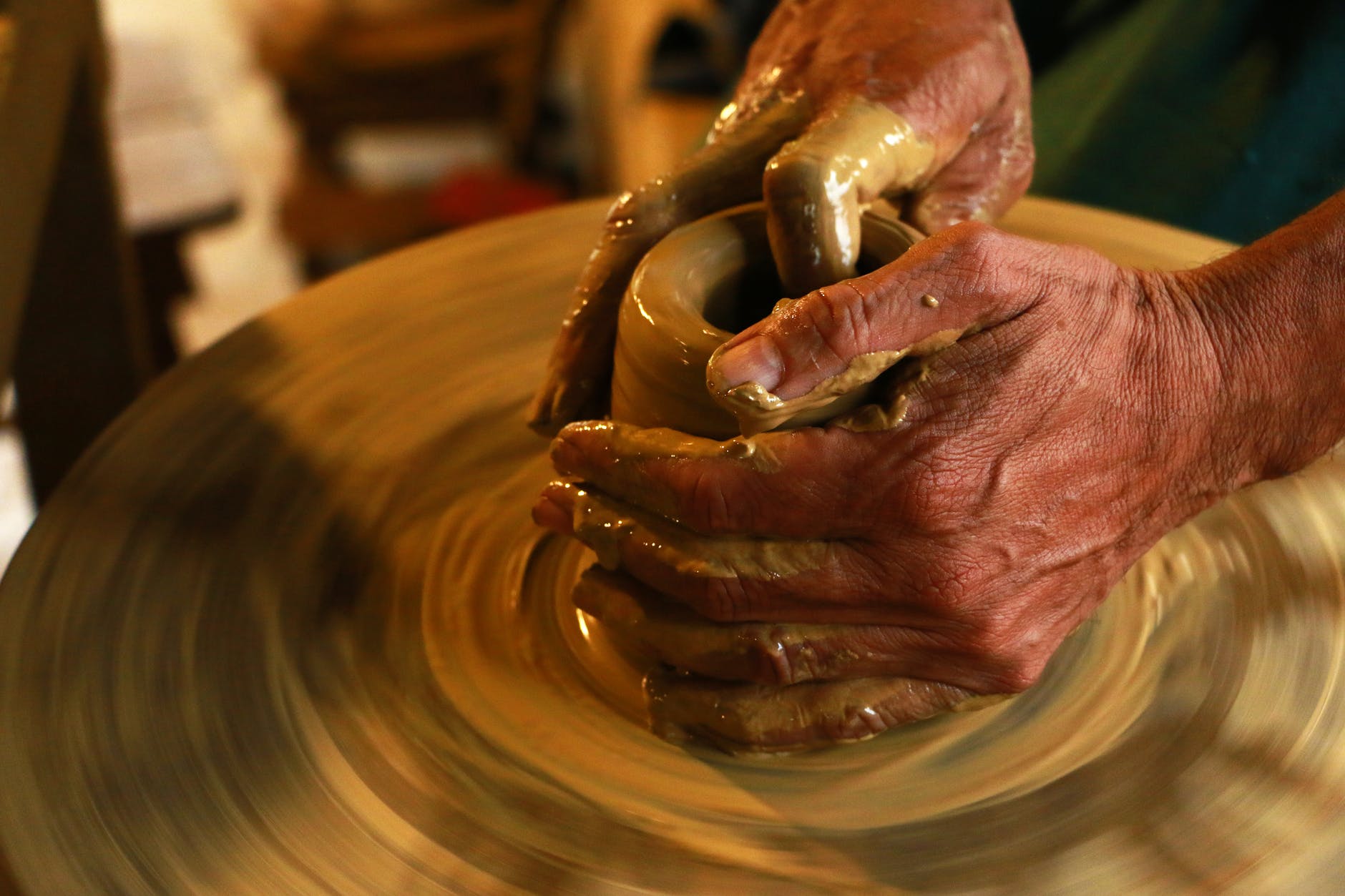
When we center clay on the wheel we talk about the way this process encourages all the particles in the clay to move in the same direction, and we learn ways to shape the clay that works with its momentum, and that isn’t at all about forcing it to look the way you want it to. I think that’s a good goal for me too, working with my momentum, and gently encouraging all the disparate parts of me to start moving in the same direction, and enjoying the messiness of the process. It’s all a good reminder too that growth is multidimensional, not linear. It can look like you are spinning your wheels, but you are actually creating something extraordinary.

Love, Cath

On Creation, Waiting, and Time

By Catherine DiMercurio

I don’t have a record player but periodically I think of getting one and it seems every time I do, it’s after I heard a Tom Petty song. I recently listened to a snippet of an interview with him in which he was talking about the process by which he wrote “The Waiting.” You know that one. The waiting is the hardest part. Every day you get one more yard. You take it on faith, you take it to the heart.

He was talking about how a bit of the melody came to him and he played it over and over again for weeks, and then the chorus, same thing. He just played the same thing over and over. The snippet cut off after he talked about somebody knocking on the other side of the wall telling him not to play it anymore but presumably the rest of the song came to him this way, in pieces, over time.

I wish I could speed up processes sometimes, creative processes, learning processes, healing processes. It’s like I’m always waiting for my ability to catch up with my creative energy. My results don’t often match the vision I had in my head and I’m chasing the kind of book I want to write or piece of pottery I want to create. Or, the life I’m trying to build.

I look around at the things that seem to come easily for people and long for something like that for myself. I feel wildly impatient with my slow pace in nearly all things. Sometimes I feel as though I have the mentality of a perfectionist but not the talent, or results, to show for it. I am not meticulous. I am a messy learner with almost no eye for detail. I am full of earnest trying but am frequently wanting something more to show for the effort than what I was actually able to produce. I wake up too early and agonize over glazes I applied too thickly despite my best efforts in pottery class or fret over stories I’ve been submitting for years that keep getting rejected. I wonder, when is it going to all come together, and, what have I missed?

And then, things come together a little bit, all at once. Last year, I did get two pieces of writing accepted at literary journals and they finally were published this past week, within twenty-four hours of one another. And the glazes I’d been so worried about turned out fine, and I threw well that night at pottery class. I enjoyed it thoroughly, that moment where things coalesced in a brief way, knowing that such moments never promises anything. Any future success in either art form will be just as hard-earned and the waiting in getting there will continue to be the hardest part.

I look at all my impatience and I wonder where it’s all coming from and why it percolates everywhere for me. For all my striving toward self-acceptance, this feels out of place. When I step back, I can see that it isn’t there all the time, but it comes back to me, maybe when I’m feeling low about other things. I am trying to pause and consider why it matters so much that I learn faster, glaze better sooner, write and publish more now, etc. I think a lot comes down to validation.

If I’m producing “good” work in a visible way it’s proof, right? I mean, that’s how external validation works. We believe that if others can see something of our “goodness” or “value” then maybe it’s easier for us to believe in ourselves. Alternatively, it simply is enjoyable to feel seen, to have someone else confirm what we’ve been cultivating in ourselves, i.e., a sense of our own worth. For so long, I thought the goal was to not need external validation, that there was something wrong with wanting it. So, I worked diligently on trying to find where this need arose from in my past, how it came to be that I felt unable to sense my own worth. I work at rebuilding my sense of self in the same way that I create, revise, and re-create art in the mediums I’m working in now: clay and words. I’m continually learning how to be me in the same way, with the same habits of working and trying and reshaping and revising. I hum the same bars over and over for weeks. Still, I’m coming to understand that it doesn’t all have to be internal. We must feel safe and good and loved within our own skin, but it also feels good to have someone tell us good things. There’s nothing wrong with enjoying that.

Many people struggle with feelings of not being “enough” or “good enough,” and all for different reasons. I’ve dug into my own reasons, determined to understand them better, because I have found that the only way for me to cultivate healthy self-perspectives and habits is to use precise and loving language in my internal thought processes, language that responds specifically to the lessons and events of my life that wired my brain for self-criticism and an extreme response to anything that feels like rejection.

I am impatient with all this, but I think one of the reasons it takes so long to recover yourself from various types of wounds is that you often can’t face it all at once. It’s too much. It was too much for me to heal in a smooth and linear way and all at once from a twenty-year marriage ending in the storm brought on by my then-husband’s alcoholism and infidelity. Some wounds feel as though they change us at our core, forever, and after bearing the initial brunt of that pain, we begin to understand that the only way to survive it is to take breaks from it. We turn away, we look to others for help. Then we go back to it when we’re strong enough and rested enough.  

Photo by Tima Miroshnichenko on Pexels.com

What I need is to believe that I have time. That I can keep conquering what I need to, that I can keep writing and learning, that there’s no need to rush. But we live in an urgent world that is always proving that nothing is promised, certainly not how much time any of us have left. But I need to believe that I have time, anyway. That my own pace for healing and nurturing my sense of self, for building my writing self into who she is becoming, for learning all I can in an artform as elusive and slippery as wet clay, is all sufficient. I need to believe that because whenever I try to rush things, something is sacrificed. Whenever I grow too impatient, I wind up falling into a dark place and my energy is then focused on pulling myself out of that instead of all the other things I’d rather be doing.

In a way, that’s my own version of blind faith: that I have time, that we all do. To keep creating the person I want to be, the life I want to have. My pace is neither fast nor slow, just mine, is what I tell myself. The waiting for it all to come together will always be the hardest part, because that’s where all the living is, in the waiting. The moments when things coalesce are fleeting, and the rest is creative energy at work. There is so much beauty and art in the waiting, even if it is the hardest part sometimes.

Love, Cath

On Elemental Lessons, Love, and Good-Messy

By Catherine DiMercurio

Sometimes the most basic lessons are the hardest to learn.

Sometimes I think the best in the shower. In my soul, I’m a water person, though this body can’t swim very well. But whenever I’m around water, I’m calmer. Recently, in the shower, it occurred to me that it is almost the one-year anniversary of the ending of a relationship. It was a relationship that was hard to let go of, in spite of the fact that it needed to end, and I got to thinking that I seem to have more anniversaries of things that ended than things that began. Not long ago, that thought would have sunk me, at least for a few days. I would have ruminated, and found ways to feel increasingly worse about myself. But standing there in the water, after a year of becoming more in tune with myself, my next thought was this (and yes, I do address myself in the second person sometimes): Wait. Are you really saying that you think you have more to mourn than to celebrate?

My immediate answer to myself was no, but part of me still wanted to tally, to dig into hurt and remember it. We get used to making ourselves feel terrible sometimes. For a lot of reasons. But I have spent the last year looking at those reasons, my past, my deeper past, and learning. And in this moment, I understood that it is natural for me to have a lot of emotions around this time of year about the ending of that relationship, and that having those feelings did not have to translate into a trip down the rabbit hole. That’s progress.

Some of that progress can be attributed to the pottery studio. I feel as though I’ve been on an incredible journey when I think of the first several classes back in January. I pushed myself way out of my comfort zone, not only in trying something new, but in hauling myself out of my cozy house in deep dark winter for a 7 to 10 p.m. class with strangers. I am definitely a morning person, so I knew one of my obstacles was going to be my own fatigue at this point in the day. Optimal learning and creative time for me happens much earlier in the day. And there were a lot of other obstacles, one being that physically, I am not very coordinated, and hand-eye coordination is pretty important when you are wheel-throwing.

I was not prepared for how challenging the experience would be, for how frustrated I would feel. I have no poker face, and even when I’m trying to have a neutral outward demeanor, it is plain for the world to see when I am struggling. Though the class was different from any that I’d ever taken, my brain slipped into student-mode where the usual process was: work hard, study, succeed. In the past, doing well in school meant that the people around me were happy (teachers, parents), and it allowed me the opportunity to excel at something, since it wasn’t going to be in the realm of sports, or anything social.

But, I struggled. Class after class, I felt clumsy and awkward and self-conscious. I had almost no control over what the clay was doing and trying to understand the relationship between the movement of the wheel and how my hands were interacting with the clay seemed like a mystery that I couldn’t unravel. There were too many factors—the wheel speed, the moisture level of the clay, the pressure, placement, and movement of each and every finger on both hands, my posture. I was certain the other new people were already better than me. I thought about quitting. A lot. I even bought a cheap-ish pottery wheel so I could practice at home. It is easier to fail without anyone watching. I wanted only to get a little better between classes so when I sat down in the studio it would be evident that I was making progress. I wanted so badly to be perceived as someone who worked hard, and if my work did not show evidence of that, how would anyone know?

And I did make progress, in my own epically slow way. But I was doing so out of some sort of ancient ache to prove myself, to insist on some kind of worthiness I wanted others to recognize in me even when I routinely overlooked it in myself. Part of my pottery journey has been to trace this powerful need, which has shaped (malformed) so many relationships, back to its roots. This work is not done, as the work of truly understanding ourselves and making peace with it all never is.

Even though I felt like I wasn’t progressing fast enough, my instructor was so good at underscoring how difficult it is to learn any new art form. I remember getting frustrated at the wheel, trying to accomplish something that wasn’t working out. I had a poorly centered lump of clay in front of me that I’d been able to open up enough to begin to pull up the walls. She was standing near, talking me through it, and I said something like, “I just can’t. . . .” I was unable to finish the sentence, because I felt like none of it was working. I couldn’t do any of it. And she replied, “And it’s what? Your third class?” She taught me to embrace wherever it was that I was in this journey. If something turned out wonky, and I could get it off the wheel, I could still practice trimming and glazing. It was all part of the process.

Photo by Regiane Tosatti on Pexels.com

That was kind of a turning point for me. After that, some fresh ideas began to make themselves known in my brain. Couldn’t I just learn and play and grow? Trying to force progress wasn’t working. And feeling tense internally was something that found its way into the clay. Everything was going to happen on my own timeline. And there was no grade. There was no metric by which to measure failure or success, only those that I imposed upon myself. Doors and windows flew open inside me. Soon, I began to feel energized and creative and good-messy, and suddenly, when I thought of all there was to learn, I saw the future blossoming in front of me, whereas only weeks before, when I thought of how much I didn’t know, I’d felt overwhelmed.

The whole experience thus far has reshaped the way I look at myself. It is shocking to me that learning how to throw and work with clay is revealing so much that has nothing to do with clay. I think because I was already doing some of this work, the experience simply shoved open doors whose locks I’d spent some time jimmying open.

To some friends and family, I’ve tentatively equated my evolving feelings about pottery to falling in love. I say tentatively because it seems a strange thing to admit. But what I’m beginning to comprehend is that what is happening is that I’m falling in love with myself. Sometimes it takes us so, so long to learn elemental lessons. And sometimes it takes the elements—earth, water, air, fire—to teach us.

Love, Cath

On Seedlings, Rip Currents, and New Things

By Catherine DiMercurio

Solitude is one of those gifts that doesn’t always feel like one. There is much delight in self-discovery, but the responsibility to make the most of this time can be troubling. Yet in the absence of other humans to react to and with on a daily basis there is a freedom to observe ourselves, to re-learn what makes us tick.

For me, this prolonged period of solitude has provided the opportunity to ask questions. What does being me look like when I am not in the mode of daily parenting or in a state of being partnered? In a way, being in solitude is like being the control group in an experiment about my own identity.

Here, I have the time and space to observe what affects my mood, my sense of well-being. What stressors alter the course of my day, how do I respond to them? How did I respond differently when I lived with my children, when I was with a partner? What do I like about the way that I live and think and feel, and what would I like to improve?

Here is something I’m learning about growth. Imagine one of those old, time-lapsed photography videos of a germinating seedling, the way it pushes through the dirt up to the warm sunlight and begins to unfurl. I wish my growth was like that, unconscious and inevitable, rooted in the instinct to move toward the light. When a human chooses to pursue growth—emotional, psychological, relational, etc.—they bump up against obstacles that can feel more troublesome than the soil a seedling faces. We must move through them somehow to get to where we want to go. It is not an instinctual movement with a clear direction. For many, growth requires confronting fears, and most fears stem from old wounds, from past relationships that reach all the way back through our childhoods. Our growth often requires that we dig down before we can inch up.

Photo by Gelgas Airlangga on Pexels.com

One of the things I have learned about myself is about the way I pursue things, or avoid pursuing them. Sometimes I can’t sink my teeth into something that intimidates me until I have run out of all the excuses to avoid trying. Sometimes I can’t truly let go of someone—even after the relationship has ended—until I have exhausted myself trying to figure out why it didn’t work. Things take as long as they take. Especially because we have to live life at the same time we are doing this work.

We owe ourselves these searches, these explorations of wounds to be done grieving, of lessons to be learned. But it’s hard and we need to take breaks. And the work does not have an exclusive claim to our time. We have other things to do. I have a full-time job, writing goals, hobbies, dogs who are strangely like best friends half the time, and mysterious toddler-like creatures with a never-ending set of demands the other half.

Some people seem better equipped to live in the moment. I feel as though I’m almost ready for whatever moment I find myself in, I just have to think about a few more things first.

In having all this time to myself, I decided it was time to learn something new. I had two aims in mind: learn the new thing, and, to learn something about myself in the process. One of the reasons I wanted to learn the new thing is that I have begun to understand the extent to which I have lost myself in past relationships. So, I am exploring the lost self, the remaining self. Further, I have a duty to undertake this exploration openly and honestly, to side-step self-criticism, and to nurture myself through this process with as much care as I would treat anyone who is going through transition or transformation.

The new thing, if you’ve read any of my recent blog posts, is pottery. It is an artform rich in metaphor. It is an artform where proficiency is elusive. Developing even rudimentary skills is challenging, more so than I ever imagined. Instead of being able to feel relaxed, or excited, or joyful, or curious about learning this new thing, I have found with dismay that I’m often frustrated or anxious. It is a disappointing reaction. I try not to be disappointed. I try to dig. Anxiety tries to point us in certain directions. Just like pain is our body’s way of telling us something is wrong, our anxiety is a way of our brain telling us that something is off. Certainly, there is nothing much actually dangerous about pottery, so why was I reacting this way, with so much worry? Was it more than just wanting to do well and struggling to get there?

I was about to head to the pottery studio and my anxiety was jangling so loudly it felt like I could hear my teeth rattle. Instead of ignoring it, or trying to distract myself, or telling myself to knock it off, I decided to talk myself through it. I asked myself a series of questions that kept whittling down the issue to a couple of difficult past experiences (long past!) and the years of emotional residue they left. I let myself experience the emotions those memories brought with them.

Sometimes anxiety makes us feel as we are in current danger even though our brains are remembering something else. So, this time, I tried to be aware of what was remembered, and feel it, and understand it, and forgive myself and the people around me. Miraculously, the anxiety that had gripped me so tightly evaporated. I didn’t realize it at first. I just found myself packing my tools, and I sensed that I felt better, calmer. I went in and spent three hours making a lot of mistakes on the wheel and when I was finished, I didn’t feel terrible about the mistakes as I had done in the past. I thought, this is great; my hands are getting used to how the clay feels, how it behaves. I was able to enjoy the process of failure.

If you’ve ever swum in Lake Michigan you may have seen the signs posted about dangerous rip currents, and how they pull unsuspecting swimmers away from the shore. The signs instruct you, should you get caught in a rip current, to swim parallel to the beach, so that you can get out of the rip current, before heading back to shore. Though I have never experienced a rip current, this is what anxiety sometimes feels like. There is no current (immediate) danger, but there is current danger (danger of getting pulled under and away by the current). The moment when I started asking myself questions about the anxiety that I felt was key. I took it seriously and didn’t panic. I realized that while I was not in imminent danger physically, I was in danger of the anxiety taking over, pushing me under. My questions allowed me the opportunity to swim parallel to the shore. Arriving at the studio in a calm state was much better than having to fight the jangling the whole time.  

While pottery is the new thing I am using to try and learn about myself as I learn about the art itself, life is going to give us all other new things. I think it is important to try and understand ourselves so that when things come our way, we know what to do with them, how to handle them, what holds us back, what pushes us under, what moves us forward.

I have a Post-it note stuck to my computer monitor. It reads: curiosity. I’m trying to let that guide me. To be curious rather than skeptical about new things and to wander through this part of my life with the open-heartedness with which I started the blog in the first place. Happy wandering! May your next new thing be good to you.

Love, Cath

On Pottery, Pressure, and Place

By Catherine DiMercurio

Sometimes the pressure we feel is part of the process.

I was driving home alone after dropping my son off at college after the winter break. We stopped by my daughter’s place for a hug and a quick conversation about everyone’s covid concerns about going back to school and work, as well as some recent car trouble and how we would coordinate getting the vehicle repaired. It was a Monday, and I’d taken a couple hours off and would be jumping back into work after a week off as soon as I got home. That evening, I would have my first pottery class, and I was having some anxiety about that.

Somewhere along the line, my excitement about the upcoming class had turned into a not-unexpected collection of worries. I was experiencing my own classroom covid concerns, along with my usual social anxiety, as well as a lot of uneasiness about the learning something new in a public, exposed way.

As I drove home with all these worries tumbling in my brain, I turned the radio on, scanning randomly, and “Under Pressure” came on, by Queen and David Bowie. It all just hit me, on so many levels, how much pressure everyone is experiencing, and I cried and sang, moved by music in a way I hadn’t been in a while.

Oddly, I heard the song again on my way home from pottery class that night. Did I mention that along with all the other ways the class is out of my comfort zone, it also runs from 7 p.m. to 10 p.m., which is a huge breach in my usual routine. So, it was very late for me to be out and driving on a winter Monday night, and I was overwhelmed and intimidated by the class, frustrated with not being able to master the thing you must master before you can really make anything—centering the clay on the wheel—when I heard “Under Pressure” again. I didn’t cry this time, but I felt it deeply. Again, it wasn’t just about me and the pressure I was feeling personally. It was impossible to listen to the song and not thing about what everyone has been dealing with the past couple of years. The song has been in my head all week.

Photo by Pixabay on Pexels.com

At one point when all I could think about before trying to fall asleep was clay, it occurred to me that so much of the struggle of centering is about pressure, which hand is applying pressure on the clay and where and how.

The other thing I’ve been thinking about for a while is place. I’ve been doing some soul searching and trying to figure out what that word means to me, and where I might belong, and how do I get there. But over the past couple of days, I’ve also been thinking about it in terms of where people are from. Some folks are fiercely from a place. Though I’ve lived about a half mile from Detroit for more than 20 years, I never say that I’m from Detroit, because people who are actually from Detroit really hate that, and though I love it, it isn’t my city. It didn’t shape me the way it shaped folks who grew up there, or who have made their life there in a meaningful way over the years. I get it. I don’t get to claim that.

I usually tell people I from Saginaw, which isn’t strictly true either. I grew up in Carrollton Township, a little working-class suburb of Saginaw. That’s what shaped me. There was a sense of community there, largely focused on the school, which I didn’t fully appreciate until many years later. Being from a suburb is kind of a strange thing in that it does not feel distinctive at all. Precisely because it is neither rural nor urban, a suburban upbringing can feel blurry, though suburbs are as different from one another as they are from rural towns or from cities. It is perhaps thought of as the middle ground between extremes, between the clear this or that of the rural or the urban. In fact, it is its own place.

There is much more to be said, and much more for me to explore personally, but it is fair to say that growing up where I did and how I did, the appropriate response to all the pressure I’ve been feeling would be an acknowledging shrug. Yup. That’s just how it is. (Parenting is hard. Everyone has car troubles.) The work ethic would kick in along with an accompanying sense of duty. You made a commitment, so you have a responsibility to stick with it and do your best. (You signed up for this class, so see it through and just keep trying.) The strong sense of community never leaves you, either. We have to help our neighbors when they need it. (We’re all tired—so tired—but it is important to keep protecting ourselves and each other with masks, vaccines, boosters, and common sense.)

In many ways, I have also been feeling a different kind of blurriness, this sense that I am in an in-between place, a mythical suburb of the soul. Maybe it is okay that it feels neither here nor there. Perhaps it, too, is its own place, and this it what it means to learn to belong to yourself.

In C.S. Lewis’s The Chronicles of Narnia, there is a place known as the Wood between the Worlds, where some characters travel on their way between Earth and Narnia. Maybe we all have access to an in-between place like that. Perhaps at times we believe we are in the Wood between the Worlds, when in fact, we have moved through that place into a new world, a new version of self. And perhaps we pass through the Wood more times than we realize in our journey toward self. I have also speculated that it is only in the Wood between the Worlds—in the in-between place we sometimes find ourselves—in which we are truly ourselves, and that journeying there is necessary in order to both forget and to remember our selves, before we move on to the next chapter of our lives.

I think that sometimes the pressure that we experience is the discomfort of transition, of the shaping and reshaping of ourselves that is both natural and difficult. Maybe this centering of self gets easier though. Maybe that’s just how it is.

Love, Cath

On Clay and Conversation

By Catherine DiMercurio

So much of life depends on how you look at things.

I don’t mean seeing things from a different angle in order to guide yourself toward a more positive perspective. I mean new experiences sometimes hand you a metaphor and give you a way to contemplate something more deeply or fruitfully than you have before.

Recently, my daughter and I took a trial wheel-throwing pottery class. It was something we’d both wanted to try for a long time. I was nervous about investing time and money into a semester-long class without first having some idea about how I would feel about working with this medium, so the two-hour workshop format appealed to me.

On the drive over to the studio, I had a strange thought. I was feeling anxious and as I dug around in that feeling I realized part of it was because I did not want to disappoint the instructor, some person I’d never met before. Why on earth would I care about that? Maybe I didn’t want them to think that my inability to follow directions, or create “properly” meant that they were not doing their job well. I wanted to be a good student so they could feel like a good teacher. It was also part of my people-pleasing mentality. [The reasons people do this are varied and complex. Sometimes it is because we’ve lived with emotionally volatile people and we learn to not make waves. Sometimes it is because we need others to think well of ourselves since we have a hard time doing that on our own. This is often a result of us having internalized messages—religious, cultural, societal messages—in such a way that we feel it is necessary to prove that we are, in fact, good people.]

Still, I tried to shelve these ancient worries. I wanted to focus on having fun with my daughter and learning something new. I wanted to prove to myself that I could.

As it happened, my daughter and I were both feeling a little anxious, because it’s normal to feel that way when you’re trying out something you’ve never done before. But once we walked into the studio, met the owners and their dog, and toured the space, I began to feel more relaxed. Shelves of drying cups and bowls and vases, pale stoneware waiting to be glazed. Gorgeous curved and sumptuous shapes. Rows and rows of completed, glazed work, waiting for students to collect them. Oh, the glazes. I love glazes. I wish I had the vocabulary to describe them, understood their chemical composition. Reddish browns, honeyed golds, pale bronzy greens. It all washed over me. I felt both calm and exhilarated. I love that hard-to-come-by feeling.

I couldn’t wait to feel the clay beneath my fingers, to begin to see how it responded to the corresponding forces of my touch and the movement of the wheel. I’d watched enough of a British pottery competition program to imagine what it might be like but now I’d be getting my own hands dirty and trying it out.

One of the owners, Mike, sat down at the wheel and talked us through various processes and techniques. And then suddenly we were doing it. Mike helped when we weren’t sure if our clay was centered, or if a bowl was widening to the point of collapse. He was a good guide.

I wasn’t shockingly good at it for a beginner, though I really wanted to be! I may not have uncovered a hidden talent, but I also did not uncover the disaster I’d been fearing. This wasn’t gym class, and I wasn’t unbelievably horrible at it, as I was with most sports. Have you ever been so bad at something that people are embarrassed for you? Not fun. But here, in the studio, I did have fun, and so did my daughter.

There was some kind of perfect little relief in the newness of it all. A bliss in getting to believe in something else, a different kind of space, a different kind of making. I think my daughter and I both experienced that and it felt important to be able to share that with her.

In the days since the class, one of the things I’ve reflected on is the notion of conversation. Working with the clay, my hands had to be in conversation with one another. They didn’t simply work “together.” They worked in harmony and in response to one another. It is different than say, playing a musical instrument, where your hands are working together, but each is performing a separate task. In building a bowl on the wheel, my hands had to talk to each other, listen to each other, in order to create something together. It was impossible not to see this as a beautiful metaphor for what I hope to one day find in a relationship. If you are not working together, focused on the relationship you’re creating, it will not hold together, things will spin out of control. You must want the same thing. You might end up making something different than what you intended at the beginning, but you’re in on it together. And unless there is a cooperative, positive effort, it won’t be anything at all.

Because my brain works the way it does, I seized upon this metaphor and tried applying it retroactively to past relationships that did not turn into what I’d hoped they would. Maybe this was the way I could make sense of how things happened the way they did. The pottery metaphor provided an effective lens with which to view things and helped me to remind myself of why those things didn’t work out.  

I’ll be honest. Sometimes I need a new way to look at an old thing I’ve been turning around endlessly in my head. The ending of relationships is hard. Grief is real, full, and deep, no matter how much you believe that the ending was necessary. I often find myself reciting the stories and their endings back to myself, so I remember, so I don’t repeat past mistakes. So that, if I’m lucky enough to get a next time, I get to keep it. Grief takes up a lot of space in a heart. In a way, we remain in conversation with our grief, long after the loss that caused it.

Another thing about conversation is that in the past I’ve mistaken emotional or intellectual connection for emotional intimacy. It’s all about conversation, but they are not the same things. We have to look closely and see if what we are offering to our partner is what we are being offered in return. There were times that I was not actually having the conversation that I thought I was. Things take time to reveal themselves. People do. We all try to be the best versions of ourselves when we want something to work out. But we can’t keep that up indefinitely. And one person’s idea of something “working out” can be very different from another’s and in the absence of emotional intimacy it might take a while to figure that out. We may think we are building something with a partner, but unless we are in true conversation with one another, one hand might be trying to create a saucer while the other is trying to make a vase.

Another lesson here for me is about a new kind of open heartedness. It took a bit of pushing myself to decide to take this class. I must remember to do that sometimes, to nudge myself into action, into new ways of looking at things. I admire people who can jump into new things without the anxiety that sometimes holds me back. At the same time, I love that these experiences for me feel special, wonderous, even, given that it wasn’t easy for me to approach them.

We all come at the world and all it has to offer differently, but I don’t believe that there are methods that are superior to others. We go at our own pace and are rewarded in the ways that feel meaningful to us. And we learn the lessons we need to when we are ready for them.

After you make something at the wheel, it goes through many other steps. It air dries, then is trimmed, then dried in the kiln, and then glazed, and then fired once more. Or something like that. My daughter and I didn’t get to do those other steps—that is what the full class is for—but we did get to pick out glazes. I’m eagerly awaiting the call from the studio saying that our pieces are ready. Pottery, it seems, like everything else in my life, is trying to teach me patience.

I’m pretty sure I’m going to sign up for the full class, but the next session will begin in January, and meets for three hours on Monday nights. That’s a big commitment! But I think I’m intrigued enough to take it on.

Wishing you true conversation and a little bit of genuine bliss.

Love, Cath