On Spring, and Little Mysteries, and Soft Truths

By Catherine DiMercurio

It’s been a bizarre spring. The last time I wrote, it was just the beginning of it. Now we’re in the thick of it, the irises are blooming and the peonies are about to burst and the buckthorn is proving to be its annual nuisance. Last time I wrote, I was figuring out some paths forward and now they all look a little different.

When I began this blog about open-heartedness, I invited my readers to wander with me, to explore heartbreak and wholeness and everything in between. I think this blog has been around for about eight years, and one of the main things I have discovered in that time is that there is wholeness even in heartbreak, there is wholeness when we feel healed and wholeness when we feel broken. To be human is to be whole; the breadth and depth of our experience is encompassed by who we are in this life and nothing—not pain, loss, grief, fear—can deplete the full richness of our identity. We absorb it all, we metabolize it, transform it, re-emerge as new versions of ourselves over and over again.

The wholeness can feel elusive sometimes. In parsing out recent events, I tell myself I don’t have anything to prove, but my brain cycles through the discussions I’ve had with myself, formulating a defense for decisions I’ve made, paths I’ve taken, as if I have to account for them to anyone other than myself. She has a high threshold for what “makes sense,” this internal judge of mine, and hears arguments daily, usually when I’m in the shower and relitigating my past. I sense it is time to move past such habits, that my energy is needed elsewhere.

But still, I have a strong desire to be “fair” and “reasonable,” and to be perceived that way, so holding myself to account is habitual but sometimes excessive, often unnecessary, and occasionally, cruel. Looking back over my life, I see the ways in which my gut was right, but that it was also right to test its theories, as guts don’t always see nuance, or the need to have certain experiences anyway. But that gut has a good head on her shoulders. I’m learning to be mindful of what she’s instructing. I find that I’m often wary about going with my gut instinct right from the get-go because it is difficult to determine if something is actually and truly wrong when I get that “something feels off” kind of feeling, or if the discomfort I’m feeling is a natural and necessary part of a particular growth journey.

There is also some work to be done when I consider what I just said a few sentences ago, about my desire to be perceived as fair and reasonable. Who is my target audience and why should their perception matter to me so much? Ralph Waldo Emerson wrote, “What I must do is all that concerns me, not what the people think.” I remember reading that in college, being struck with the boldness of that statement. I feel as though I’ve internalized a lot of expectations about who I’m supposed to be and how I’m supposed to behave, and I get caught in the trap of overexplaining, even to myself, why I’ve chosen a particular course of action. Maybe to be regarded as fair and reasonable is so important because I’ve always been a sensitive person who was often told she was overreacting or misperceiving a situation. So I’ve grown accustomed to overcorrecting and interrogating myself, as if there is some value in making my life make sense to other people. There used to be value there. I craved the validation of others, people I trusted saying good thinking, and yes, that makes sense. It’s always nice to hear but in truth I haven’t needed it for some time, though part of me doesn’t entirely know that yet.

It is a strange thing to consider walking through this world and accepting mystery and to say, maybe I don’t need to understand that. Maybe I can stop trying to figure out why I feel better alone than when I’m in a relationship. When I knew myself less, the opposite was true. I thought I was a better me in partnership. But just as my understanding of myself has improved, so has my understanding of what does and doesn’t constitute a partnership. Maybe when we’ve done all the philosophizing and therapizing we can, all the studying and soul-searching, we can say, for now, I accept this as a mystery of life, a mystery of love, a mystery of the universe and of my own soul. Maybe my energy is needed elsewhere, maybe yours is. Possibly it will all make sense when we’re ready. Or, we are ready and it does make sense and we are slow to acclimate to the truths of our existences.

Photo by Valeria Boltneva on Pexels.com

This morning I was preparing to go outside at dawn with my coffee and my dog. He usually sniffs around the yard and I fill the birdfeeder. I examine what’s blossoming: currently, irises, dahlias, snapdragons, impatiens, columbine. I usually hope to see cardinals and woodpeckers before the sparrows and grackles arrive, but lately that hasn’t been the case. Today, though, when I looked through the window before opening the door, I saw a fawn grazing near the overgrown herb bed. I looked past her and noticed two other deer nestled in the myrtle at the back of the yard. Soon, one rose, another fawn, who also began grazing in the yard. The larger doe who I assumed to be the mother remained reclined. She laid there so long after her offspring had risen and wandered that I began to wonder if she was hurt, or, perhaps even giving birth to another baby. I watched the three for a while through the window, feeling glad that they felt safe and nourished in my yard. I left them to their quiet morning routine, told my dog we’d go out in a little bit. I returned after about twenty minutes; they had gone. When I finally wandered out into the yard with my dog, I could see the indented places in the myrtle where they had lain and I wondered if they had cozily bedded down for the whole night in my yard. It gave me such a feeling of peace to cede my space to them for a little while. I imagined that the myrtle was still warm in the chilly morning from their soft brown bodies.

There has been some grief this spring, some loss of a sense of safety and well-being in my little circle. I know that this morning’s sighting of the white-tail deer in my yard was a chance occurrence but also I don’t know if it wasn’t a tiny little gift from the universe, a brief glimpse of a mother and her two youngsters feeling safe and fed and content and together. Maybe mornings like these are for embracing little mysteries as they come to us, and in them, we sense our own enough-ness.

Love, Cath

On Wolves and Missions

By Catherine DiMercurio

In Italian, to wish someone good luck you say “in bocca al lupo,” which literally means, “in the mouth of the wolf.” The person you are wishing good luck to would reply, “crepi” (crepi al lupo”), which means “may the wolf die.” It seems that Italians have a good sense of what a dangerous place the world can be, though of course it is an older expression and probably had at one point really referred to wolves. With this expression, used in modern times, folks are expressing a sense of hoping that their loved ones escape some kind of danger or threat. We face different dangers than wolves these days. Sometimes the wolf is the forty-hours of work required to keep a roof over our heads, but which leaves us nearly too spent to enjoy anything but crashing on the couch under that roof. Sometimes the wolf is depression, anxiety, longing, fear. Sometimes it is a loose dog chasing you. Sometimes it is grief and loss threatening to eat you up alive. And sometimes it is much worse than all of that, depending on where you live in this hurting and hurtful world.

Photo by Steve on Pexels.com

When I first drafted part of this essay, the air was cool and the sun was shining and I was outside with my dog, who contentedly sniffed around the yard. Maybe contented is a strong word. He seemed relaxed. We had some good walks last week, having only had to skirt some deer grazing in neighbors’ yards. I find it surprising that I feel like I know less about helping this reactive dog feel okay in the world than I did raising my children, though I suppose when I was in the thick of things when the children were little, I didn’t feel much like I knew what I was doing then either. In both situations, raising the kids and raising the dog, I was/am in the position of trying to help these other souls feel that the world is a good and safe place and that they can be happy, when in fact, the world is often insisting on something else. I am often tuned into my awareness the world is in fact something else.

It is as though I must gently lie to myself so I can gently lie to them because it is only when you believe the lie a little bit that you can relax your sense of vigilance and hold on to and share luminous flecks of hope and peace. They are like fireflies, dancing around us and not wanting to be caught, but luring or lulling us into a sense of calm. But we need that calm, and hope, and peace, to manage existing in this world. Telling these little lies to ourselves is a skill, whether offensive or defensive I’m not sure, but perhaps necessary for thriving. When the kids were little, I struggled with this, how to teach them both how to feel at peace in the world and how to protect yourself from its threats. In the end, I feel as though all I was able to do was love them as hard as I could, while the world taught them the rest, against my will.

Still, I feel safe and good sometimes too. I often feel safe and good when I’m alone in the woods, or in my garden, or by the water, or when I’m with people who don’t want anything from me, don’t need me to be a certain way in order for them to enjoy spending time with me, for them to love me.

But I confess that nothing made quite so much sense to me as did the sense of mission I felt as the parent of my two children. Perhaps the sense of mission is retrospective, and at the time, like I said, all I did was love them as hard as I could. But I suspect that even then a sense of purpose thrummed through me that was different than anything I have felt since. Now though, whatever it was that rose up in me and thrilled to that purpose, still wanders around in the emptied rooms within me, trying to attach itself to other endeavors. But it doesn’t know where to land. I don’t need it to pursue my writing—I’ve always had a different sense of purpose for that; it is like a separate spirit with a unique set of skills that knows how to keep me trying even when I get discouraged. But whatever animated that sense of mission as a mother seems to hover and wait, and maybe it helps me with my dog, but for the most part, it lights up when I interact with the children and then settles back in to wait and wander. On the one hand, the children have blossomed into independent adults, which was the whole point. But on the other hand, I don’t know what to do with this feeling. Some people have that sense of mission about their work, which is a beautiful thing and I’ve watched amazing things bloom from this type of mission in many of the people around me. It’s hard for me to feel that way about my job, and maybe right now there are factors, the job included, that are clouding something that I need to see about where I should be training my focus.

All of this can be exhausting. Does living this way—in a state of looking for purpose, while confronting our fears, and searching for the safe people and places—also make us stronger? I don’t know. What is strength? When I think about the obstacles I’ve encountered in my life, I don’t look back on them and feel like the silver lining is that they made me stronger. I certainly have learned a lot about myself and other people, and perhaps there is strength in that wisdom. Still, I think it is easy to confuse strength and toughness. There is beauty in the idea that we can turn hardship into strength, that what we go through builds us into something fortified, able to both endure and grow. But too often we simply armor ourselves, we build walls, grow scales, we keep out what makes us feel weak or vulnerable, and in doing so, keep out lots of other things, good things. There is some gritty toughness to that and depending on what the world is throwing your way it is a natural and understandable response, and I think it is more common than whatever true strength looks like. There is that same question again: how do we both protect ourselves from the world and find peace and goodness in it?

How do you keep facing the wolves but also keep being open to good things, keep growing? I wish I knew. I wish the world made more sense. Sometimes I feel like I just landed here and am wholly perplexed by this human world we’ve constructed. Sometimes it feels like it makes sense to everyone else but me, but I know that’s not true.

Everyone metabolizes the unease of the human experience differently. Maybe I’m not afraid, maybe we’re not all living life while managing an array of fears; maybe it is something else entirely. It sometimes looks like fear but perhaps it is more accurate to say that our true selves, maybe our souls, are intuiting a dissonance—that clanging gulf between the way the world is constructed and our ability to access what we need to thrive in it. We show up every day into a world that seems designed to keep us in a state of agitation. Everyone puts on the masks or armor that they need in order to live their lives while scared or confused or hungry or grief-stricken or wobbly or exhausted.

And I’m trying to figure out how, in the course of doing things while afraid or exhausted or hurt, people remain open to a better way. If we lead ourselves through the world by our open hearts—yes, scared hearts and hurt hearts, but open—then maybe it can begin to change a little something in this place and we can feel like we belong here, belong with each other.

Maybe that is the mission, to keep living in an open, loving way in a bruised and bruising world. It was perhaps, the mission all along, and maybe I am supposed to be applying the same methods to my own life that I applied while parenting my children. What if we love ourselves as hard as we can? I don’t know why it feels like that doesn’t satisfy the sense of mission but maybe it doesn’t until I wake up and see that it matters. That adults, even those of us lucky enough to still have our parents around, have to parent ourselves sometimes, in the way a loving parent would nurture a child. We still need that. Life doesn’t get any easier and we are still confused and still growing up, aren’t we?, and no one really knows us better than ourselves at this point. Maybe nothing makes more sense right now. Good luck. In bocca al lupo.

Love, Cath

On Mud, March, Skinned Knees, and Transitions

By Catherine DiMercurio

The season is changing, but at times it has felt too early, given the stretch of warm weather earlier in the month, including a few days around 70 degrees. Though I do get out and enjoy the warmer weather, it doesn’t come without a feeling of worry about the overall warming of the planet. Will it be 90 in April? Part of the seasonal shift often leaves me unsettled in a different way. I’m not entirely ready to move away from the cozy feeling of winter hibernation. Sometimes my energy level lags behind the shift in seasons. More daylight is so delightful but it also leaves me with a sense of obligation to make the most of it. I will get there eventually, I always do, but at my own pace, like with everything.

I feel as though I do a lot of monitoring of my own energy level, and I tend to associate feeling good with having lots of energy. But it is certainly true that even when we have less energy, we can also be in a good state. It is hard to remove the judgment from it all sometimes. Maybe it would be better to simply assess, in the same way I check the temperature to see what to wear for the morning walk with the dog, what our energy level is and what expectations we should have that are commensurate with that level. Sometimes I forget that it is just data. Instead of saying that my energy is “low” and that I feel “lazy” maybe it makes more sense to simply say my energy is at a 3 or 4 out of 10 so today I’ll plan to manage these set of tasks and save some other tasks for another day. The world has taught us so much language that is rooted in the idea that productivity is equivalent to value and worth. We feel obligated to “make the most” of sunny days or having lots of energy. We feel good when we “get a lot done.” There’s certainly nothing wrong with getting things done and our jobs and our lives require it. In fact, there is so much required of us it’s no wonder that when we have down time we don’t want to have any expectations about our time or what we do with it.

March has been a sluggish month for me so far. Creatively, I’ve felt muddy. I am not sure why this is, as I have writing projects at all stages of development, from drafting new work to submitting finished pieces and book-length works to contests and journals and publishers. I am at the end of a pottery semester and though I don’t always get the results I want, I’ve been practicing and learning and exploring. But right now, I’m feeling like I don’t have that much to show for my efforts. Intellectually, I know that the “point” of it all is the effort, not the result. A finished or published story, or a ceramic piece that comes out of the kiln looking beautiful are wonderful things, but as many people know, the lift we get from such things is fleeting. Because that lift is simply a feeling. A great mix of feelings, actually, but of course it is the doing from where we derive our true satisfaction. Yet we do need some successes to keep us motivated. The lifts are not insignificant.

Right now I have the sense of something churning that hasn’t revealed itself, as if my brain is working on something in the background it hasn’t shared with my conscious self yet. Will it be a new writing idea, a new mindset, is it processing past emotional turmoil? It feels like something is at work beneath the surface, which makes sense for March, as roots are busy waking beneath the soil and preparing to do the work of growth above ground.

Photo by Gelgas Airlangga on Pexels.com

I suppose it isn’t surprising that March – a month of transition – is hard for someone who has always had a tough time with transitions. Not just large life changes but simple things, like saying goodbye to someone after spending time with them. The past ten years have been filled with a lot of transitions in terms of work and relationships beginning and ending and moving houses and kids leaving home. So sometimes I think that when seasons change, I’m bracing for transition, regardless of how I feel about the coming season.

I try to accept this about myself, because everything is easier when you’re not judging your own responses to things, but sometimes my slowness in moving toward the next part annoys me and I get impatient. Impatience gets me into trouble a lot. The need to see progress sooner than I’m seeing it, whether it is with a health goal, a writing goal, a pottery goal, or some other objective creates unnecessary tension in my brain. The pressure we put on ourselves can sometimes be motivating but can also leave us feeling abraded and aggravated. Sometimes my heart feels like a skinned knee. It is difficult to determine what is the right amount to push ourselves toward what we want to accomplish, but to not push ourselves so hard we fall down.

I used to make myself do difficult things, like training for half marathons. I loved running and I loved feeling fit, but I also clung to the idea that being able to do something challenging made me feel strong at a time where I felt like I needed to prove to myself that I was strong. Now, I want to take long hikes because I enjoy them. I combine running and walking for a cardio workout and because I do think running at that level is fun and just enough. It doesn’t need to be extra challenging just for the sake of it. Maybe I’ve run out of things to prove. Or, at least, I finally know my own strength.

Still, I have struggled in the transition from my 40s to my 50s in certain ways. As with most things, we never quite know the ways in which something is going to be difficult until we are in the thick of it. I never imagined aging was going to be effortless, painless, easy. But the challenges hit differently than I thought, and there is so much emotion wrapped up in everything that happens to people’s bodies, lives, perspectives.

I turned 50 in 2020, a few months into the pandemic. I was selling the house where I’d raised my kids, where so much of my adult life had happened. The move itself was physically demanding, with lots of work done on the new house, and on the old house in preparation to sell, along with purging, packing, and physically moving. And the move came after a tumultuous number of years, full of change and heartbreak. So by the time the move was finally complete, I crashed. I feel as though all the exhaustion from the prior years, combined with the move, all caught up with me. Catching my breath took a long time. My energy was sapped. In some ways, I’m only now recuperating. It probably doesn’t matter whether some of my struggles over the past few years were related to all of that, or to the physical act of aging into my 50s, or all of it happening all at once. What matters is how we evaluate things when we pause to take stock of where we are and where we’re going.

I think that’s where acceptance comes in. I fell out of some healthy habits in the years after the move with regard to regular, dedicated exercise, but in the past year and a half, I’ve been trying to rebuild routines that previously served me well, but also to reimagine them, since I’m not the same person I used to be. Still, I find myself resisting the term “acceptance.” It feels loaded, and two-faced. It invites me to step into this next chapter of my life and enjoy without judgement or resistance the altering of old practices and development of new ones that serve me well now, at this exact time and place where I exist as a fifty-three-year-old human. At the same time, it also mocks me and questions me. Acceptance? Do not go gentle into that goodnight! That’s a bit melodramatic to be sure, but it does make me bristle and feel combative to accept things that I don’t feel great about. I’m sure there is a balance to be found but I have not yet gotten there, and maybe the muddy, churning month of March isn’t the right time to look for it.

I wonder if there’s a perspective, somewhere adjacent to acceptance, where we allow ourselves to simply be where we are, where we acknowledge that things are not perfect, and that we struggle with this or that, and that we’ll continue to do so. We know we’ll fight some things and embrace others. We know we’ll make mistakes as well as plans—to improve or change course or reimagine. And we know we’ll enjoy some small victories; it is reasonable to expect some, to keep our eyes open for them. Maybe all of this is a part of a continual process of alignment, where who we are connects with who we thought we’d be, where we find our common ground. Acknowledge and align seems like a game plan I can live with. At least, they are buzz words I can call to mind when I’m feeling as messy as March mud, and when I forget about those sleepy roots beneath the soil stretching out and preparing for growth.

Love, Cath

On Coloring Inside the Lines and Owls at Midnight

By Catherine DiMercurio

It’s a strange world to be in, where it feels like it is falling down all around us but we’re expected to still be our best selves, working, keeping a roof over our heads, pursuing our own dreams and our own happiness. It’s hard to make sense of.

I certainly don’t have any answers. I’m just over here coloring inside the lines, keeping my head down and staying focused on my work, whether it’s the job that pays the bills or my creative work. I try to be a good mom when I’m needed, a good friend, a good girlfriend, a good sister and daughter. I try to stay true to myself, pay attention to the world around me. But I also have to resist taking in too much when it makes me feel like I’m drowning.

Still, all of that can feel like you’re keeping busy watering the plants while the house burns down around you. I have dreams about various apocalypses, global and personal.

I try and focus on the whispers of good things, to amplify them, the little moments that breeze through our lives and feel like happiness, joy, silliness, small victories. A laugh shared with my kids, moments of connection with my friends or family, a hug with my guy. Recently, before I went to bed, as I was turning the heat down, I noticed the battery monitor on my thermostat was at one bar. I flashed back to years ago in my old house, not long after my divorce. It seemed that the furnace had stopped working. I had several long moments of panic, and then somehow realized it might be the battery in the thermostat. I couldn’t remove it from the wall though, to get to the batteries. I ended up breaking something on the flimsy plastic housing and then having to tape it back together. Every time I touched that thermostat afterwards, I was angry with myself for having broken it, frustrated that I didn’t have it in me at the time to replace it and figure out how to rewire it. I just lived with it broken but functional. This time, in this new house with the new thermostat that the repair man installed after doing some expensive work on the furnace, I proceeded differently. I was being proactive in replacing the battery, instead of waiting to have the thermostat stop working. I googled how to get this particular model off of the wall, and I changed the batteries (I actually had the right batteries to replace the old ones!). I went to bed, warm and safe, with nothing being broken. Small victory. Such a small victory. But I clung to it nonetheless.

It was hard not to think about how such a simple domestic chore could represent change and growth. We live long stretches of our lives, feeling broken but functional. And eventually, we become new. Well, new-ish. There’s no magic in it. It’s a series of choices, consequences, broken heartedness, healing, and continued striving. It’s work. And often, the amount of work that we’ve done is not apparent until we look back over the years.

When I started writing this post, it was different; it was about belonging. I had attended a pottery show/market with my boyfriend and one of my closest friends and her husband. I saw many people from the studio where I take my class, and I felt like part of the “club” each time I greeted someone, or they greeted me. Later in the week I learned that one of my stories had been nominated for a literary award. It was affirmation, that I am on the right path with my writing. It was a nod to the fact that I belonged here too, in this club of writers. But it was only because I spent years cultivating a different sense of belonging, that I could enjoy these other types. It took me a long time to feel as though I belonged to myself, and without that foundation, I don’t know that these other instances would have resonated as they did. I think my self-criticism would have found a way to outweigh the good things.

Of course, there is still self-doubt, about relationships, creative work, life in general. Sometimes we don’t know if we’re growing or regressing. Sometimes we’re just as nervous about good things actually happening as we are about bad things potentially happening. That certainly doesn’t feel like growth, but in its own way, it is. That is, having an awareness of what we’re feeling and being able to name it is so much better than feeling awash in a vague discontent or despair that we can’t pinpoint. We have cultivated an awareness about uncomfortable feelings in our bodies—an upset stomach, a tight chest, tensed muscles—and we understand that it is because we’re anticipating something. Even when it is a good thing, our bodies sometimes feel this way. And though we’d love to get to a point in our evolution where good things aren’t something we brace for, the growth is in the fact that we get it. We understand that this happens sometimes, that we experience a nervousness and tension, which is part excitement but part anxiousness about the unfamiliar, or which is a sense of caution about potential danger. Sometimes that caution hangs around us like a fog even when we’re standing in the sun. Knowing ourselves in this way, when we haven’t understood such feelings before, and knowing that we can work through them, is growth. But that doesn’t mean it feels comfortable. And it doesn’t mean that working through them is linear.

When I couldn’t sleep recently, I listened to the neighborhood Great Horned owl sometime after midnight. It’s hard to think of a more peaceful sound than such a magnificent bird calling out at night. I read online that the particular call I was hearing was a “territorial” one. I recalled the way I move through my house sometimes, looking at objects that represent my personality or my journey, and I think “mine, mine.” So, I understand the territorial call, the need to mark out space as your own. There is a part of me that remembers every detail of every battle that led me back to myself. That part of me recognizes that being the person I am today represents a hard-won victory, and not a small one. There is another part of me that appreciates the need for a softer approach, especially at the beginning of a new relationship. Not a relinquishing of self, but some kind of flexibility as two people try to understand how to share their lives. That part feels unfamiliar and ill-defined after a long time on my own, and an even longer time getting the balance wrong, relinquishing too much in past relationships.

It’s no wonder that the territorial part of me is hooting in the night, as if to remind me not to forget who we are and how we got here. And that’s okay. That’s the part I’m on. At the beginning of something new, of course this is going to be what comes up as I begin to draw close to someone. But, it’s navigable. The owl knows and navigates the night, and so do we. What’s more, we know and navigate ourselves.

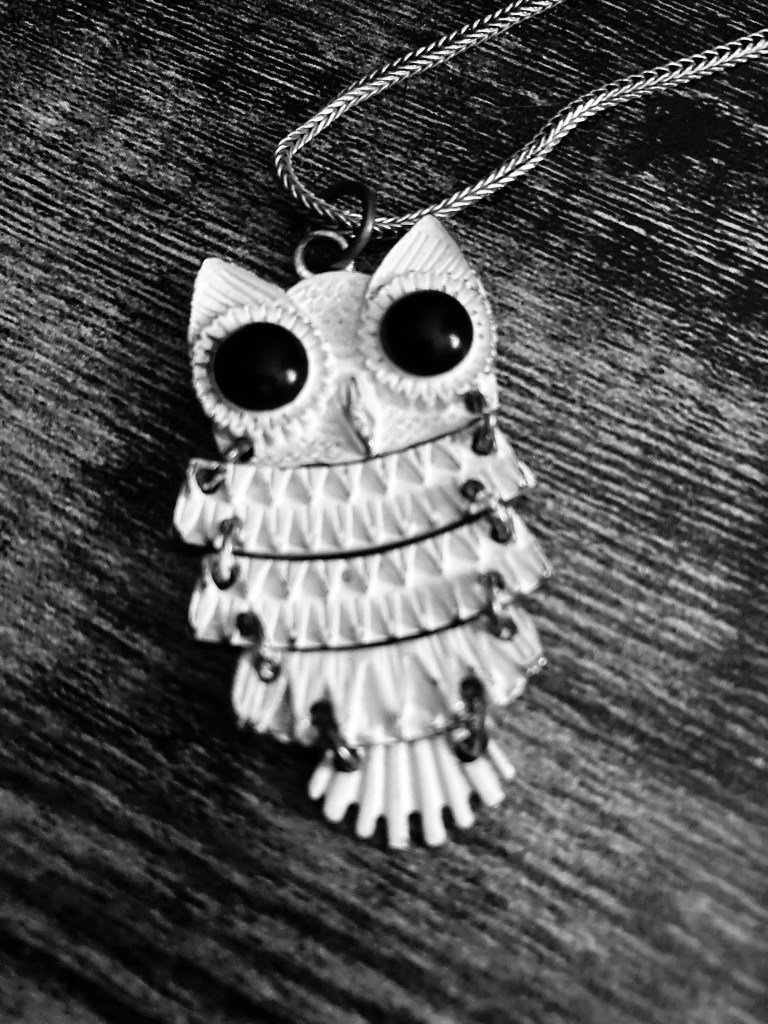
On my desk is a kitschy owl pendant I’ve had for over a decade. I rediscovered it recently, wear it sometimes. It landed on my writing desk at some point in the last week or two. It is almost unfathomable to recall who I was when I first wore it and who I am now. And I’m startled too to think of continuity, and what we retain of ourselves through all the years and all the changes, what has always been a part of us. What a victory, to be able to recognize and embrace all these parts and versions of ourselves, and where we are right now at this precise point in time.

Love, Cath

On Growth and Stillness and Glow

By Catherine DiMercurio

When I was at the pottery studio recently, we were waiting for the raku kiln to reach its final temperature of 1850 degrees Fahrenheit. We worked while we waited. I attached handles to mugs I’d thrown the previous day. I will mention here the details that occur to me as mattering. I worked with reclaimed clay. Scraps once discarded and brought back to new life with water and time and reshaping. I practiced different techniques for crafting the handles, all of which I find difficult, none of which resulted in the graceful form that I’d hoped for, all of which will be fired and glazed and useful and beautiful anyway.

The woman sitting at the table behind me was talking about how she did not like how the nights were getting cooler and that she could hear crickets now. As soon as you hear the crickets, she said, you know summer is coming to an end.

Had I been facing her or had I known her better, I might have started a cricket discussion with her. Is this true? I might have asked. I have cherished cricket song for as long as I can remember, and often lament the summers when it seems to start so late. I had just been thinking earlier that week of how nice it was to finally hear crickets at night. In my memory, crickets are associated with summer, all of it, not the end of it, but mind and memory tends to blur time and boundaries. Cricket song will always be one of my favorite sounds regardless of when in the summer it begins. But I’ve been thinking about what she said.

I thought about how, if this is true, about crickets being a harbinger of the end of summer, then in a way, they are like my favorite moon phase, the waning gibbous, which I’ve written about here before. It is something that to me symbolizes a period of calm in the aftermath of the large, chaotic wildness of the full moon. It also reminds me of the lines from one of my favorite poems, Wallace Stevens’s “Thirteen Ways of Looking at a Blackbird”:

I do not know which to prefer,   

The beauty of inflections   

Or the beauty of innuendoes,   

The blackbird whistling   

Or just after.  


There is so much I love about “just after” moments. Maybe for me, it is a way to prolong a moment, because in the moments after, if you are of a mind (and a heart) that is able to fully savor, it’s almost as though you are still living the actual moment.

Sometimes I wonder, though, if I have difficulty in fully living in the moment. Is the pleasure I take in the “just after” moments merely the counterpoint to the anxiety or anticipation that I often experience before the moment? And do both overshadow my experience within the moment itself? Maybe sometimes. Not always.

Take the raku firing for example. It was explained to all us students the timeliness of what would happen the instant the kiln was opened, how we must briskly but safely retrieve our pieces. Sometimes, based on the choreography of the kiln, we’d need to wait a moment until someone else removes their piece before we can safely access our own. Such was the case with my piece. And in that moment of waiting, I stared at the vase glowing in front of me. At that temperature, all the ceramics glowed like bright stars. My piece had some carving in it, vines and leaves. And because in those places the clay is thinner, they shone even brighter. And it felt like the image was burning itself into my memory. I wished I had been able to take a picture, but there is no time for such things. You have to move quickly and get your piece into a metal bucket filled with newspaper. The paper catches on fire. After it burns for several seconds, you put the lid on it. This is a reduction environment, with a limited amount of oxygen, and it is where the magic happens. The oxygen is consumed by the burning of the combustibles. This creates beautiful effects in the glaze.

Still, regardless of how much you make of a moment, or just after, or just before, they are all only moments. We might be able focus our consciousness during them to experience them more fully, but they last as long as they last.

When I think about how I want to live, I think about moments a lot, and how to make the most of them, whether they are blazingly beautiful and exhilarating or whether they are strikingly ordinary. I think too, of the moments we’d like to forget. Certainly there is a lot of talk about learning from difficult things, and how this is the method to discover value in mistakes and tragedy. Too often, too many of us get stuck there, in this search for meaning. I get overwhelmed by the need to understand the whys and hows of bad things. I replay them in my head from all the angles and look at what could have been done differently. And I do that because the world has suggested that this is a way of making them “okay” somehow, if I at least learned from them. But, what if I didn’t learn the right lessons? What if I didn’t learn enough? We are told we are doomed to repeat past mistakes unless we really and truly learn all the right lessons. But we are also told not to dwell on the past.

Because my brain has formed this habit of overanalyzing past pain, errors, and difficulties, I began to believe that if I failed to learn from the past—enough things, the right things—then I invited nothing but pain and tragedy in the future. But this is a miscomprehension, and one that can leave you frozen. It’s not that the past has nothing to teach us, but it is one class in a full schedule. It’s not the only way, or the only thing, we learn.

Photo by Skyler Ewing on Pexels.com

And one of the things I’ve learned is that it takes focus and endurance to shift our gaze from past lessons and look at other areas of experience. Sometimes we have to keep opening our hearts and looking at the world with a fresh eye. We focus, with all our strength, on the unfurling of fern fronds, and the way lake water baptizes our hearts into their new whole selves, and the way peace stretches roots within our lives when we invite it there every day, and on the star-glow of freshly fired clay. Maybe we must be clear about what we’ve won, not only what has slipped away as loss, and be just as clear-eyed about what we willingly trade every day, as in, I will accept the occasional storm of loneliness so that I can steep myself in calm for as long as I need to, for as long as it shows me how to grow, even though unfurling happens in increments so whisperingly minute it looks like standing still. But it isn’t.

I’d like to say that I find myself at an inflection point: tired of trying to learn everything I am supposed to from the past and ready to refocus my gaze. Yet, I’ve been inflecting. I’ve been at this, refocusing, shifting, turning, for many moments, but because it is so gradual, I sometimes forget that what looks like standing still from the outside can feel like standing still from the inside too. But it’s not. [And also, is there anything wrong with stillness? No.] Physical growth can be demarcated on a wall, a pencil line scratched into poplar molding glossed with white latex paint. I remember the smell of my children’s hair as I marked their height, the earthy sweetness of their sweat, the scent of the summer air clinging to each beautiful strand on their scalp. But how do we mark out our own growth as adults, out of the lattice work of our own pasts and into who we are now? There is no pencil for this, no wall, we simply keep going and wondering. We are unfurling, whether or not anyone can see it. When we think but I am trying so hard we must believe in the efforts we are making, whether or not our growth can be demarcated with pencils or moments or star-glow or nothing at all.

Love, Cath

On Donkey Tails and Butterflies, or, an Alternate Theory of Happiness

By Catherine DiMercurio

When I was much younger, I used to think of happiness as something fixed, the donkey’s tail reunited with its waiting body at a child’s party. Life was the twirled and blindfolded eight-year-old, and when they pinned the tail, whether it found its way to the donkey’s nose or flank, it stuck. I used to think that it would stay stuck. I counted on it, as one does when one is young.

Still, even when it didn’t stay stuck, I assumed that there was always another chance, another spun partygoer who would make an attempt to once again affix happiness to my waiting existence, and it often worked this way. I felt lucky. And patient. I could wait it out. Wait for the next chance, and then prance ecstatically once again, when that magic reunion happened.

What I didn’t count on were the people in my life who were less optimistic about the return of happiness to our waiting bodies. They seemed to assume that once it had fallen away, that was it, game over. What they never understood was that the odds were in our favor. It would return, it always did if you believed it would. What I had to learn was that while there was chance involved, and luck, and optimism, you also had to make yourself an easy target. You have to watch the way everything is spinning and try and get out in front of it. Be hopeful and easy and trusting that it is on its way back around.

I lived that way for a long time, trusting and certain that happiness would make its way back to me. Sometimes it was just so easy, how could I not believe that? But when the person you’re with has a different philosophy, as a pair, the two of you become a less likely target. And then, when you’re no longer a pair, you find that you’ve begun to doubt your own beliefs. Life becomes less like a dizzy, capricious child at a party. Happiness is bestowed less easily and frequently. It becomes something you pursue instead, a quarry that seems to prefer remaining hidden, and life provides countless obstacles that make the hunt even more challenging.

Everyone is always trying to figure out how to find happiness, how to keep it, how to be it. But I remember that I once simply cultivated peace and contentment, and I enjoyed happiness when it found me. But I didn’t expect to permanently live in a state of it. I made myself an easy target for it. I practiced the good habits that made me feel healthy and whole, and when happiness found me, I was there for it. Ready to soak it up. There is a way to bask without grasping for it, without trying to bottle it up like so many fireflies.

I feel as though I have forgotten some of my former way of being, my pin-the-happiness-on-the-human philosophy. With the ebb and flow of life, with the stress, and the changes and the losses life throws our way, it seems sometimes that we are made of steel, that there is no soft surface any longer for happiness to be affixed to. It doesn’t help that a lot of the messaging we’re bombarded with tells us that happiness is something that we should be striving to fully embody at all times. That unless we’re able to say, I AM happy, simply feeling happy sometimes is somehow not enough. It’s easy to conflate being and feeling, especially when we’re young. It’s that notion of happiness being affixed, the idea that we have it now, as if there is permanence to it, which makes the losing of it harder to bear.

Photo by Hebert Santos on Pexels.com

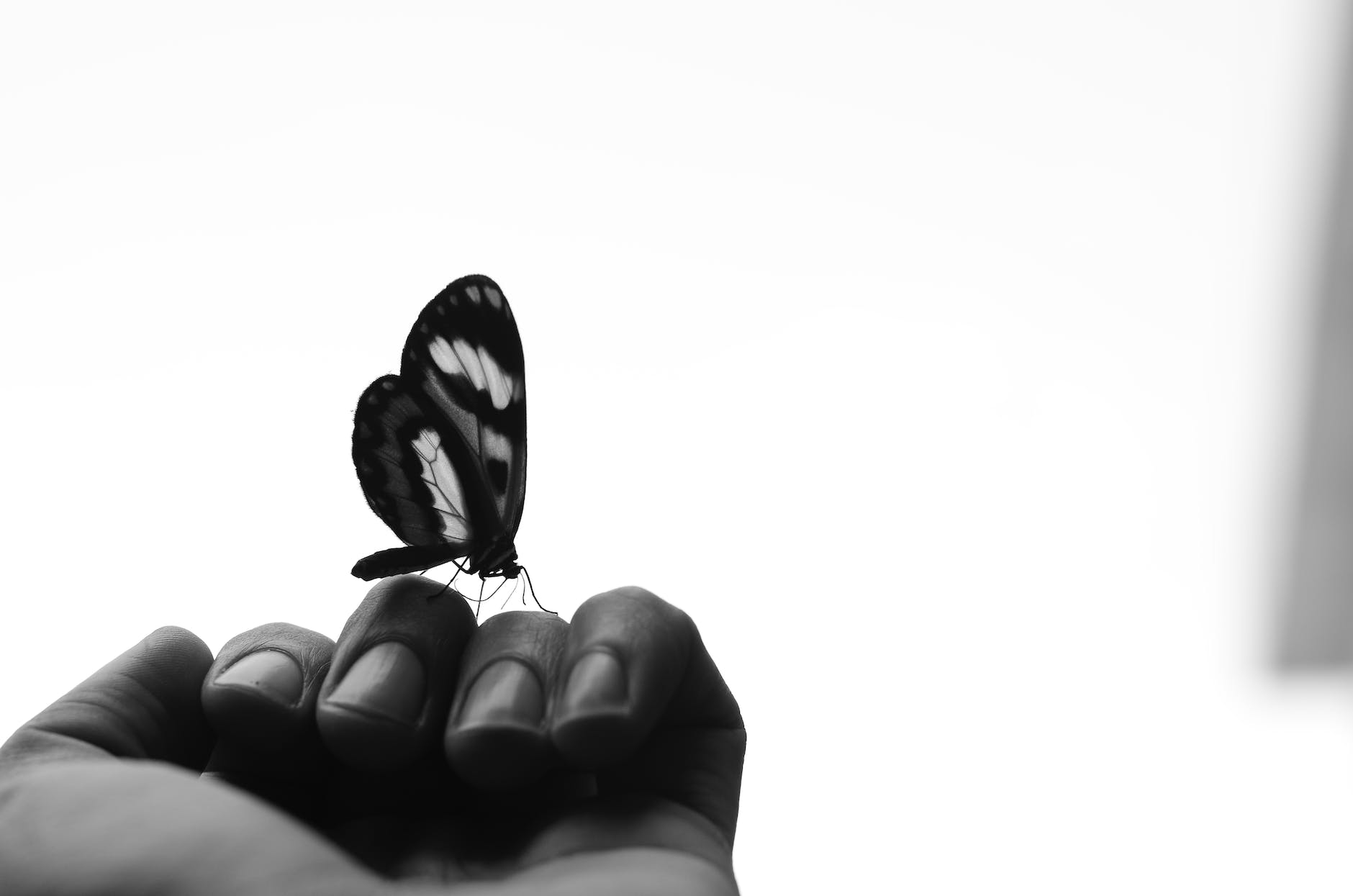
But if we acknowledge that it is a transitory thing—something that lands on us when the conditions are right the way a butterfly lands on you when you’re standing very still in the sunshine and wearing the right color—the loss of it is softened. If we stop demanding happiness, searching for it, clutching it, then maybe when it finds us, we can enjoy it more fully, and when it flutters away, we’re not left with a shattering loss, but rather, the peaceful and contented state we have been cultivating, and which we were in, before the butterfly, or the tail, alighted upon us.

We attract happiness in the way we construct our lives, but that doesn’t mean we can live in a permanent state of happiness. To expect to do so invites disappointment and even despair. But we open ourselves to it, and we control what we can. We monitor and tend to our health—physical, emotional, mental, spiritual—and we are careful with those we surround ourselves with, drawing near to us those who encourage us to be our full selves, who don’t diminish us through word or action. Life has taught me that there is a high price to pay for being with someone who prefers a certain, constrained version of yourself to your actual self. And even after you realize it, the rebuilding of self takes a long time.

I have a theory that when the quest changes from how do I find and keep happiness to how do I cultivated peace and contentment, happiness finds its way to us with more regularity anyway. I also believe that peace is not arrived at through conflict avoidance but instead through a reverent attention to self-growth, self-acceptance, and self-respect. It’s different for everyone, I’m sure. But after a confusing decade filled with so much change and so many beginnings and endings, taking time to look inward has made the most sense to me. And doing so reminds me of all the earlier iterations of myself and what worked and what didn’t.

This morning I woke earlier than I have been lately, and it was still dark outside when I let the dog out. I recently strung fairy lights beneath the newly painted patio area. They are solar lights and I am often in bed reading before I really have a chance to spend any time beneath them in the evening, so it was unexpectedly joyful to have them still glowing this morning, when I was out with my coffee and the pup. I felt happiness rustling nearby and I let it find me, let it erase my grumpiness at having woken too early after a restless night. I created that outdoor space for just such an experience. It’s filled with flowers and comfy furniture, and though it’s rustic and imperfect and really needs to be rebuilt, it is doing exactly what I hoped it would do: setting the stage for the peaceful and contented mindset I’m trying to cultivate. And in this environment, happiness alighted, and affixed, at least for now, which is all that we can ask of it.

Love, Cath

On Creation, Waiting, and Time

By Catherine DiMercurio

I don’t have a record player but periodically I think of getting one and it seems every time I do, it’s after I heard a Tom Petty song. I recently listened to a snippet of an interview with him in which he was talking about the process by which he wrote “The Waiting.” You know that one. The waiting is the hardest part. Every day you get one more yard. You take it on faith, you take it to the heart.

He was talking about how a bit of the melody came to him and he played it over and over again for weeks, and then the chorus, same thing. He just played the same thing over and over. The snippet cut off after he talked about somebody knocking on the other side of the wall telling him not to play it anymore but presumably the rest of the song came to him this way, in pieces, over time.

I wish I could speed up processes sometimes, creative processes, learning processes, healing processes. It’s like I’m always waiting for my ability to catch up with my creative energy. My results don’t often match the vision I had in my head and I’m chasing the kind of book I want to write or piece of pottery I want to create. Or, the life I’m trying to build.

I look around at the things that seem to come easily for people and long for something like that for myself. I feel wildly impatient with my slow pace in nearly all things. Sometimes I feel as though I have the mentality of a perfectionist but not the talent, or results, to show for it. I am not meticulous. I am a messy learner with almost no eye for detail. I am full of earnest trying but am frequently wanting something more to show for the effort than what I was actually able to produce. I wake up too early and agonize over glazes I applied too thickly despite my best efforts in pottery class or fret over stories I’ve been submitting for years that keep getting rejected. I wonder, when is it going to all come together, and, what have I missed?

And then, things come together a little bit, all at once. Last year, I did get two pieces of writing accepted at literary journals and they finally were published this past week, within twenty-four hours of one another. And the glazes I’d been so worried about turned out fine, and I threw well that night at pottery class. I enjoyed it thoroughly, that moment where things coalesced in a brief way, knowing that such moments never promises anything. Any future success in either art form will be just as hard-earned and the waiting in getting there will continue to be the hardest part.

I look at all my impatience and I wonder where it’s all coming from and why it percolates everywhere for me. For all my striving toward self-acceptance, this feels out of place. When I step back, I can see that it isn’t there all the time, but it comes back to me, maybe when I’m feeling low about other things. I am trying to pause and consider why it matters so much that I learn faster, glaze better sooner, write and publish more now, etc. I think a lot comes down to validation.

If I’m producing “good” work in a visible way it’s proof, right? I mean, that’s how external validation works. We believe that if others can see something of our “goodness” or “value” then maybe it’s easier for us to believe in ourselves. Alternatively, it simply is enjoyable to feel seen, to have someone else confirm what we’ve been cultivating in ourselves, i.e., a sense of our own worth. For so long, I thought the goal was to not need external validation, that there was something wrong with wanting it. So, I worked diligently on trying to find where this need arose from in my past, how it came to be that I felt unable to sense my own worth. I work at rebuilding my sense of self in the same way that I create, revise, and re-create art in the mediums I’m working in now: clay and words. I’m continually learning how to be me in the same way, with the same habits of working and trying and reshaping and revising. I hum the same bars over and over for weeks. Still, I’m coming to understand that it doesn’t all have to be internal. We must feel safe and good and loved within our own skin, but it also feels good to have someone tell us good things. There’s nothing wrong with enjoying that.

Many people struggle with feelings of not being “enough” or “good enough,” and all for different reasons. I’ve dug into my own reasons, determined to understand them better, because I have found that the only way for me to cultivate healthy self-perspectives and habits is to use precise and loving language in my internal thought processes, language that responds specifically to the lessons and events of my life that wired my brain for self-criticism and an extreme response to anything that feels like rejection.

I am impatient with all this, but I think one of the reasons it takes so long to recover yourself from various types of wounds is that you often can’t face it all at once. It’s too much. It was too much for me to heal in a smooth and linear way and all at once from a twenty-year marriage ending in the storm brought on by my then-husband’s alcoholism and infidelity. Some wounds feel as though they change us at our core, forever, and after bearing the initial brunt of that pain, we begin to understand that the only way to survive it is to take breaks from it. We turn away, we look to others for help. Then we go back to it when we’re strong enough and rested enough.  

Photo by Tima Miroshnichenko on Pexels.com

What I need is to believe that I have time. That I can keep conquering what I need to, that I can keep writing and learning, that there’s no need to rush. But we live in an urgent world that is always proving that nothing is promised, certainly not how much time any of us have left. But I need to believe that I have time, anyway. That my own pace for healing and nurturing my sense of self, for building my writing self into who she is becoming, for learning all I can in an artform as elusive and slippery as wet clay, is all sufficient. I need to believe that because whenever I try to rush things, something is sacrificed. Whenever I grow too impatient, I wind up falling into a dark place and my energy is then focused on pulling myself out of that instead of all the other things I’d rather be doing.

In a way, that’s my own version of blind faith: that I have time, that we all do. To keep creating the person I want to be, the life I want to have. My pace is neither fast nor slow, just mine, is what I tell myself. The waiting for it all to come together will always be the hardest part, because that’s where all the living is, in the waiting. The moments when things coalesce are fleeting, and the rest is creative energy at work. There is so much beauty and art in the waiting, even if it is the hardest part sometimes.

Love, Cath

On Rage and Other Big Things We Don’t Like to Talk About

By Catherine DiMercurio

I took my rage for a walk the other day because the only thing that made sense was tiring it out. I wondered if it was more like a toddler in tantrum or like a puppy full of energy to spend. But the rage—my rage—was unlike either of those things. It wasn’t innocent frustration opposing the structure of its world and it wasn’t joyful and bored and antsy. It was more sophisticated and self-aware, and I couldn’t think of it in a way that made it seem cute and small and not very dangerous. It was not cute, and it felt volatile and intimidating.

On my drive out to the woods, the rage quieted. Simmered. Waited. I was tired of trying to talk myself out of it, just because I didn’t know where it came from. I was tired of trying to figure out all the reasons I felt so full of this surging and unpredictable reactive energy. But I did it anyway. Was it because of the world at large and all the ways it is hateful and crumbling? Was it frustration with life and how there’s no way off this treadmill of working to pay for a roof over your head and having little time or resources to ever do much else? Was it this new and uncontrollable bristling I feel when I encounter inauthenticity? Or was it the powerlessness I feel when I witness people abandoning themselves the way I once did, in service of people or situations that were hurting them? Or was it simply grief’s companion, still flailing over all the things that still hurt?

I don’t know that I learned how to properly self-soothe as a child. People tell you to calm down but they don’t tell you how. I’ve spent a lot of time figuring out what to do with myself when emotions feel too big for my body. When my kids were young, I would tell them to not do anything with their hands when they were angry because we’re so much stronger when were mad. Mostly this was to keep them for hurting each other when they were upset. We talked about different things they could do when they felt that way. Scream into or punch a pillow. Jump up and down. Take deep breaths. But we probably didn’t talk often enough about all this. I was still learning myself, but I suppose a lot of parenting is like that.

Now, as I began walking a trail covered in snow, several inches deep but packed down by other feet and frozen into other shoe shapes, my own boots slipped and slid. I had decided by then to just let myself be angry instead of trying to figure out why it had appeared out of the blue without an obvious trigger. I tried to not be resentful this time. Fine, be mad, I sometimes told myself, all the while feeling a meta-anger, that sense that I was mad about being mad.

This time, I tried to be agreeable about it all. Okay. Today we’re going to be mad, I guess. It’s okay to be mad. I tell myself this now. Because it is, even though I don’t like how it feels inside my body. And I did try to impart this to my kids, too, that it’s okay to be mad but it’s not okay to take it out on other people. But whenever I tried to apply this lesson to myself, I kept trying to talk myself out of my feelings. Maybe I was told too many times that I didn’t have anything to be mad about.

I have this idea that as an adult I’m supposed to be calm and in control of my emotions all the time. I have a habit of judging myself for the “negative” emotions that take me over. In a way, trying to figure out all the reasons I might be mad felt like an attempt to justify, to counter the “you don’t have anything to be mad about” charge, like part of me was yelling, yes I do! It’s as if I’ve been seeking permission from myself to be angry. I have embraced sorrow. When it visits, I let it stay as long as it needs to. I feel it, I talk to it, I cry. I let it have its say, and that seems to matter. But I’ve been afraid of doing this with rage. It feels too big, unstable, uncontrollable.

As I hiked through the snow, I turned on the path that leads to a loop through a big, open, hilly field. It’s a less popular trail and the snow was fresher here, less hard-packed by the few hikers who had passed this way before me. It was deeper to trudge through, and it felt good, pushing through the snow. I checked in on my rage and it felt like it was diffusing a bit. By the time I’d finished five miles, I felt tired and refreshed. The rage had loosened its hold on me, glad perhaps that I didn’t try to tell it to go away, that it didn’t have a right to be here.

On the other side of rage, it is sometimes easier to see that it’s often about fear and things we have no control over. I always want to understand it because I’m afraid I’ll miss something. People say that you should listen to your anger because it’s trying to tell you something, point you in the direction of something that needs healing.

But the tricky part about healing is that it doesn’t mean something stops hurting. At least, not so far.  Sometimes we’re pointed in the direction of our pain and all we can do is recognize and honor it, just like we do with the emotions that brought us there. We self-soothe as best we can. We cry, take a hot shower, go for a snowy hike, scream into a pillow, ask for help or a hug, snuggle the dog. Sometimes we simply must take a deep breath and get on with our day.

Maybe healing is simply showing up for yourself, again and again, without judgement. Without criticizing yourself for having grief, or rage. I think all of us are all the time trying to heal, from big psychic wounds that we never saw coming and stay with us for decades, and from all the little things that gouge at us more recently.

For a week I was not able to pinpoint what it was that had made my insides churn with a rage that seemingly had nothing to do with my life at the moment. Everything had been relatively calm in the days preceding and then I woke up and the rage just hit me. I’ve spent the week thinking about it, and telling myself to stop thinking about it, that the why doesn’t matter. That I did the right thing in finding a way to let myself feel it safely. Anger is a big emotion and it made sense to enlist the woods and the solitude and snow to help absorb it, and that worked.

Photo by Kris Lucas on Pexels.com

But it still bothered me that I couldn’t pin it down. This morning, a week to the day, I woke up, and as my amorphous thoughts gathered into language like raindrops on a windowpane melting into one another, I thought, I’m mad at myself for still feeling grief. I don’t want to feel this way. I don’t think I should. But I do. As I walked myself back through the previous week I realize it all started with a dream. I’d woken up, been frustrated that my subconscious was still nursing old wounds, but I didn’t give it another thought. Then as the morning wore on I realized this rage had seeped in from someplace, seemingly all of the sudden. My dream had been forgotten. And I didn’t put it all together until now.

Our minds and hearts operate in strange ways. In the calm and safe world I’ve built for myself, my brain works on things while I sleep, in ways I do not understand, but in waking life, I’m left to process it all along with the residual emotions. I suppose it is all happening the way it should. The part of me that has waited for me to be ready to do this part of the work is nudging me. But sometimes it feels like a war between two voices inside me, one saying you don’t get to be mad at yourself because things still hurt, and one saying, just watch me.

Maybe it’s my job to be the peacemaker. To tell myself that my anger is a valid response, especially since, if I pick it apart, I can see that it isn’t solely anger at myself for still hurting, it’s anger at the people who hurt me, and anger at myself for “letting” them. In peacemaking, I can allow safe spaces for the anger to exist and expend itself, to rise up when it needs to, just like I’ve learned to allow with the grief. Maybe my anger just needs some time alone with me, away from grief.

I don’t know if it will ever all dissipate, or if all these disparate parts of myself will peacefully coalesce, like those raindrops on a windowpane. For now, though, there’s not much I can really do except keep listening, and making space when the big emotions show up and demand attention. Maybe healing is simply showing up for yourself, again and again, without judgement. Maybe life is.

Love, Cath

On Not Knowing, or, (Not) Navigating Deep Water

By Catherine DiMercurio

I’m not sure why, but part of me still clings to this idea that the clarity I look for as I navigate some of the things I’m struggling with is something that will reveal itself to me as a shout, as a brand new beginning, the shiny other side of the coin, freshly tossed. I want to cross over along the timeline, from one side of a vertical line to the next. To say, definitively, I am here now.

But what the world has tried to teach me over and over is that everything is non-linear. Even a circle would be a welcome, familiar shape, but my life is not that either. Despite the continuity of my days, my carefully cultivated habits and routines, my inner world zig zags, soars and dives, as much as the chaos of the world outside my door.

I began writing this several days ago, firmly convinced I understood my mindset on a particular issue. I had decided I was Done, yes, with a capital D, with dating apps, Done searching for a partner, Done with the false (?, hopefully false) urgency of a timeline. Done with that feeling that I would somehow run out of chances or will or heart if I didn’t meet someone in a certain number of months or heartbeats. I don’t think there is a biological clock to this part. Though, I suppose future-me might wake up one day and wish I had tried harder sooner. But we do what we can, when we can. Don’t we? Don’t I? I mean, it is already too late for some of the dreams I once had. I have run out of time to ever celebrate a 61-year anniversary with someone, as a friend’s post about her parents celebrating their anniversary reminded me. I once had dreams of celebrating those types of anniversaries, but I’m aging out of that possibility. Letting go of that, as I’ve tried to do for some time now, means there really isn’t a clock ticking in that sense anymore. If I do meet someone, I’ll likely wish we’d had more time together, whether I met him tomorrow or in five or ten years.

So, I had let myself be Done. For now. For as long as it feels good to be doing the kind of growing and listening to myself as I’m doing now. Until I know how to do that no matter what. Until it’s like breathing, and something that won’t be abandoned like an ill-conceived New Year’s resolution the second I’m dating again.

Because I don’t want to go back to that way of loving, and I’m scared that I will. I wonder, was the reason it felt so good to be completely consumed by a relationship that I had little knowledge of or respect for myself? Did I enjoy losing myself because myself was such a flimsy concept, easy to let go of, so much so that I didn’t realize that she was lost?

Before I decided to be Done, I had grown more careful, deliberate, about who I entered into conversation with on those apps. I didn’t want to enter into anything nonchalantly. If I was going to expend my limited social capital, it had to be on someone I thought there was a chance with. I didn’t want a collection of first dates with men I didn’t plan on seeing again; I wanted to meet someone who was also looking for something long term, not just gathering with me out of sense of gathering loneliness.

I’m not lonely, which comes as a surprise to me. I have periodic moments or hours, maybe even a day or two at the most, of deep, sharp loneliness. But it is something that happens to me and falls away. It isn’t what I am.

I’ve leaned into that. What does it mean, then, to not be pursuing a relationship? I have always been in a relationship, or in between relationships. Being single but open to something happening still felt for a long time like many things: expectation, hope, wish. The natural order of things had been, for so long, that I was partnered. I always thought that I was a better me with someone else, but I didn’t have much to compare it to. If my time alone were drops of water, they would have filled a few drinking glasses, whereas my time with a partner over the years, between my marriage and my post-divorce relationships, filled up bathtubs. A swimming pool maybe. But, on my own, I am something else entirely. Something that can’t be measured by way of shallow, domestic containers. On my good days I feel like a lake, carved fathoms-deep by ancient glaciers. I have always been this same person, even when in relationships, but I didn’t know her yet. And if I didn’t, neither did the men I was with. How could they?

Photo by Miguel on Pexels.com

I often feel slow to understand things. My comprehension feels impaired by an onslaught of input. I’ve regarded myself as deep-thinking, but not quick-witted. Brains work differently. Mine is full of images and words, teeming with them. I can only handle so much external input at a time. So when I look back at what it was like to be in relationships where I prioritized the needs of my partner over my own (and unpacking that tendency is a whole different series of essays) it is no wonder that I have been slow to know myself. Think of all that additional input! Not that you can’t learn anything about yourself in a relationship. I can and did. But because of the way I was going about being in a relationship, there were things that I couldn’t learn about myself until I was on my own.

But for some reason I felt as though I needed to commit to the idea of being Done. To say, I am here now, on this side of that line. I felt as though I had to say, I know exactly what I want and it is this. That way, I know what to do, or not to do, next. When I had a tug of longing to be with someone, I then wondered, did I commit to the wrong idea, the wrong game plan? Do I still want to find someone?

The bottom line is, I don’t know, and I’m not comfortable not knowing what I want. It feels like failure. It feels like lack of insight, not knowing my gut. It feels wrong, and as if it must be remedied. It feels like wasted time. If I knew what I wanted, I could pursue it, and get on to the next part that much faster. It feels like something I ought to be ashamed of and I’m not sure why. Maybe it is because by now I should have this part figured out?

How can I not know what I want? I feel like I was always supposed to know. What do you want to be when you grow up, where do you see yourself in five years, etc. We’re supposed to be able to visualize it so we can manifest it, right?

I think one of the reasons I don’t know what I want in terms of a partner is that I’m figuring out what I want in other areas of my life. I know that I want to continue to pursue both writing and pottery, and I know that I can’t do either of those things without my “real” job that keeps a roof over three heads, mine and the two dogs. And I want a big enough roof so that when my kids come home to visit everyone has a place. And I want to nurture relationships with family and friends, connections that mean so much to me, that have on and off over the years been largely neglected when I was busy being totally consumed by romantic relationships that I let swallow me up. All of this adds up to a fullness I didn’t realize was possible. Sometimes I can’t imagine where a partner would fit into all that, possibly because I’ve never had a partnership where the fullness of both people’s lives was respected and nurtured in a healthy way.

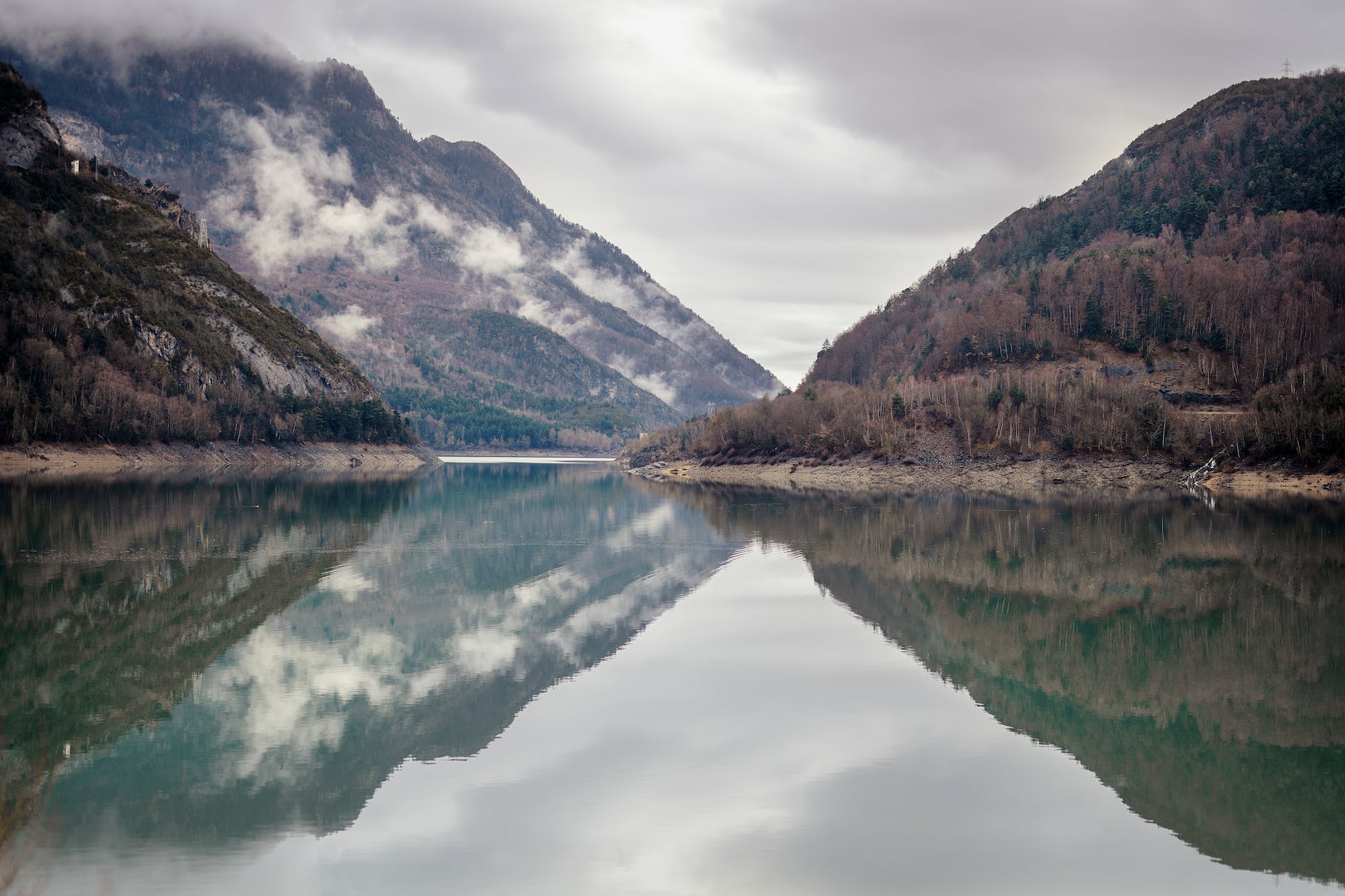
I think the most important thing for me right now is the idea of embracing the mindset of not knowing, instead of fearing it, or, embracing it and the fear. It’s a little like swimming in deep water with no shore in sight. Yet, when I think about it, when we struggle with understanding ourselves, we are, in a way, both the swimmer and the deep water. We can keep ourselves afloat, or we can pull ourselves under. We are vast and deep, not easily navigated, and there is no shame in that. Oddly, what I am finding, is that a person can be true to themselves without having it all figured out. 

Love, Cath

On Lanterns, Looking, and Home

By Catherine DiMercurio

Many people have been inspired by the line Emily Dickinson wrote to a friend, “I am out with lanterns, looking for myself.” It struck me today too, as I came across it again.

Recently, I was texting with my firstborn, about various things, but the conversation turned to the idea of home. Several months ago, I helped them and their partner move from the house they’d been living in with too many college housemates into their own place, one of those quirky Ann Arbor apartments comprised of a collection of rooms in an older house. It is cozy and suits them. My child was telling me that they finally have a place that feels like a home that is their own. This delights me: my child feels safe and happy, in their own place, in a healthy relationship.

Less recently, though it still feels like yesterday to me, I moved out of the house I’d lived in for twenty years, raised my kids in, lived the best and worst years of my marriage in, into this little ranch house in a different suburb, not far away but very far away from where I used to be. And I only feel that my new house is home some of the time. I do love what I’ve built here, that this house is a reflection of my personality, filled with books, watercolors, pottery, artwork from friends, and dogs. It is cozy and it suits me. But sometimes, it doesn’t feel quite exactly right. It’s like a newish shirt you mostly love but when you put it on you remember that the tag is itchy. Sometimes. Other times, like now, everything feels safe and good, happy and peaceful. It’s early morning and I’m drinking coffee from a mug I threw and glazed myself. I’m snug under a blanket I crocheted years ago. The puppy is cuddled up next to me. I’ve decorated a small tree—my solstice/Christmas/winter magic tree—and strung up some colorful lights. I feel lucky. I have created peace and stability for myself in a way that several years ago I wouldn’t have ever thought possible.

When I feel restless, or have that what am I doing here feeling, I know where it comes from now. When loneliness hits, it is usually from two directions. One is from the past, from the part of my life where I woke up in the same house as my children for the first 18 years of their lives. I don’t think it matters how full your life is as an empty nester; part of you is always aware that the loss you know was coming is happening. That empty space takes up space. The other direction loneliness attacks from is from the future. We all have points in our lives, after the loss of a meaningful relationship, where it feels as though the future we had anticipated is being erased, like an Etch-a-Sketch turned upside down and vigorously shaken. As new relationships unfold, we wonder, is this the future, beginning to take shape? When those dissolve too, it feels like starting all over, with the future blank again.

I also keep forgetting that “the future” is not a single fixed point. It is hard to embrace the idea that nothing is really fixed, as in, a single unchanging point in time, and fixed, as in finally and fully repaired. Everything is in perpetual motion, our healing, and where we’re headed. What happens next is the same thing as how am I continuing to grow, and it appears in my mind like night, with a sky full of stars, and I’m out wandering, with my lanterns.

Photo by Burak The Weekender on Pexels.com

And all of this is tied into the idea of home for me. The house I currently live in blinks on and off, in a way. It feels like home, and then it flickers, and the feeling fades, and then it’s back on, steady as ever. What I’m beginning to realize is that it is less about this house and how long I’ve been in it, and whether or not my kids have lived here, and more about me being at home with myself. This feeling is getting stronger and stronger with me, after years of faltering, and looking for home in someone else. I didn’t even know that feeling that way about myself was possible, or important, until recently. It’s beautiful to think of home as either where you were raised, or, being with the people who love you regardless of your physical location or place of residence. But feeling at home with yourself, knowing that you are the safe place and you are the someone who loves you, that is something else entirely. I love that this is happening for me, that I finally thought to look for it, and that the feeling is becoming fuller and steadier.

Sometimes when I’m out with those lanterns, I’m not really looking for myself anymore. Sometimes I’m feeling found, and I’m just enjoying a starry walk with myself. But I do know that everything changes, especially selves, and that I am no more a fixed point than anything in future. So, to some degree, I’ll have to be out looking with some regularity. Sometimes that’s a scary thought and sometimes I’m just tired, but it feels important and necessary.

I keep returning to these same ideas over and over but sometimes we need to keep hearing the same message, whether from ourselves or from outside sources, multiple times as we learn and grow and acclimate ourselves to new ways of looking at things. For me, this is part of being open hearted. To grow, I need to be patient with myself, with the way I learn and the pace at which I learn. So I’ll be out there with lanterns, as usual. Maybe I’ll see you there.

Love, Cath