On Winter Gifts and Safe Harbors

By Catherine DiMercurio

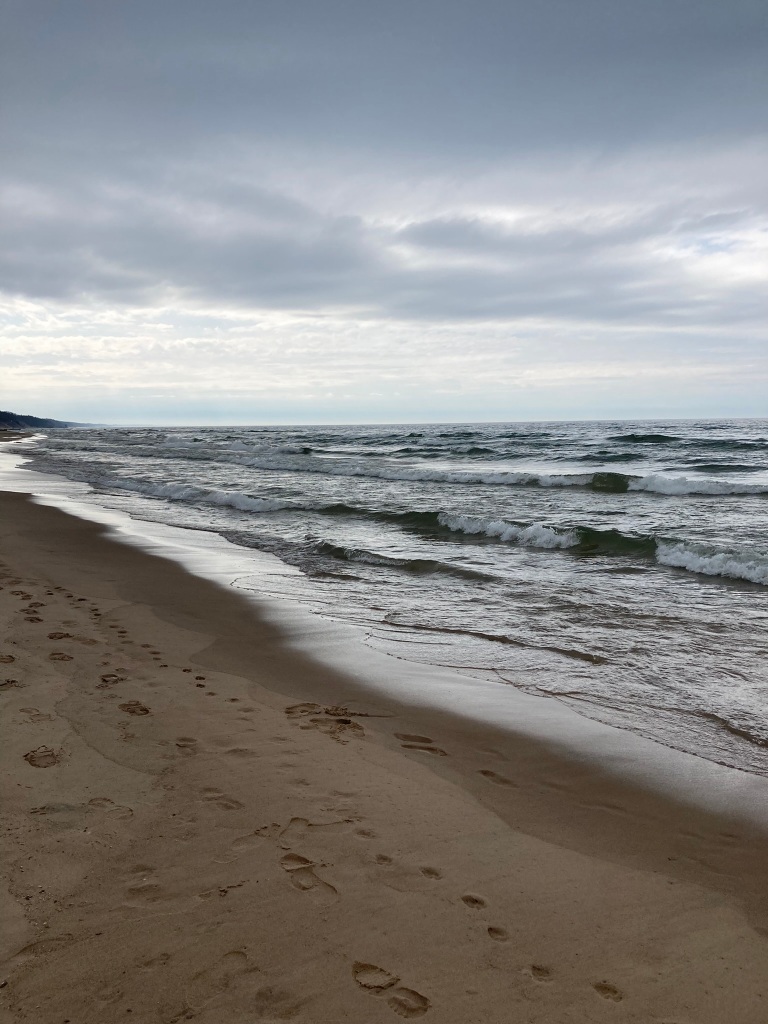
As I walked along the snowy beach, the lake splashed against the frozen droplets of former waves at the shoreline. It was wondrous with the sun sparkling across the waves and the icy beach. I slid across frozen puddles, crunched across the ice that rippled like a memory over the windswept sand. I never expected to enjoy a wintry beach walk quite so much. I talked to the lake like an old friend, thanked it for being deep enough to receive my troubles and old griefs without finding me “too much,” without resentment or judgement.

It has been a year packed with some big transitions, which is why, when winter hit so suddenly and forcefully a couple of weekends ago, I didn’t feel prepared. It was a big snowfall, followed by another heavy round a couple of days later. And since, we seem to get another few inches every couple of days to add to the two feet of snow already on the ground.

I remember my father taking my sisters and I sledding when we were little, ice skating once or twice too. I wanted to like it. I did enjoy playing in the snow, building snow men and snow forts and making snow angels. But I remember being at the top of the sledding hill and feeling a sense of apprehension, a worry that we’d collide into the other children sledding down the hill. I wonder if I would have enjoyed it more if it had been just us. Skating never made sense to me. It wasn’t the kind of thing I was going to get the hang of on the first time out and since we only went a couple of times, there was not really a chance to improve, but I also didn’t enjoy the slipperiness, the falling. I felt clumsier than usual, and I was already a kid that got called klutzy. Despite growing up in a state known for its winter wonderland, I have always had complicated feelings about the season.

One Christmas Eve when I was still quite young, we were returning home after visiting my grandparents’ house. Our car spun and skidded off the snowy road and when it stopped, we were facing the Saginaw River. I don’t know how close we were to the river, but in my memory, I have this sense that we had narrowly escaped careening into the water. Maybe that’s why, years later, after I learned to drive, I would become extremely fearful of driving in snowy conditions. Of course I adapted, as you do when you have places to go. You do what you have to do. But possibly this early memory is at play when my driving-in-bad-conditions apprehension surfaces. Perhaps I also just have a strong survival instinct. That, and I don’t really trust other drivers who seem to have no sense of caution.

Combine all this with the anniversaries of some Bad Things happening in early December many years ago, along with the short days and lack of sunlight, and you get a very tricky time. Yet, there is a kind of unexpected vibrancy in this community I’ve landed in, a recognition of and appreciation for the natural beauty we’re surrounded by. People get out there and enjoy the lake and the woods and the fresh air in all kinds of conditions. It’s a bit contagious, even if, especially in winter, I have to work a little harder to get motivated to spend lots of time outside.

I’ve been doing okay though—snowy hikes, walks or drives to the lake, icy beach strolls, sunsets. Some days though I get hit with melancholy, or fatigue, or some other cocktail of emotions that seem to rise to the surface more readily in darker, cold months. Like many people, I walk a fine line between knowing when to let those feelings in, acknowledge them, feel them, deal with them, and knowing when to get out of the house and out of my head. I’m still learning what it means to feel the heavy feelings without falling into ruminating, stewing, spiraling.

At the worst time in my life, I felt as though I was constantly at risk of falling into a deep darkness that I would not be able to climb out of. In retrospect, I think I did fall in sometimes, though, at the time, I believed I was pulling myself up and out just in the nick of time. So when things seem heavy, I occasionally get a feeling of dread, as in, please don’t let this be that. But it has never been that again, thankfully. I have a lot more tools now, and I’ve had a lot fewer reasons to ever feel quite like that again. I don’t often give myself enough credit for the navigating I’ve done, away from dark places.

But here, where I’ve landed, I often look around at the beauty of my surroundings and thank myself for captaining myself to this shoreline city. Sometimes there are two selfs, the one who doubts and is often fearful, and the one who sees the path and makes the necessary choices and journeys. Do you believe me now? I’ve asked myself. Do I believe now that I can make the decisions that land me in the right places at the right time? Do you trust me now? We made it here, after all.

Photo by Anna Morgan on Pexels.com

At the end of my street is a marina. The joy those docked sailboats bring me, when I see their masts jutting into the sky as I stride down the hill, is both reliable and exhilarating. Reliable joy? What a gift! A sign reads “A SAFE HARBOR MARINA.” Safe harbor. How wonderful to discover that this is what we can be for ourselves, and what an actual place can feel like. Finding that feeling after a period of drifting and searching, of looking for belonging and not quite getting there, is as magical as the icy beach, or the gathered boats snug in their harbor. I hope this winter finds you in a safe and wondrous place.

Love, Cath

On Moving through This Particular Time and Space

By Catherine DiMercurio

These past several months I have felt as if keeping my head above water takes most of my energy. Each moving-related milestone felt less like a hurdle overcome and more like a wave crashing down on me, until it is over, and I can float a little, catch my breath a little, until the next wave hits. In the midst of all the painting I was doing this past week at the new house, I was fighting to do just that, catch my breath. The task felt overwhelming, the number of walls, the trim to either paint or tape off, the cutting in, the multiple coats, the clean-up, the way the plaster was so thirsty and gulped up all the paint, the cove ceilings and their delicate curves, the yucky and ancient vinyl floorboard molding in the kitchen, the ruined window frame in the living room.  

It’s been over a year since I got it in my head that I was going to move. I took my time with the process, knowing how much I loathe how urgency makes me feel. Winter and early spring were focused on clearing out the basement and making plans, and then in April and May I began to ramp things up with house repairs. Then things really sped up in June when I listed my house for sale and began searching for a new home in earnest. Now, I’ve closed on both houses. I spent a long weekend at the new house organizing some initial improvements—tearing out carpet and having a fence built—and cleaning. This past week, I went back to paint. It’s a task I always enjoy in the beginning, but by the end, I’m ready to be done. And this time the end didn’t come until the fourth room was painted on the fourth day. It was a big job, and like any home improvement task, it came with unexpected obstacles.

But, this isn’t going to be a boring home improvement post. I thought I wanted it to be about how good it felt to let this new-to-me but old house breathe and feel cared for again after a couple of years of vacancy. I thought I wanted to write about how I was trying to make this random place feel like my home. And I thought it was going to be about what a long, sometimes scary journey it has been.

Yet what is hitting me most right now, as a sit in my cozy current home now that I’ve returned from the painting week, is how confusing and chaotic prolonged transitions feel. Many people are in the midst of them now, with grown children off on new adventures or otherwise finding their footing in adult life. People are ending relationships, or starting them, or moving, or grieving, or changing jobs. Sometimes we go through big changes with others and sometimes we go through them alone. And we might have folks helping out where they can, but when we’re flying solo, the upheaval of big changes can hit especially hard.

Somewhere between wrapping up the painting of the bedroom and the office and the hallway and beginning the painting of the kitchen, I felt particularly wrung out and empty, and then I sort of remembered why I was where I was. Two miles west of me was one of the best stress-busters I’ve ever known: Lake Michigan. So that morning I made my coffee and loaded Zero in the car, and we drove the short five minutes to the lake to see the morning light play on the waves. We just stayed in the car, because we see off leash dogs all the time and that is not a great thing with a reactive dog whose training got derailed. I wanted this to be a moment of calm, so we stayed cozy, and watched the other early morning people go by, or do the same thing we were doing, viewing the lake from our cars as if we were at a drive-in theater. I’m looking forward to when I’m actually living at the new place, and I can go grab moments of lake-calm for myself whenever I need to. In this particular moment, I marveled at the way the light of the morning could be both bright and soft at the same time, and the way a gull sounds different when it’s swooping around the shoreline than a gull sounds in the old Kmart parking lot in the puddle of my childhood memories.

That moment was also a reminder to seek out calm wherever I am, lake or not. Because life can feel so big and so chaotic, whether or not we’re in periods of momentous transition. It’s not as if I forgot that I need to do that, or like I wasn’t trying all along to manage my stress with yoga and walks and early morning coffee in the yard with Zero and chats with family or friends. But sometimes we tell ourselves there’s no time, or that it won’t help anyway because there’s too much to do or our feelings of overwhelm are too great.

We tell ourselves a lot of things when we’re tired or drowning in all there is to do every day. We tell ourselves there’s not enough time to sit quietly in a safe place and catch our breath. Maybe we even tell ourselves there are no safe places, and it is tragic when that is true. But sometimes we’re still learning to be our own safe place and that takes time and practice. Sometimes we tell ourselves that we miss things that weren’t particularly good for us. Sometimes there were good parts to miss, but that doesn’t change things. We might ask ourselves why we ever thought we could handle the enormity of moving farther away than we’ve moved before and then we remind ourselves that we are, in fact, handling it. We’re almost there. We’re almost home.

And still, that doesn’t erase the hard parts. Holding two opposing truths within us at the same time can cause a bit of inevitable heartache. For reasons of financial and mental health, I need to go. To follow the dream of living near the lake, I need to go. Because I want to love where I live, I need to go, and at the same time, the fact that I’ll be almost three hours from my kids instead of half an hour hurts like hell. I haven’t made peace with that. I don’t know how to. And I guess, I don’t really want to make peace with it. I want that angst to keep motivating me to find ways to make it easier for us to see each other. I don’t want to slip in to “but it’s so far and everyone is so busy.” I want to remain highly motivated to find someone who can watch my sweet but challenging pup so I can take off for a long drive and a short visit, or to take a weekend here and there to see friends and family. People figure this stuff out all the time and I will too. It’s just, in moments of high contrast, the difficult parts feel sharper. Having just had time to hang out with my kids, the prospect of missing them is looming large.

It’s as if we have to keep finding ways to be bigger on the inside than we are on the outside, so we can hold all that life seems to ask us to hold. And sometimes there is no more room, and we have to become willing and able to put something else down so we can hold on to what we want to hold on to. Maybe there are old griefs I can leave behind so that there’s space to manage this new challenge of geography and proximity to the people I love. Maybe the perplexing problems I have for so long felt gnawing at me are less about algebra (as in, how do I solve for all these variables) and more about physics (as in, this is about the realities of force, mass, and acceleration, as in, how can I move myself forward through this particular time and space). Maybe the math analogy is bad but what I’m saying is that maybe it’s time to get practical instead of theoretical.

We’re all moving—together and separately—through this particular time and space and I hope we all find ways to allow ourselves to lean on one another and to be strong when we can’t and to be strong when someone else needs to lean on us.

Love, Cath

On Spring, and Little Mysteries, and Soft Truths

By Catherine DiMercurio

It’s been a bizarre spring. The last time I wrote, it was just the beginning of it. Now we’re in the thick of it, the irises are blooming and the peonies are about to burst and the buckthorn is proving to be its annual nuisance. Last time I wrote, I was figuring out some paths forward and now they all look a little different.

When I began this blog about open-heartedness, I invited my readers to wander with me, to explore heartbreak and wholeness and everything in between. I think this blog has been around for about eight years, and one of the main things I have discovered in that time is that there is wholeness even in heartbreak, there is wholeness when we feel healed and wholeness when we feel broken. To be human is to be whole; the breadth and depth of our experience is encompassed by who we are in this life and nothing—not pain, loss, grief, fear—can deplete the full richness of our identity. We absorb it all, we metabolize it, transform it, re-emerge as new versions of ourselves over and over again.

The wholeness can feel elusive sometimes. In parsing out recent events, I tell myself I don’t have anything to prove, but my brain cycles through the discussions I’ve had with myself, formulating a defense for decisions I’ve made, paths I’ve taken, as if I have to account for them to anyone other than myself. She has a high threshold for what “makes sense,” this internal judge of mine, and hears arguments daily, usually when I’m in the shower and relitigating my past. I sense it is time to move past such habits, that my energy is needed elsewhere.

But still, I have a strong desire to be “fair” and “reasonable,” and to be perceived that way, so holding myself to account is habitual but sometimes excessive, often unnecessary, and occasionally, cruel. Looking back over my life, I see the ways in which my gut was right, but that it was also right to test its theories, as guts don’t always see nuance, or the need to have certain experiences anyway. But that gut has a good head on her shoulders. I’m learning to be mindful of what she’s instructing. I find that I’m often wary about going with my gut instinct right from the get-go because it is difficult to determine if something is actually and truly wrong when I get that “something feels off” kind of feeling, or if the discomfort I’m feeling is a natural and necessary part of a particular growth journey.

There is also some work to be done when I consider what I just said a few sentences ago, about my desire to be perceived as fair and reasonable. Who is my target audience and why should their perception matter to me so much? Ralph Waldo Emerson wrote, “What I must do is all that concerns me, not what the people think.” I remember reading that in college, being struck with the boldness of that statement. I feel as though I’ve internalized a lot of expectations about who I’m supposed to be and how I’m supposed to behave, and I get caught in the trap of overexplaining, even to myself, why I’ve chosen a particular course of action. Maybe to be regarded as fair and reasonable is so important because I’ve always been a sensitive person who was often told she was overreacting or misperceiving a situation. So I’ve grown accustomed to overcorrecting and interrogating myself, as if there is some value in making my life make sense to other people. There used to be value there. I craved the validation of others, people I trusted saying good thinking, and yes, that makes sense. It’s always nice to hear but in truth I haven’t needed it for some time, though part of me doesn’t entirely know that yet.

It is a strange thing to consider walking through this world and accepting mystery and to say, maybe I don’t need to understand that. Maybe I can stop trying to figure out why I feel better alone than when I’m in a relationship. When I knew myself less, the opposite was true. I thought I was a better me in partnership. But just as my understanding of myself has improved, so has my understanding of what does and doesn’t constitute a partnership. Maybe when we’ve done all the philosophizing and therapizing we can, all the studying and soul-searching, we can say, for now, I accept this as a mystery of life, a mystery of love, a mystery of the universe and of my own soul. Maybe my energy is needed elsewhere, maybe yours is. Possibly it will all make sense when we’re ready. Or, we are ready and it does make sense and we are slow to acclimate to the truths of our existences.

Photo by Valeria Boltneva on Pexels.com

This morning I was preparing to go outside at dawn with my coffee and my dog. He usually sniffs around the yard and I fill the birdfeeder. I examine what’s blossoming: currently, irises, dahlias, snapdragons, impatiens, columbine. I usually hope to see cardinals and woodpeckers before the sparrows and grackles arrive, but lately that hasn’t been the case. Today, though, when I looked through the window before opening the door, I saw a fawn grazing near the overgrown herb bed. I looked past her and noticed two other deer nestled in the myrtle at the back of the yard. Soon, one rose, another fawn, who also began grazing in the yard. The larger doe who I assumed to be the mother remained reclined. She laid there so long after her offspring had risen and wandered that I began to wonder if she was hurt, or, perhaps even giving birth to another baby. I watched the three for a while through the window, feeling glad that they felt safe and nourished in my yard. I left them to their quiet morning routine, told my dog we’d go out in a little bit. I returned after about twenty minutes; they had gone. When I finally wandered out into the yard with my dog, I could see the indented places in the myrtle where they had lain and I wondered if they had cozily bedded down for the whole night in my yard. It gave me such a feeling of peace to cede my space to them for a little while. I imagined that the myrtle was still warm in the chilly morning from their soft brown bodies.

There has been some grief this spring, some loss of a sense of safety and well-being in my little circle. I know that this morning’s sighting of the white-tail deer in my yard was a chance occurrence but also I don’t know if it wasn’t a tiny little gift from the universe, a brief glimpse of a mother and her two youngsters feeling safe and fed and content and together. Maybe mornings like these are for embracing little mysteries as they come to us, and in them, we sense our own enough-ness.

Love, Cath

On Identity, Negative Space, and Sand

By Catherine DiMercurio

Sometimes I feel as though this world has pinched whatever eloquence I might have once possessed, and all I can do is write earnestly about the twists and turns of my own journey. I’ve been thinking a lot lately about how, in the face of such bizarre twists and turns of this current American reality, do we keep on keeping on, keep on living our lives and pursuing dreams to the extent that we are able. But at the same time, how do we do otherwise? One of the most meaningful things we can do is to keep on living meaningful lives, right?

Part of my own such quest has long focused on the pursuit of belonging and connection, and the way the natural world informs that journey. For many years, I’ve yearned to find a way to live closer to places that ground me, and that’s what I’m currently pursuing.

In line with that goal, I got to spend some time recently by Lake Michigan. It was a grey, rainy couple of days and I was there, in a little lakeside city, to do some research. At times, I am completely overwhelmed by the prospect of moving again. There’s no getting around how demanding, complex, and disruptive it is, no matter how much you’re looking forward to the destination.  I’ve made a good home in my current location, but it wasn’t necessarily a place I was in love with. It was a practical decision and the right one at the time. In some ways, it will be hard to leave. I have good neighbors. I’m relatively close to family and friends. Within these walls, I remade myself, as we often must do during various transitions in life. There are plenty of times where I think it would be easier just to stay.

But, it’s always easier to stay, isn’t it? I have a low tolerance for chaos, always have, and moving is nothing if not chaotic. And easier isn’t always the point. Sometimes we need easy, we need to rest, and regroup, we need to feel settled and calm and peaceful, and then, we’re ready to unfold in a new direction. We all unfold and stretch and grow in different ways and at our own pace.

There are huge unknowns. Though, most of life is that way, so that should not really dissuade anyone (myself included) from exploring new possibilities. Will I be able to find and build some sense of community there? Will I feel like I belong? Will it be a good place for my dog? Will I be able to find a pottery studio? Will I find a way I can contribute to my new community?

One of the many perplexing things about life is that it is short, and therefore we should leap into our dreams but also, we have bonds with people who we find ourselves leaping away from, and we don’t want to lose those either, the dreams or the bonds, and how is all that supposed to fit together? And all those people have their own dreams and bonds, their own journeys, and we can’t anticipate all the ways and reasons people move around in their lives.

After a weekend near the lake, I have sand in my car. I like that. I like what it represents. I like the idea of living someplace with street names like Seaway and Lakeshore Drive and Beach Street. I love the frequent calls of gulls mixed in with house sparrows and robins. It sounds like a place I could call home.

I think a real sense of connection to place is hard to come by, at least it has been for me in the last several years, and I don’t know if I will have it there, in a new place, where I have no history at all, no people. I’m craving the feeling of having something fall into place and hoping to accomplish it by having me be the something falling into a new place.

Five years ago, I was preparing to move from the home I’d lived in for 20 years, where I raised my kids, and in many ways, where they raised me. I wrote a lot about the meaning and nature of home, and here I am again. At the time, I remember feeling as though the emotional work of the next part of my life needed to focus on learning to be at home with myself, wherever I was. In these last five years, I’ve tried very hard to do just that; it is an ongoing journey.

Here, in this house, I weathered the bulk of the pandemic. Here, I became an empty nester. Here, I ended a relationship. Said goodbye to the sweetest, most beloved dog, said hello, to another sweet, rambunctious furry soul. Spent a couple of years in relative solitude, on my own in all these new and different ways. At times the most lonely I’ve ever felt, at times the most free I’ve ever felt. Here, I started a new relationship.

People talk about finding yourself as if it is something you’re supposed to do when you’re young, or something people crash into doing at middle age because they never did it when they were young, but all of that is wrong. At least, we should acknowledge that it is something that can and should be ongoing our whole lives. More than anything, it is a mindset, rather than something that always requires big actions. It’s about looking, about cultivating an awareness of how we experience the world and who we want to be in it, who we are in it.

Shouldn’t we be out there looking for ourselves every day, in each little action, getting truer and truer as we go along, and finding our way back to ourselves if we get lost? We probably have to get a little lost here and there. Sometimes it is the accumulation of wrongs that points the way to what’s right for us.

My first-born is an artist, among many other things, and right now I am looking at a linocut print they made of a snail, and marveling at the way such a beautiful image is built line by line, the way with linocut, the image is revealed as a result of what is removed, the way the negative space that is created allows what remains to receive the ink.

It’s the same with the continuing process of learning who we are, and relearning that as we change and grow. What is removed from us through loss or through getting lost, or whatever life takes out of us, keeps revealing a new image of who we are now and who we are becoming.

I didn’t think I’d have sadness about leaving this place; when I moved in I did have the sense that it would be transitional. It was what I needed at the time. Things are different now. Things are always different now.

As I’m getting this house ready to sell, I think of all the ways it has held me, and all that I have put into it. All the living it has contained. And how I don’t really have to leave if I don’t want to. But just because it is hard, and just because there’s sadness, and just because I could stay if wanted to, doesn’t mean it’s not time to go.

I go over it all in my head, crunch the numbers, crunch the reasons, trust my gut, find the way. On the one hand, what’s the big deal, right? I’m just moving across the state. On the other, it’s another leap, farther than the last one. I’ll no longer be 30 minutes from where I used to live. In some ways, this feels more akin to moving away from home for the first time than it does to any of the other moves I’ve made in the past.

When I was at the lake two weeks ago, I plunged my feet in the icy water, ran barefoot along the beach, drew hearts in the sand with my toes. I felt the way the lake unlocks something in my chest, allowing me to breathe deeply and feel a big sense of centeredness I can’t seem to feel too often anywhere else. Later, I brought my dog down to the water. I know how much people like to let their dogs run on the beach, and Zero and off-leash dogs don’t mix, so I was hesitant, went early on a rainy Sunday morning. The waves were loud, but not overly large. We were only by the water a few moments, because I could see people with a dog further down the beach and didn’t want to take the chance that the dog might give chase. Zero wasn’t keen on getting too close to the water. He’d take a couple of steps toward it while the waves receded, and then dart away when the waves rushed in. I don’t know if he’ll ever be a beach dog and that’s okay. I’ve probably got enough beach dog in me for the both of us.

I observed Zero’s hesitancy as he surveyed the unknown terrain, the way he looks at me sometimes with both trust and concern. It’s as if he’s embodying what’s in my head, the part of me that’s not so sure and the part of me that trusts that I’ll get this right. Sometimes I wonder if he and I are extensions of one another, and then I wonder if we all are. It’s easy to feel that connection, to everything and everyone, even when I’m alone at the lake with my dog who kind of isn’t sure he wants to be there; he just wants to be with me.

Stay connected, and keep looking for yourself.

Love, Cath

On Stress, Right Answers, and Noticing

By Catherine DiMercurio

I cherish calm, routine days. I think I’ve always been that way, but at this point in my life, I am more thankful than ever for peaceful stretches of time where I’m able write, exercise, work, hang out with my dog, and spend time with people I care about, without anything disrupting that flow. I had the thought recently that I need to figure out how to hang on to that sense of peace when I’m stressed. But a new thought dovetailed into that one. Once I’m stressed, that feeling of peace or well-being or calm is lost or distorted. What I actually need to do is to keep that stress outside of me.

Can we deal with stressful situations without becoming stressed? Is it possible not to internalize it? I have started to wonder not only if it is possible, but if it is the way many people already know how to handle it. Can I simply decide to not let it in? Sometimes I think of stress as a cold shadow, and though I try and stay warm and in the sunlight, I get cold and dark anyway.

Maybe it has less to do with what we let in and what we don’t. Like many people, I use the terms “emotions” and “feelings” rather interchangeably, but there’s a lot of information emphasizing that they are two different things. A Psychology Today article I read provides an example of the emotion of discomfort one might experience at a party. Your stomach might constrict and your breathing becomes shallow and rapid. Maybe you start to perspire. One person might interpret these physical cues as feeling anxious our awkward. Another person might experience the same physical cues and describe feeling excited. I certainly have tried to tell myself at times that the physical experiences that I associate with anxiety, often about a social situation, are actually excitement, hoping that if I labeled it differently it would calm me. It usually doesn’t.

Whether stress in particular is a feeling or an emotion seems a little blurrier. It certainly involves physical changes in the body that we label as “feeling stressed” but it is bigger than that. The Mayo Clinic notes that stress affects our body, thoughts, feelings, and behavior. I feel as though my big “revelation”—the idea that maybe I can choose whether to internalize or externalize it—will not be so simple to enact, given that an external situation that is stressful causes immediate physical reactions in my body; this happens before thought, or regardless of thought.

Is it possible then to experience the physical signs of stress—to be having an internal, bodily response—but still try to externalize the stress? As in: there is a stressful situation happening over there. I can feel my heart beating harder in my chest and my breathing is shallow. And while I recognize that I am experiencing physical discomfort and am feeling fearful, the situation itself is still happening over there. I can choose to react to it differently. I can take deep breaths and stretch and I can trust that I will find a way to handle the details of that situation.

Yet a stressful situation is stressful because some part of us feels threatened. Whether it is related to our own experience or that of someone we care about, we might feel that physical or emotional safety is threatened, or financial stability jeopardized, or there might be some other fear we feel deep down in our bones. It might also be very difficult to see it as something external if it is something related to our own bodies, like an injury or illness.

I suppose some of the best advice is just about noticing. When we’re in a heightened, uncomfortable state, we can notice what we’re experiencing in our bodies and how we’re labeling it. Then we can try to bring our bodies back to a state of calm—by breathing deeply, stretching, jumping, dancing, shaking it out, crying. I wonder if the most important part is avoiding what many of us do: we try to talk ourselves out of feeling what we feel. But what if instead, we attempt to love ourselves through it, and to be curious about why we’re responding the way we are.

Sometimes, the most comforting and grounding way for me to respond when I observe that my body is  tense, and my mind is swirling with worry, and my feelings are overwhelming me, is to say to myself: hey, it is normal for you to be feeling this way in this situation. This is a natural response to stress, especially given the circumstances (whatever those may be). Sometimes it is that permission to respond in the way I am responding that makes the path through it a little clearer. This is a generous, loving response that I had to teach myself slowly and painstakingly over a long period of time, that I am still teaching myself.

What’s key here is that when faced with a stressful situation our bodies often have an immediate intrinsic response. It is incredibly challenging to move ourselves toward a calmer state of being if we tell ourselves we should not feel the way we are feeling. But maybe it is possible to take it in steps. Our bodies and minds are going to have that immediate response to something stressful, and that’s normal and healthy. They want to protect us. But once we manage those physical symptoms, and after we’ve been gentle with ourselves and acknowledged the existence of those normal feelings, can we then try to separate the stress from ourselves, can we other it, externalize it, place it “over there” as a set of problems to be solved or details to be managed? It’s worth a try.

Perhaps there is some danger too, in the idea of externalizing stress. That is, we don’t want all big and uncomfortable feelings to be something we see as separate from ourselves, right? I think when we separate ourselves from our grief or rage for example, we lose an opportunity to work through them in a healthy way. But stress is a special beast and maybe it needs special rules to tame it, and to treat its effects on us. It is a strange thing in many ways to try and extricate ourselves from stress and its effects. What I mean is that the world and its energy is woven throughout us and always has been. We can’t float along through this life untouched by things we’d prefer not to experience. It is hard to be soft, to let ourselves have a permeable barrier that allows us to take in as much love as we can, without taking in pain too. It’s hard to live fully and to also protect ourselves. The act of living and pursuing our dreams invites stress and risk.

Photo by Kevin Malik on Pexels.com

One of the things that always comes back to me—wise words from a long time ago—is that there is no right way to do this. No right way to heal, or grow, or explore new things, to say yes to some things and no to others. There is no standard, no road map. As a kid, I always wanted to have the right answer, and in school, there always is one. I wanted to get the “A” and to be ready in class if I was called on. I think of my hand, shooting up into the air, ready to be the one to get it right. Throughout my adult years, I have searched out the “right” answer. The right way for me to live, to love, to be, to be me. It’s been hard to trust that I have ways of doing things that are the right way for me, especially since I look at the way my path has been different from that of a lot of people I know. My way doesn’t have to be someone else’s.

Sometimes when I’m not sure about what to do, I feel as though if I listen hard enough and in a particular way, I will be able to figure out what I truly want. I have worried that I’m on the wrong path because I’m not listening well enough.

What I forget is that there is a chance that the part of me I turn to for the “right” answers for myself might not know yet. It’s one thing to trust your gut, but sometimes your gut is still working on things. It’s hard to be patient, to trust in the timing as well as the answer, to trust that I’ll know what I need to know when I need to know it. I wonder, what if I miss it? What if the answer is too subtle, or I’ve been waiting so long I’ve forgotten to listen?

Perhaps, this is when it all comes back to noticing. We must be ready to notice what our instincts, our gut, is trying to tell us, in its own time. Maybe we must strive to dwell in a state of awareness. Perhaps this is part of what I had in mind, without fully knowing it, when I started this blog. Being an open-hearted person means being open to what is happening around us and inside us; it is about cultivating a rich, fulsome awareness. I think of that same hand shooting up in the air, not to proclaim the right answer, but simply to feel the air, simply to notice.

Love, Cath

On Herons, Ducks, and Dessert

By Catherine DiMercurio

I want to be a heron when I grow up. I want grace and patience.

We saw a heron this weekend, my people and I, on a walk after lunch. The heron was standing on a log in a pond, maybe about to catch a fish, maybe not, apparently unconcerned that we were nearby and watching. I wonder what it is like to be still and calm and wholly myself in the midst of a busy, busy world.

If a heron can, why can’t I?

That is, I can, sometimes, but not always when I need to.

One of the things I have always found challenging is finding a way to feel happy, calm, or peaceful in the midst of dealing with some kind of struggle. I always have the sense that once I get past this thing or that, then I’ll be able to relax, find contentment. Maybe that is one of the things this current challenge is trying to teach me. I’m dealing with a major home repair, the kind that requires financing, the kind that it is depressing to spend so much money on, where you aren’t sure you can manage it but you have to. It has left me feeling stressed, depleted, tired. Everyone deals with things like this in one form or another. We all do, throughout our lives. We go through periods when we seem to be hit over and over again.

If we’re lucky, we also go through periods where not much seems to go wrong, and we have an awareness that somehow, bad things seem to be avoiding us. Sometimes, the more things go wrong, the more things seem to go wrong, and it is too easy to lose ourselves in that mode of thinking. Every time I feel this downward spiral, I have to do the mental work of avoiding its momentum.

This past weekend, I tried not to think of the repair that is about to take place, over the course of 2.5 days. When you have a reactive dog, it is challenging to have people who need to work on your house coming into your home. I’m almost as stressed about managing Zero as I am about the financial component of this repair. The disruption to my workday is also a factor. I try to keep things in perspective, try to manage as many of the pieces of the puzzle as I can. At times I sink into a resigned sort of acceptance; this is simply what needs to be done and I’m managing it as best as I can. At other times, I struck with the impossibility of it all, with the fact that not only is there one more thing to deal with, it is a giant thing.

Throughout the holiday weekend, I tried to compartmentalize so that I could enjoy my time, and I did a pretty good job for the most part. I’ve been thinking though about the way people metabolize the obstacles in their life. Some lean into faith; they pray, or accept challenges as some kind of plan they don’t fully understand. Some consider obstacles as necessities in our soul’s evolution. When challenges arise, they are welcomed and met gracefully. Still others embrace the apparent randomness of the universe, and don’t take challenges personally. I vacillate between approaches; I try to be graceful or wise, or calm. But first, it is true that I sometimes panic, depending on the size or severity of the obstacle. I know that part of this reaction is fear, and I ask myself: can I handle this, and how will I handle this, and what if I don’t handle it well, what if I make choices that cost me in ways I haven’t anticipated. That all comes from a not-fully-realized self-trust. But sometimes, I have a sense that though I can handle something, I’m simply tired of handling things. I feel defiant. “No more,” I wish to say, shaking my fist at the universe. But in the end, the fear or panic or weariness is simply futile, and we weather what we must because there is no other way. Life moves us inexorably forward. It doesn’t matter if we feel buffeted by stormy waves, a small duck in a big lake. Sometimes I want to make myself bigger, stretch tall on heron legs, unfurl the full length of my wings and defy storms. But whether duck or heron, we all simply weather the storms in our own ways. We do what we can.

The other thing I’m learning right now is to give myself space to have those moments of panic without judgement. Somethings are genuinely frightening. A huge, unexpected home repair can trigger feelings of financial insecurity in anyone; it is natural that it would leave many people with the sense that something of our essential safety is under threat, especially if we’ve experienced such instability in the past. I might later say, “I wish I’d handled that better,” but why? It is okay for me to feel anxious, to seek emotional support from my trusted circle. I wonder sometimes why I expect that I should feel unflappable, why I view responses such as fear or anxiousness as antithetical to handling something “gracefully.” I do long to feel a sense of serenity, an inner peace that is untouchable, unable to be shaken by woes or threats of any kind. It’s not a bad goal, but if I’m not there yet, then I’m not there yet. There’s no sense in having judgement about it. Maybe going forward, when I’ve had time to rest and regroup after this particular obstacle, I’ll sink into a kind of sustainable peace that will be less disrupted by whatever the next challenge is. Or, at least, I’ll strive for that.

For now, I’ll I can do is endure this latest challenge and trust that I’ve made the best decision I can at the time. I can use all the little tricks I have up my sleeve to get Zero and me through this. And I know I have people to lean on, and I know that leaning on people makes things easier, and also it doesn’t make the challenges go away. We all have to go through what we have to go through, one way or another, though for a long time I think I sort of expected that leaning on someone was sort of like splitting a dessert at a restaurant. You’re too full to have your own, and everyone consumes however many bites feels comfortable for them. But challenges are not chocolate cake.

Take small bites and deep breaths!

Love, Cath

On Adjustments, Distractions, and Tools

By Catherine DiMercurio

On a mid-May morning, mid-week, I take my dog out to the backyard. It’s just after 6 a.m. We won’t go for a walk today because it’s garbage day, and though he is fine with walking past the loud trucks and even the workers, he struggles with the people dragging cans to the curb, sometimes with an unleashed dog tagging along. A month after a loose dog attacked us, I try to minimize the risk of another such encounter. So instead, I train in the yard, running Zero through commands that he does without fail in the house. This is a training step I skipped over when he was smaller, working through familiar things but with added distractions. I was eager and impatient to add walks into our routine and pushed him through a lot of things too quickly. So now I’m taking a step back, trying some things again, but still endeavoring to keep several walks a week incorporated into our schedule. We walk early these days, armed now with an airhorn and pepper spray. Walking just after the sun begins to rise, we see mostly rabbits, and deer. We know the schedules of the folks who have to leave their house before 6:30.

As I try to extend the duration of a “stay” command in the yard, with Zero battling the distractions of birds, squirrels, scents of all kinds, I myself get distracted by the sweet and slightly herbal scent of iris blossoms, newly bloomed. It is hard for both of us to stay focused sometimes.

Mid-May also marks the one-year anniversary of the death of my older dog. It took Zero and I at least half a year at least to stop expecting to see Phin in his favorite napping spots. With every walk I take with Zero, avoiding his triggers, I think of walking Phin, and his joy at being out, trotting along in front of me, excited but also in his own peaceful, exuberant state of mind. He was friendly with everyone, afraid only of loud noises or being left alone. Without Phin, Zero and I have made adjustments, to our schedule, to the way we interact with one another, to the way we interact with our space, a home without Phin in it.

And just before that sad anniversary, we celebrated my son’s graduation from college. I’m now the parent of two college graduates, two people who are healthy and strong and surrounded by people who care about them. I make adjustments in this area of my life, too. I have to, to the way I think of my children and how our relationships have evolved, and will evolve now that this milestone has been achieved. It’s been a while since either of them has lived at home. They’re self-sufficient, and I’ve marveled at how readily they’ve taken on various forms of independence in the years since they’ve been at home. I wonder and worry about how our relationships will change, even though we’re close. We talk and text often; we visit as frequently as makes sense for everyone’s schedules. They have full and wonderful lives of their own and whenever we see one another it strikes me how honored I am to be a part of their current worlds.

In my relationship with my boyfriend too, we are often making adjustments. We navigate, communicate, gain deeper insights about the other as things come up. I’m learning that there is and there isn’t a trick to all this. There isn’t some magic that eliminates the need to do any work. There’s nothing that makes everything easy all the time. But there are ways to make communication more effective. There’s a way to listen with an open heart and a way to speak without defensiveness, and when both people are willing and capable of those things, tough conversations unfold differently than they used to for me. They don’t leave me feeling confused or attacked, but rather, heard and respected.

Life is constantly throwing things at us. I’ve spent long portions of my life believing that you could wait things out, that there would be periods where nothing was being thrown at you and in those times, happiness awaited. But then you learn that not only can you not predict when those “down times” will be, you can’t expect them to last, and when you’re in them, you’re not always aware of it. And even if you are, you might be recovering from the stuff you’ve just dealt with, or feeling anxious about what’s coming next. I get that this is why we get so many messages about “living in the moment” but that can be incredibly difficult to do. For me, this is another adjustment I’m constantly making. I often need to tweak my perspective, and not beat myself up for not having everything figured out. If I was adroit at planning several steps ahead, maybe that would lessen anxiety a bit, or maybe that would simply extend future-worry even farther ahead in the timeline.

So how do we manage anxiety about the future, or concern over how we’ve handled things in the past? How do we cope with the ways things are changing, constantly in a state of flux? How do we accomplish not just making the most of the times in between turbulent parts of our lives, but find some sense of calm even during the storms?

For me, there is a lot of reframing, a lot of conversations with myself where I try to put various things into perspective. Sometimes we have to remind ourselves: I’m safe or I’m strong or I’ve got this or I’m loved. When I’m worried about whether this scenario or that will come to pass, and I’m doing all the what-iffing worriers do, I have to remind myself of things I have handled, have gotten through.

When I was spending time with my son recently, I was marveling at the way, throughout college, both he and his sibling handled their housing situations. After the first stint in the dorm, they each found living situations that they could afford based on the jobs they’d secured for themselves; they found housemates, they signed leases. They handled things. No one was calling me to ask for advice on how one does this, or what does that mean in the lease, or how to handle a roommate or landlord situation. Of course, I would have tried to help if they’d needed it or asked, but they both figured out so much. I was telling my son how impressed I was that both of them did this and my son replied that they’d learned it from me, from the way I figured things out after the divorce: how to be a single parent, how to find and adapt to a full-time job after years of freelancing, how to refinance the house, how to sell a house, buy a house, and how to navigate relationships and grad school in the midst of all this. My son reminded me of how much I hadn’t known how to do or hadn’t been prepared for, and how I just kept figuring things out. He said that’s how he had approached things he wasn’t sure of.

What a gift, to have this conversation, and for him to be able to share that with me. And it was such a timely reminder for me, that even through all the recent changes in my life, I can keep figuring things out, that I do know how to do that.

There are so many things in my life that I thought I’d get to keep. Various loves, imagined futures. I also thought that once I’d achieved a belief in myself, it would simply thrive inside me without needing attention. I’m learning that it needs to be nurtured like anything else. You don’t get to keep anything without taking care of it. Nothing is free, nothing a given. We know this is true for all the relationships in our lives, but I sometimes forget that it is also true for the relationship we have with ourselves. I don’t only need quiet time to myself, and good sleep and exercise, and time to write and do pottery, I need to continually cultivate a healthy mental state, be a supportive friend to myself.

Sometimes this surprises me, that something in me calls for my own attention in that way, but I’m also pleased to observe that other things that I’ve tended without apparent payoff have come to fruition in their own time. A couple of years ago, I divided the irises I’d inherited in this yard and moved some to other locations in the yard. Last year the transplants were still alive, but hadn’t bloomed. This year, the plants are filled with snowy white blossoms, and deep purple ones too, which are about to open. I worked hard and then I waited and things came together on their own timeline. The thing about the waiting is, I didn’t know I was waiting. I had not given up, but I also was not actively hoping. I thought, who knows if these will ever bloom?  It makes me wonder what else is preparing to bloom in people’s lives, things we’ve put work into, things we’re not consciously waiting for, things we keep nurturing anyway, because it feels like the right thing to do, it feels like we’re compelled to. It’s the same reason I write, going long stretches without anything getting published. Why I keep signing up for the next semester of pottery. It’s why we try.

There is so little sense to be made out of life. But it is also sort of ridiculous to think it is supposed to make sense. This is another way I try and reframe things. It doesn’t make sense to want it to make sense. All we can do is make our own order here and there, make the adjustments and do the work that allows things bloom in our lives, try to do good and be good. I feel like we do get guidance here and there, about where to direct our energy. Trying to lean into the things that make us feel connected or safe or exuberant or peaceful or joyful—this makes sense. But the world is going to knock us around anyway, and we’re always going to have to make adjustments to the way we respond to all that happens in our lives. I think it is such a delicate endeavor, recalibrating our responses and perspectives as life unfolds, and change is inevitable. We need a variety of tools and skills to keep being able to make the necessary adjustments, and maybe the most important one is patience, with ourselves, as we learn to keep adapting and blooming.

Love, Cath

On Mud, March, Skinned Knees, and Transitions

By Catherine DiMercurio

The season is changing, but at times it has felt too early, given the stretch of warm weather earlier in the month, including a few days around 70 degrees. Though I do get out and enjoy the warmer weather, it doesn’t come without a feeling of worry about the overall warming of the planet. Will it be 90 in April? Part of the seasonal shift often leaves me unsettled in a different way. I’m not entirely ready to move away from the cozy feeling of winter hibernation. Sometimes my energy level lags behind the shift in seasons. More daylight is so delightful but it also leaves me with a sense of obligation to make the most of it. I will get there eventually, I always do, but at my own pace, like with everything.

I feel as though I do a lot of monitoring of my own energy level, and I tend to associate feeling good with having lots of energy. But it is certainly true that even when we have less energy, we can also be in a good state. It is hard to remove the judgment from it all sometimes. Maybe it would be better to simply assess, in the same way I check the temperature to see what to wear for the morning walk with the dog, what our energy level is and what expectations we should have that are commensurate with that level. Sometimes I forget that it is just data. Instead of saying that my energy is “low” and that I feel “lazy” maybe it makes more sense to simply say my energy is at a 3 or 4 out of 10 so today I’ll plan to manage these set of tasks and save some other tasks for another day. The world has taught us so much language that is rooted in the idea that productivity is equivalent to value and worth. We feel obligated to “make the most” of sunny days or having lots of energy. We feel good when we “get a lot done.” There’s certainly nothing wrong with getting things done and our jobs and our lives require it. In fact, there is so much required of us it’s no wonder that when we have down time we don’t want to have any expectations about our time or what we do with it.

March has been a sluggish month for me so far. Creatively, I’ve felt muddy. I am not sure why this is, as I have writing projects at all stages of development, from drafting new work to submitting finished pieces and book-length works to contests and journals and publishers. I am at the end of a pottery semester and though I don’t always get the results I want, I’ve been practicing and learning and exploring. But right now, I’m feeling like I don’t have that much to show for my efforts. Intellectually, I know that the “point” of it all is the effort, not the result. A finished or published story, or a ceramic piece that comes out of the kiln looking beautiful are wonderful things, but as many people know, the lift we get from such things is fleeting. Because that lift is simply a feeling. A great mix of feelings, actually, but of course it is the doing from where we derive our true satisfaction. Yet we do need some successes to keep us motivated. The lifts are not insignificant.

Right now I have the sense of something churning that hasn’t revealed itself, as if my brain is working on something in the background it hasn’t shared with my conscious self yet. Will it be a new writing idea, a new mindset, is it processing past emotional turmoil? It feels like something is at work beneath the surface, which makes sense for March, as roots are busy waking beneath the soil and preparing to do the work of growth above ground.

Photo by Gelgas Airlangga on Pexels.com

I suppose it isn’t surprising that March – a month of transition – is hard for someone who has always had a tough time with transitions. Not just large life changes but simple things, like saying goodbye to someone after spending time with them. The past ten years have been filled with a lot of transitions in terms of work and relationships beginning and ending and moving houses and kids leaving home. So sometimes I think that when seasons change, I’m bracing for transition, regardless of how I feel about the coming season.

I try to accept this about myself, because everything is easier when you’re not judging your own responses to things, but sometimes my slowness in moving toward the next part annoys me and I get impatient. Impatience gets me into trouble a lot. The need to see progress sooner than I’m seeing it, whether it is with a health goal, a writing goal, a pottery goal, or some other objective creates unnecessary tension in my brain. The pressure we put on ourselves can sometimes be motivating but can also leave us feeling abraded and aggravated. Sometimes my heart feels like a skinned knee. It is difficult to determine what is the right amount to push ourselves toward what we want to accomplish, but to not push ourselves so hard we fall down.

I used to make myself do difficult things, like training for half marathons. I loved running and I loved feeling fit, but I also clung to the idea that being able to do something challenging made me feel strong at a time where I felt like I needed to prove to myself that I was strong. Now, I want to take long hikes because I enjoy them. I combine running and walking for a cardio workout and because I do think running at that level is fun and just enough. It doesn’t need to be extra challenging just for the sake of it. Maybe I’ve run out of things to prove. Or, at least, I finally know my own strength.

Still, I have struggled in the transition from my 40s to my 50s in certain ways. As with most things, we never quite know the ways in which something is going to be difficult until we are in the thick of it. I never imagined aging was going to be effortless, painless, easy. But the challenges hit differently than I thought, and there is so much emotion wrapped up in everything that happens to people’s bodies, lives, perspectives.

I turned 50 in 2020, a few months into the pandemic. I was selling the house where I’d raised my kids, where so much of my adult life had happened. The move itself was physically demanding, with lots of work done on the new house, and on the old house in preparation to sell, along with purging, packing, and physically moving. And the move came after a tumultuous number of years, full of change and heartbreak. So by the time the move was finally complete, I crashed. I feel as though all the exhaustion from the prior years, combined with the move, all caught up with me. Catching my breath took a long time. My energy was sapped. In some ways, I’m only now recuperating. It probably doesn’t matter whether some of my struggles over the past few years were related to all of that, or to the physical act of aging into my 50s, or all of it happening all at once. What matters is how we evaluate things when we pause to take stock of where we are and where we’re going.

I think that’s where acceptance comes in. I fell out of some healthy habits in the years after the move with regard to regular, dedicated exercise, but in the past year and a half, I’ve been trying to rebuild routines that previously served me well, but also to reimagine them, since I’m not the same person I used to be. Still, I find myself resisting the term “acceptance.” It feels loaded, and two-faced. It invites me to step into this next chapter of my life and enjoy without judgement or resistance the altering of old practices and development of new ones that serve me well now, at this exact time and place where I exist as a fifty-three-year-old human. At the same time, it also mocks me and questions me. Acceptance? Do not go gentle into that goodnight! That’s a bit melodramatic to be sure, but it does make me bristle and feel combative to accept things that I don’t feel great about. I’m sure there is a balance to be found but I have not yet gotten there, and maybe the muddy, churning month of March isn’t the right time to look for it.

I wonder if there’s a perspective, somewhere adjacent to acceptance, where we allow ourselves to simply be where we are, where we acknowledge that things are not perfect, and that we struggle with this or that, and that we’ll continue to do so. We know we’ll fight some things and embrace others. We know we’ll make mistakes as well as plans—to improve or change course or reimagine. And we know we’ll enjoy some small victories; it is reasonable to expect some, to keep our eyes open for them. Maybe all of this is a part of a continual process of alignment, where who we are connects with who we thought we’d be, where we find our common ground. Acknowledge and align seems like a game plan I can live with. At least, they are buzz words I can call to mind when I’m feeling as messy as March mud, and when I forget about those sleepy roots beneath the soil stretching out and preparing for growth.

Love, Cath

Coyotes and Sketches and Dreamy Trees

By Catherine DiMercurio

I have today off, and during my dog walk, I had a strange experience that led to a series of strange thoughts, which I sketched out with the pencil of words as quickly as I could when I returned home. It felt the same as waking up in the middle of the night to write down a dream because it seems so full of meaning and you do not want to forget. Maybe it will make sense later and maybe it won’t, but it feels important to try.

This morning, I walked the dog a little later than usual, because I had that luxury today, the luxury of time, and no set schedule. It was sunny, but cold, about 22 degrees. My dog is reactive, a label that I really didn’t know too much about before I adopted him. There is a lot I could write, and have written, about my pup and how he responds to the world, but for now, it’s easier to just say that we try to avoid seeing other dogs while we’re out. A barking dog behind a fence or another dog on a walk can make him jumpy. He pulls, sometimes barks, and it can be difficult to move him past the situation. If another dog is walking on a leash away from us, and we do not follow him, he is actually calm enough to be still and observe, and this is progress, so I reward him with treats. This morning had been rather peaceful, despite the fact that a fenced boxer barked—loudly, and long after we’d past. But my dog calmed himself with some eager sniffing of the path ahead, and I meandered a bit before turning us toward home.

And then we saw a coyote.

The coyote was running in that distinctive loping way down the street that we were headed toward. We were about to turn in the direction the coyote was coming from. We stopped, my dog and I, and both instinctively froze. The coyote turned away from us, probably didn’t even see us, and headed toward the golf course, and the woods near it.

More than anything, I was relieved that my dog had the good sense not to bark or draw attention to us in any way. I didn’t know what to expect, had the coyote turned toward us. Maybe the animal was young and had belated realized he or she was out past dark. It was 9:20 a.m. Maybe they were just heading home, same as us.

It was an unprecedented treat for me to watch this beautiful animal running in front of us. Small, grayish brown, casually quick, hurrying but not sprinting through the morning sunshine.

As much as my brain then turned toward getting home as quickly as possible—I was a little spooked, and so was my dog—part of me turned immediately toward meaning-making, as it usually does when something unexpected like this happens.

I began following two trains of thought simultaneously—one focused on the way happiness is not so much fleeting (as in, quickly disappearing) but fleet of foot (as in, quick and decisive), and one focused on the way so many of us are always on the lookout for signs from the universe.

It is hard to not see an unexpected visitor from the wild natural world, loping through the domesticity of the suburban street, as a nudge. Pay attention, the universe seems to be saying. I feel as though I am always wondering if I’m on the right track, so when something larger than normal unfolds in front of me involving an ambassador from the natural world, I feel as though the universe is reassuring me. This is your sign that you’re on the right track. But what I’ve been wondering lately is that when we are looking for signs from the universe, is it more accurate to say that what we’re looking for is a sign from ourselves? And wouldn’t it be true to say that’s the same thing anyway? Are we not brimming with the universe and does it not expand within us when we make room? Maybe it is guiding us from an internal rather than external vantage point and maybe those are designations that are meaningless to the universe.

With regard to happiness: how like this coyote is happiness and the way it moves through our lives and hearts, deliberately, softly. I want to say swiftly but then I think that the coyote seemed swift to me, but from the coyote’s perspective, how swiftly was it really moving? Isn’t that the same with happiness? The speed is relative. We have an experience and we feel happy and then it is over and the happiness might linger but soon we don’t feel happy anymore and our instinct is to chase it and get it back. But in the now-timeline of the happiness, it is expanding in all its fullness and etching itself in our memory and while we have a sense of it being over quickly, in so many ways it is still expanding within us, but when we feel the now-ness of it dissipated, we imagine that it has darted off, that it is gone. And I’m here to speculate that maybe this is the wrong way to look at it. Maybe it doesn’t leave us as quickly as we think, and maybe we don’t need to chase it. Maybe it isn’t ours to get, it’s just ours to have for a little while, without acquiring. We are just stewards of it for a time, and we must make an environment hospitable for it.

My instinct is to dissect it all, pin it down, put it under a microscope, but instead what I’m trying to do here and in my own thoughts is to let these ideas move through me, and settle where they will, if they will, and enjoy the moments where I’ve been able to marvel at happiness loping through me and the universe stretching out and getting comfortable in the den of my mind. I worry that if I think about it too much and use language less ephemeral than metaphor it will slip through my fingers, through the bright but hazy instinctual way of understanding.

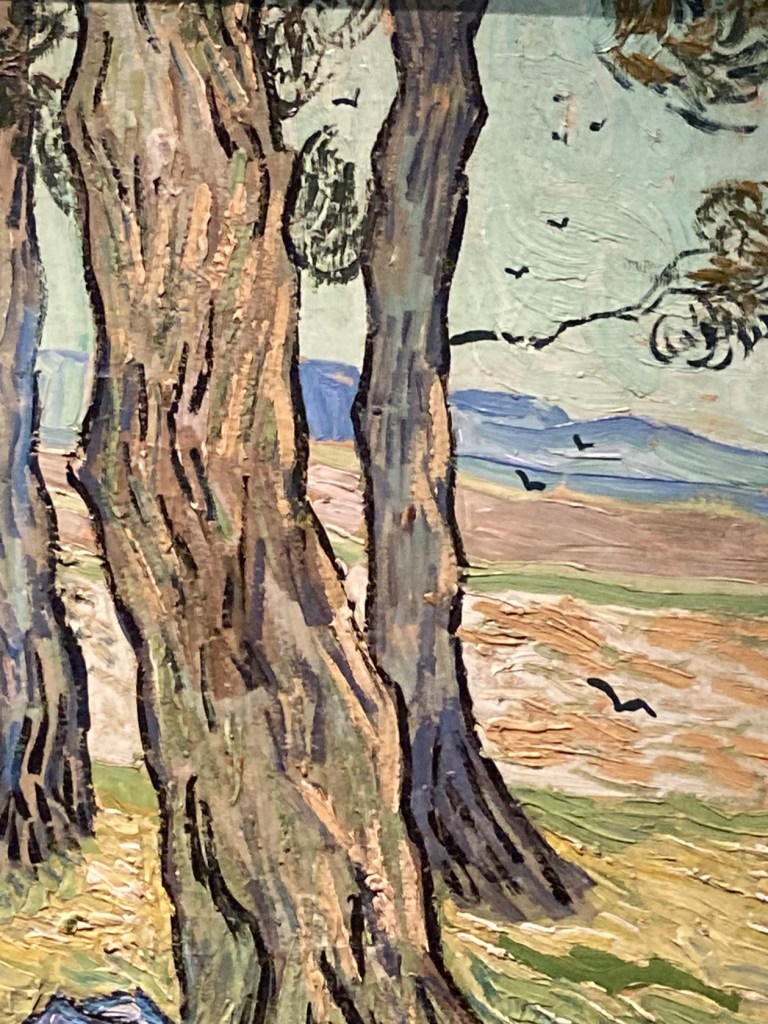
At the DIA this weekend with my honey I stared at the trees in Van Gogh’s The Diggers. What I love about those trees is that they both look like trees and they also look the way trees might look in a dream. Likewise this coyote was at once a now-coyote and something from a dream, constructed out of lines that hummed with color and life and meaning that you grasp only by not trying too hard to see it or hold it. It was something to wonder at.

What if our grandest purpose is simply to find ways to see and feel differently, dreamily, to lean into metaphor and let it shape us. In that way, do we become a part of something larger than ourselves? If we experience the universe in this way, can we understand our world, and our place in it better? And make it a better place? Imagine what it would be like if more people cultivated a sense of wonder instead of war, built a habitat for happiness in their hearts, so it had a home when it visited.

I hope something magical happens to you today, or soon, and you can feel, at least for a moment, the universe expanding within you.

Love, Cath

On Magic, Tricks, and Magic Tricks

By Catherine DiMercurio

There’s something about being in a new relationship in your fifties that leaves you with a whole deck of new thoughts and feelings, which get shuffled around and presented to you, as if some sprite doing the universe’s work is trying out a magic trick. Is this your card?, they say with a flourish. And you study it, trying to figure out if it is, in fact, your card.

Photo by Israel Garcia on Pexels.com

What I mean to say is that all new relationships can leave you feeling a little perplexed. After a divorce, no matter how long after, and after other relationships that didn’t work out, no matter how many, when you’re in your fifties and feeling careful and cautious, you don’t immediately believe in the magic part of the magic trick. You’re kind of looking for the trick.

So, this summer, a year after I had reached out to a guy on eharmony and it hadn’t gone anywhere past an initial exchange, he emailed me. I’d had the foresight to give him my email address the prior year, knowing I was about to be done with dating apps. This past August, when I read his email, it took me a minute to connect the dots back to that initial exchange on the app. I then remembered why I had initially reached out: he was a fellow writer, and a professor (I’d joked with my friends about dating a professor. Where’s my professor? I’d ask). It seems he showed up. He also liked some of the same things I did, such as exploring the natural world, hiking. He was a parent, too. There were possibilities here. I had the sense that if I didn’t write back immediately, I would talk myself out of it, and part of me felt like I should give him a chance. I decided to write back before I could change my mind. I was candid about the fact that I was content on my own, and not sure I even wanted to date anymore.

After my last break-up, I had settled into a largely peaceful rhythm that involved following my interests and instincts, enjoying time with family and friends, and reveling in the absence of the particular anxieties my last relationship had wrought upon my heart and brain. Not that this period was angst-free, but when I poked around the notion of what if this is the way it always is—just me and my dog and writing and pottery and family and friends—I was largely okay with that. While I worried that at some point I would wish I had found someone to grow old with, I also was comforted by the idea that alone wasn’t truly something that I’d be, because I have a lot of good people in my life.

Still, I was curious. I suggested that we could email one another and get to know each other that way, as a start. He was agreeable.

We did this for a couple of weeks, and as writers, the format suited us. We sent long missives back and forth on a variety of topics—our pasts, our beliefs, our likes and dislikes, random observations, books, the writing process. It felt like during this period of writing long emails back and forth, we were in a way approximating the feeling of a developing friendship, one that might have taken place in the real world, had we met, say, at a bookstore. I admit though that during this time of correspondence, I was on the lookout for anything I might construe as a red flag, or anything I sensed might spell trouble or be a sign of incompatibility. When I could find none, much to my surprise, I suggested we meet for a hike.

Since that time things have progressed in a way that continues to be dissimilar to any experience I’ve had in the past. He lives over an hour away. There has been little opportunity to just meet for a bite to eat or something, so we squeeze in our time on the weekends. I was finding recently though that I missed the solo down time I used to have on weekends, so I requested we take a weekend off. My ability to make this request speaks volumes. In past relationships, I would have found it very difficult to say something that the other person might perceive as a pulling away or a pushing away. I would have worried that to ask for time for myself would have resulted in their loss of interest. But in this relationship, not only did I feel confident enough of our connection to not worry about my request being misperceived, but I was also keenly aware that I needed this time for myself. I have worked diligently and purposefully toward the goal of being able to recognize and respect myself and my needs, so being able to advocate for myself feels like a necessity, not an option. I know I am a better person and a better partner when I am taking care of myself, not only trying to take care of the relationship. The fact that he received and understood my request without hesitation or negativity was a relief, though not unsurprising when viewed within the context of what I’ve come to know about him.

Still, this is all unfamiliar. It feels healthy and good but the way in which it hasn’t followed the patterns of past relationships has been at times both affirming and unsettling. Hence the aforementioned sprite with the deck of cards and the magic trick. My brain often reverts to questions that seem to assume a norm, a standard. I ask myself: is this how it’s supposed to be (i.e., am I doing this right)? But of course it won’t feel like the past. Not only were there a lot of unhealthy aspects to those past relationships, I am a different person now and am bringing a completely different energy to this relationship. There’s less urgency, less anxiety. I have the sense that we are building something with different tools and materials than what either of us have used in the past. And of course it is going to look and feel different from what other people have; every couple has its unique origin story and history. I love the feeling that we’re building our own story, figuring out the next phase and phrase as we go.

And yes, this is going to mean that at times we pause, looking for the trick. When you’ve had the rug pulled out from under you a couple of times, you tend to be careful of your footing. Or skeptical about the magic trick that seems to be happening in front of your eyes. My instinct is to slow things down, watch mindfully the way it’s all playing out. But sometimes you can’t spot any trickery. Sometimes maybe the magic is just the magic.

Love, Cath