On Spring, and Little Mysteries, and Soft Truths

By Catherine DiMercurio

It’s been a bizarre spring. The last time I wrote, it was just the beginning of it. Now we’re in the thick of it, the irises are blooming and the peonies are about to burst and the buckthorn is proving to be its annual nuisance. Last time I wrote, I was figuring out some paths forward and now they all look a little different.

When I began this blog about open-heartedness, I invited my readers to wander with me, to explore heartbreak and wholeness and everything in between. I think this blog has been around for about eight years, and one of the main things I have discovered in that time is that there is wholeness even in heartbreak, there is wholeness when we feel healed and wholeness when we feel broken. To be human is to be whole; the breadth and depth of our experience is encompassed by who we are in this life and nothing—not pain, loss, grief, fear—can deplete the full richness of our identity. We absorb it all, we metabolize it, transform it, re-emerge as new versions of ourselves over and over again.

The wholeness can feel elusive sometimes. In parsing out recent events, I tell myself I don’t have anything to prove, but my brain cycles through the discussions I’ve had with myself, formulating a defense for decisions I’ve made, paths I’ve taken, as if I have to account for them to anyone other than myself. She has a high threshold for what “makes sense,” this internal judge of mine, and hears arguments daily, usually when I’m in the shower and relitigating my past. I sense it is time to move past such habits, that my energy is needed elsewhere.

But still, I have a strong desire to be “fair” and “reasonable,” and to be perceived that way, so holding myself to account is habitual but sometimes excessive, often unnecessary, and occasionally, cruel. Looking back over my life, I see the ways in which my gut was right, but that it was also right to test its theories, as guts don’t always see nuance, or the need to have certain experiences anyway. But that gut has a good head on her shoulders. I’m learning to be mindful of what she’s instructing. I find that I’m often wary about going with my gut instinct right from the get-go because it is difficult to determine if something is actually and truly wrong when I get that “something feels off” kind of feeling, or if the discomfort I’m feeling is a natural and necessary part of a particular growth journey.

There is also some work to be done when I consider what I just said a few sentences ago, about my desire to be perceived as fair and reasonable. Who is my target audience and why should their perception matter to me so much? Ralph Waldo Emerson wrote, “What I must do is all that concerns me, not what the people think.” I remember reading that in college, being struck with the boldness of that statement. I feel as though I’ve internalized a lot of expectations about who I’m supposed to be and how I’m supposed to behave, and I get caught in the trap of overexplaining, even to myself, why I’ve chosen a particular course of action. Maybe to be regarded as fair and reasonable is so important because I’ve always been a sensitive person who was often told she was overreacting or misperceiving a situation. So I’ve grown accustomed to overcorrecting and interrogating myself, as if there is some value in making my life make sense to other people. There used to be value there. I craved the validation of others, people I trusted saying good thinking, and yes, that makes sense. It’s always nice to hear but in truth I haven’t needed it for some time, though part of me doesn’t entirely know that yet.

It is a strange thing to consider walking through this world and accepting mystery and to say, maybe I don’t need to understand that. Maybe I can stop trying to figure out why I feel better alone than when I’m in a relationship. When I knew myself less, the opposite was true. I thought I was a better me in partnership. But just as my understanding of myself has improved, so has my understanding of what does and doesn’t constitute a partnership. Maybe when we’ve done all the philosophizing and therapizing we can, all the studying and soul-searching, we can say, for now, I accept this as a mystery of life, a mystery of love, a mystery of the universe and of my own soul. Maybe my energy is needed elsewhere, maybe yours is. Possibly it will all make sense when we’re ready. Or, we are ready and it does make sense and we are slow to acclimate to the truths of our existences.

Photo by Valeria Boltneva on Pexels.com

This morning I was preparing to go outside at dawn with my coffee and my dog. He usually sniffs around the yard and I fill the birdfeeder. I examine what’s blossoming: currently, irises, dahlias, snapdragons, impatiens, columbine. I usually hope to see cardinals and woodpeckers before the sparrows and grackles arrive, but lately that hasn’t been the case. Today, though, when I looked through the window before opening the door, I saw a fawn grazing near the overgrown herb bed. I looked past her and noticed two other deer nestled in the myrtle at the back of the yard. Soon, one rose, another fawn, who also began grazing in the yard. The larger doe who I assumed to be the mother remained reclined. She laid there so long after her offspring had risen and wandered that I began to wonder if she was hurt, or, perhaps even giving birth to another baby. I watched the three for a while through the window, feeling glad that they felt safe and nourished in my yard. I left them to their quiet morning routine, told my dog we’d go out in a little bit. I returned after about twenty minutes; they had gone. When I finally wandered out into the yard with my dog, I could see the indented places in the myrtle where they had lain and I wondered if they had cozily bedded down for the whole night in my yard. It gave me such a feeling of peace to cede my space to them for a little while. I imagined that the myrtle was still warm in the chilly morning from their soft brown bodies.

There has been some grief this spring, some loss of a sense of safety and well-being in my little circle. I know that this morning’s sighting of the white-tail deer in my yard was a chance occurrence but also I don’t know if it wasn’t a tiny little gift from the universe, a brief glimpse of a mother and her two youngsters feeling safe and fed and content and together. Maybe mornings like these are for embracing little mysteries as they come to us, and in them, we sense our own enough-ness.

Love, Cath

On the Bearing of Unbearable Loss, or, an Ode to a Best Friend

By Catherine DiMercurio

Like any major grief, the pain you feel when you lose a pet is one of those soul-bruises that you feel every day. Your heart remembers, your muscles do, before your brain does. And then upon waking fully, you realize that this is a different world now, you are in a new phase of your life, the one without your sweet baby in it.

I lost Phin, my dog of 14 years, last week. Lost is such a nice way to put it when the reality is much graver. We bear witness to a painful decline and no matter how much we want to avoid it, we bear the responsibility for making a decision guided by love and empathy, and the desire to protect our loved one from further suffering. It doesn’t matter if the vet and countless other people tell you it’s the right thing to do. It doesn’t matter if you’ve known it for a while. You still have to make this impossible decision, and then follow through on it, and then live with it every day.

I picked up Phin’s ashes recently. It is a startling thing, to see what a body is reduced to.

When the grief hits the hardest, I try to remember how joyful Phin looked when galloping across the yard toward me. I’ve combed through all my photos and videos of him, but I don’t quite have one that matches the memory of him I hold in my head. He loved to run. He loved his walks. I aways used to say he could be at death’s door and still want to go for walks, and this was true to the end. His last walk, the day before his death, was brief, and only lasted a few minutes, a few steps. But he still stepped into the harness the way he always did, certain and eager.

In the mornings he would greet me with a wagging tail and lean into my legs the way big dogs do. Countless times during his life, he upended beverages, either by sweeping them across a coffee table and onto the floor with his tail, or by bumping into a side table and sending everything clattering and spilling.

We don’t get the same death rituals for our pets that we get with people, not in the same structured and expected way. But my dogs are the ones I talk to every single day, there for me when I wake up in the morning and when I go to bed at night. Constant companions since the pandemic sent us home from the office, never to return.

Phinny loved bread, sardines, and pancakes more than just about any other foods. Pita was the food that brought him back from the brink after a bout of pneumonia sent him to the ER a couple of years ago. The day before he died, after refusing rotisserie chicken, hunks of cheddar, a tin of sardines in olive oil, I offered fluffy, fresh pita bread. And he just turned his head away.

I want to remember all of his youthful frolicking more than his painful last days, but it’s not working like that for me, not yet. I’ve lost dogs before. I know how sharp the pain is in the beginning. I know how narrowly focused my brain is on the suffering that prompts the call to the vet. It is such a horrible call, and I think I am self-soothing, in a way, by reminding myself of what was necessary.

My dreams are haunted, but not by him. I’d welcome a glimpse of him in my dreams. I’m eager for any sign I can find that he’s out there, on the other side. I don’t know why I wholeheartedly subscribe to the lore of the cardinal being a sign of a passed loved one, but I do, and I saw one the other day when I was getting ready to take the puppy for a walk. I opened the door and there it was, flitting in the burning bush right in front of me. To be clear, the bush was not on fire; that’s just the common name of it. But a nice touch for a sign from the other side, no?

My big emotions are operating within me the way they have in the past, leaving me longing for connection but also resistant to comfort. Nothing feels quite right. I only want the softest fabrics against my skin, I can’t find anything that tastes really, really good, and there are few sounds that soothe me. I heard a bird this morning chirping in a quiet, rhythmic way that reminded me of the way Phin used to whine when he wanted something. He always sounded like a bird when he whined. When we first brought him home as a puppy, I used to think that a bird had gotten trapped in the house but then I’d realize it was him.

Overzealous gardening a few days after Phinny’s death left me with a very sore knee. Apparently “gardener’s knee” is a thing. The pain is more prolonged and sharper than I imagined anything gardening-related could be, but I think in general my body is telling me to slow down and let myself feel the things I’d rather avoid feeling. But it’s hard and it takes so much out of me. And while anyone who has gone through this understands how ongoingly brutal the pain of losing a pet is, as someone pointed out, there’s no bereavement time from work or anything. You walk into various situations expected to keep performing and sometimes it’s fine, the compartmentalizing, but gosh is it tiring. There are no shortcuts. We’re either exhausted from feeling the pain or exhausted from all the ways we try to avoid it, and we have to do both in order to make it through. Feel it, and take breaks from it.

I’m not ready for this part. I don’t want it. But I guess that’s the way it is when we lose anyone, either by death or other circumstances. But I certainly would never wish away a moment of the time I had with him, and I get that what I’m going through now, what my kids are, is the price of all that time, all those years of love and joy. I miss his earnest face and his big goofy smile and his big dog lean and his ability to see a simple neighborhood walk as expansive and fulfilling. And maybe it wasn’t just the walk. Maybe some of it was his appreciation of the company on the other end of the leash. I’d like to think so anyway. I’d like him to know I tried to give him a good life, and I’m sorry for the mopey years when everything was a struggle. Miss you, my sweet boy.

I wish this wasn’t such an inelegant attempt at expressing what this first week has been like, but we have to start processing somewhere. To anyone who has experienced this, I’m sending you big hugs.

Love, Cath

On Rage and Other Big Things We Don’t Like to Talk About

By Catherine DiMercurio

I took my rage for a walk the other day because the only thing that made sense was tiring it out. I wondered if it was more like a toddler in tantrum or like a puppy full of energy to spend. But the rage—my rage—was unlike either of those things. It wasn’t innocent frustration opposing the structure of its world and it wasn’t joyful and bored and antsy. It was more sophisticated and self-aware, and I couldn’t think of it in a way that made it seem cute and small and not very dangerous. It was not cute, and it felt volatile and intimidating.

On my drive out to the woods, the rage quieted. Simmered. Waited. I was tired of trying to talk myself out of it, just because I didn’t know where it came from. I was tired of trying to figure out all the reasons I felt so full of this surging and unpredictable reactive energy. But I did it anyway. Was it because of the world at large and all the ways it is hateful and crumbling? Was it frustration with life and how there’s no way off this treadmill of working to pay for a roof over your head and having little time or resources to ever do much else? Was it this new and uncontrollable bristling I feel when I encounter inauthenticity? Or was it the powerlessness I feel when I witness people abandoning themselves the way I once did, in service of people or situations that were hurting them? Or was it simply grief’s companion, still flailing over all the things that still hurt?

I don’t know that I learned how to properly self-soothe as a child. People tell you to calm down but they don’t tell you how. I’ve spent a lot of time figuring out what to do with myself when emotions feel too big for my body. When my kids were young, I would tell them to not do anything with their hands when they were angry because we’re so much stronger when were mad. Mostly this was to keep them for hurting each other when they were upset. We talked about different things they could do when they felt that way. Scream into or punch a pillow. Jump up and down. Take deep breaths. But we probably didn’t talk often enough about all this. I was still learning myself, but I suppose a lot of parenting is like that.

Now, as I began walking a trail covered in snow, several inches deep but packed down by other feet and frozen into other shoe shapes, my own boots slipped and slid. I had decided by then to just let myself be angry instead of trying to figure out why it had appeared out of the blue without an obvious trigger. I tried to not be resentful this time. Fine, be mad, I sometimes told myself, all the while feeling a meta-anger, that sense that I was mad about being mad.

This time, I tried to be agreeable about it all. Okay. Today we’re going to be mad, I guess. It’s okay to be mad. I tell myself this now. Because it is, even though I don’t like how it feels inside my body. And I did try to impart this to my kids, too, that it’s okay to be mad but it’s not okay to take it out on other people. But whenever I tried to apply this lesson to myself, I kept trying to talk myself out of my feelings. Maybe I was told too many times that I didn’t have anything to be mad about.

I have this idea that as an adult I’m supposed to be calm and in control of my emotions all the time. I have a habit of judging myself for the “negative” emotions that take me over. In a way, trying to figure out all the reasons I might be mad felt like an attempt to justify, to counter the “you don’t have anything to be mad about” charge, like part of me was yelling, yes I do! It’s as if I’ve been seeking permission from myself to be angry. I have embraced sorrow. When it visits, I let it stay as long as it needs to. I feel it, I talk to it, I cry. I let it have its say, and that seems to matter. But I’ve been afraid of doing this with rage. It feels too big, unstable, uncontrollable.

As I hiked through the snow, I turned on the path that leads to a loop through a big, open, hilly field. It’s a less popular trail and the snow was fresher here, less hard-packed by the few hikers who had passed this way before me. It was deeper to trudge through, and it felt good, pushing through the snow. I checked in on my rage and it felt like it was diffusing a bit. By the time I’d finished five miles, I felt tired and refreshed. The rage had loosened its hold on me, glad perhaps that I didn’t try to tell it to go away, that it didn’t have a right to be here.

On the other side of rage, it is sometimes easier to see that it’s often about fear and things we have no control over. I always want to understand it because I’m afraid I’ll miss something. People say that you should listen to your anger because it’s trying to tell you something, point you in the direction of something that needs healing.

But the tricky part about healing is that it doesn’t mean something stops hurting. At least, not so far.  Sometimes we’re pointed in the direction of our pain and all we can do is recognize and honor it, just like we do with the emotions that brought us there. We self-soothe as best we can. We cry, take a hot shower, go for a snowy hike, scream into a pillow, ask for help or a hug, snuggle the dog. Sometimes we simply must take a deep breath and get on with our day.

Maybe healing is simply showing up for yourself, again and again, without judgement. Without criticizing yourself for having grief, or rage. I think all of us are all the time trying to heal, from big psychic wounds that we never saw coming and stay with us for decades, and from all the little things that gouge at us more recently.

For a week I was not able to pinpoint what it was that had made my insides churn with a rage that seemingly had nothing to do with my life at the moment. Everything had been relatively calm in the days preceding and then I woke up and the rage just hit me. I’ve spent the week thinking about it, and telling myself to stop thinking about it, that the why doesn’t matter. That I did the right thing in finding a way to let myself feel it safely. Anger is a big emotion and it made sense to enlist the woods and the solitude and snow to help absorb it, and that worked.

Photo by Kris Lucas on Pexels.com

But it still bothered me that I couldn’t pin it down. This morning, a week to the day, I woke up, and as my amorphous thoughts gathered into language like raindrops on a windowpane melting into one another, I thought, I’m mad at myself for still feeling grief. I don’t want to feel this way. I don’t think I should. But I do. As I walked myself back through the previous week I realize it all started with a dream. I’d woken up, been frustrated that my subconscious was still nursing old wounds, but I didn’t give it another thought. Then as the morning wore on I realized this rage had seeped in from someplace, seemingly all of the sudden. My dream had been forgotten. And I didn’t put it all together until now.

Our minds and hearts operate in strange ways. In the calm and safe world I’ve built for myself, my brain works on things while I sleep, in ways I do not understand, but in waking life, I’m left to process it all along with the residual emotions. I suppose it is all happening the way it should. The part of me that has waited for me to be ready to do this part of the work is nudging me. But sometimes it feels like a war between two voices inside me, one saying you don’t get to be mad at yourself because things still hurt, and one saying, just watch me.

Maybe it’s my job to be the peacemaker. To tell myself that my anger is a valid response, especially since, if I pick it apart, I can see that it isn’t solely anger at myself for still hurting, it’s anger at the people who hurt me, and anger at myself for “letting” them. In peacemaking, I can allow safe spaces for the anger to exist and expend itself, to rise up when it needs to, just like I’ve learned to allow with the grief. Maybe my anger just needs some time alone with me, away from grief.

I don’t know if it will ever all dissipate, or if all these disparate parts of myself will peacefully coalesce, like those raindrops on a windowpane. For now, though, there’s not much I can really do except keep listening, and making space when the big emotions show up and demand attention. Maybe healing is simply showing up for yourself, again and again, without judgement. Maybe life is.

Love, Cath

On Loss and “Lost”

By Catherine DiMercurio

On a recent damp and drizzly hike with my sister, I got us lost. Inconveniently lost, not dangerously lost. We were deep in conversation, and I missed one of the markers that would have helped me know where I was along this path that I’d hiked once before. We backtracked and figured it out. I tried not to let it bother me, this feeling that I should not have let that happen, but it did. It bothered me in a big way at first, as though I’d let us both down, and by the end of the hike, it only bothered me a little, like a small stone in my shoe. Yet for a while, this thinking also spiraled forward to a solo camping trip I’ll be taking in the summer. What if I get lost in unfamiliar woods when I’m hiking alone?

As we walked back to the car, I tried to return my awareness to the current moment. We’d hiked longer than we intended, but we were enjoying one another’s company and were never in any danger. She didn’t care, didn’t judge me. So, I managed to shake it off.

But, it did make me realize how easy it is for a moment of anxiety to amplify itself, reverberating into the past and into the future. How did I let that happen, and what if it happens again? Sometimes we exist in all the moments at once, as if time ceased its habit of being linear. In this instance, the sensation didn’t last long, but depending on the circumstances, we can get lost in these spirals. The experience reminded me of how connected lost and loss are.

Sometimes, the losses we’ve experienced in life unroot themselves from their context. We can’t pinpoint precisely why we are feeling a certain way, but this loss is wandering around inside us, untethered from memory. We feel confused about our sadness, our fuzziness, about the despondency that leaves us inexplicably tired. It as if the loss itself is lost within us.

Have you ever gone looking for your sense of worry when you actually feel fine? You have that sense that something is missing, and you aren’t sure what, so you search for it. Now what was it that I was so worried about? The worry needs a home, so you attach it to a dentist appointment, a financial concern, a work meeting, or larger and less-specific things, like the rest of your life. I think this is what we do when we have a big loss lost within us. There are some things we might never be done grieving, and the loss sometimes shows up as worry and needs to be taken by the hand escorted back to its context, its memories.

Photo by Kat Smith on Pexels.com

The trouble is, then we must confront those memories again. And we don’t want to. Who does? It hurts. Good memories can hurt more than bad memories, too. But when they are calling to us, it is better to give them some time and hug rather than ignore them. Otherwise, they will keep wandering away again and turning up in strange ways. Does all this mean, that despite our efforts to heal, to take time for grief, and go to therapy and journal and talk, and all the things we’ve tried to do to move forward, does it mean that none of it has worked?

Of course not. It means it IS working. Being able to recognize what is happening when feelings take us by surprise, when big anxiety comes at us for little reasons, is a sign that we are evolving. When we can pause and say: Oh, yes, I see. This old pain still hurts sometimes and wants to be felt as now-pain and is showing up in this weird way so it doesn’t get ignored, even though it doesn’t have much to do with the dentist appointment or my future goals or the fact that I accidentally got a little lost in the woods. Sometimes it takes a few days or longer to unpack a response, to look at a recent event and decode why our feelings felt outsized for what was happening.

I am not good at compartmentalizing anymore. I did it a lot when I had to, when I would not have been able to function otherwise. It is difficult now for me to say I shouldn’t feel this way about this situation, so I won’t. I need to know why. I want to understand the connections my brain is automatically making (you are nervous, here is danger, avoid this), so I can intervene and try to rewire (you are nervous, and it is normal to feel that way in this situation, but it reminds you of real danger and that was scary, but you don’t have to avoid this, and it is okay to feel uncomfortable).

Being able to decode and rewire allows growth. It allows the unexpected. It allows me to open doors I have been too tired or too anxious to open, and in doing so, I discover new loves. I have fallen in love with pottery, this mysterious thing I’m learning, this vast muddy sea of things to discover. I have fallen in love with the new novel I am writing, with the process of getting to know new people on the page, their desires, their flaws, their histories.

Sometimes you are ready for a new story, and you didn’t know how much until you start writing it.

I fall hard for moments sometimes too. I fall for the quiet writing hours I cobble together in the dark mornings, listening to the birds wake, to wind and rain, to the dogs snoring away nearby. I am often overcome by how happy this makes me, this simple gift of my favorite part of the day.

I know none of this is the same as falling in love with person, which I hope is still a possibility. But being able to embrace my life and my self and everything that I’m discovering is not a consolation prize, and that has surprised me. It startles me what wholeness can feel like, and sometimes it even scares me in ways that I’m still articulating for myself.

Sometimes I’m intimidated by all there is to learn about myself, where I’ve been and where I’m going and how to get there, and other times I think it is all in the palm of my hand already, or at my fingertips. Many of the realizations I’ve written about here grew out of a scene I was writing in my novel. I guess I must keep learning to trust myself, and when I write those words, I can see that this is the through-line, my wobbly dance with self-trust. Ralph Waldo Emerson wrote, “Trust thyself: every heart vibrates to that iron string.” I remember reading those words in college, sitting at a desk in a classroom with pale green walls, and having an overwhelming sense that this mattered in ways I didn’t fully understand. It seemed unfathomable, as impossible as someone telling me to run a four-minute mile or jump out of a plane, things that other people could do, but I’d never be able to. It is no wonder that the ability to follow that advice has taken me my entire lifetime. But, here we are, trying. It’s all we can do.

Love, Cath

On Clay and Conversation

By Catherine DiMercurio

So much of life depends on how you look at things.

I don’t mean seeing things from a different angle in order to guide yourself toward a more positive perspective. I mean new experiences sometimes hand you a metaphor and give you a way to contemplate something more deeply or fruitfully than you have before.

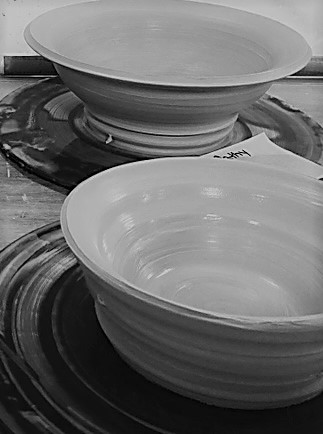
Recently, my daughter and I took a trial wheel-throwing pottery class. It was something we’d both wanted to try for a long time. I was nervous about investing time and money into a semester-long class without first having some idea about how I would feel about working with this medium, so the two-hour workshop format appealed to me.

On the drive over to the studio, I had a strange thought. I was feeling anxious and as I dug around in that feeling I realized part of it was because I did not want to disappoint the instructor, some person I’d never met before. Why on earth would I care about that? Maybe I didn’t want them to think that my inability to follow directions, or create “properly” meant that they were not doing their job well. I wanted to be a good student so they could feel like a good teacher. It was also part of my people-pleasing mentality. [The reasons people do this are varied and complex. Sometimes it is because we’ve lived with emotionally volatile people and we learn to not make waves. Sometimes it is because we need others to think well of ourselves since we have a hard time doing that on our own. This is often a result of us having internalized messages—religious, cultural, societal messages—in such a way that we feel it is necessary to prove that we are, in fact, good people.]

Still, I tried to shelve these ancient worries. I wanted to focus on having fun with my daughter and learning something new. I wanted to prove to myself that I could.

As it happened, my daughter and I were both feeling a little anxious, because it’s normal to feel that way when you’re trying out something you’ve never done before. But once we walked into the studio, met the owners and their dog, and toured the space, I began to feel more relaxed. Shelves of drying cups and bowls and vases, pale stoneware waiting to be glazed. Gorgeous curved and sumptuous shapes. Rows and rows of completed, glazed work, waiting for students to collect them. Oh, the glazes. I love glazes. I wish I had the vocabulary to describe them, understood their chemical composition. Reddish browns, honeyed golds, pale bronzy greens. It all washed over me. I felt both calm and exhilarated. I love that hard-to-come-by feeling.

I couldn’t wait to feel the clay beneath my fingers, to begin to see how it responded to the corresponding forces of my touch and the movement of the wheel. I’d watched enough of a British pottery competition program to imagine what it might be like but now I’d be getting my own hands dirty and trying it out.

One of the owners, Mike, sat down at the wheel and talked us through various processes and techniques. And then suddenly we were doing it. Mike helped when we weren’t sure if our clay was centered, or if a bowl was widening to the point of collapse. He was a good guide.

I wasn’t shockingly good at it for a beginner, though I really wanted to be! I may not have uncovered a hidden talent, but I also did not uncover the disaster I’d been fearing. This wasn’t gym class, and I wasn’t unbelievably horrible at it, as I was with most sports. Have you ever been so bad at something that people are embarrassed for you? Not fun. But here, in the studio, I did have fun, and so did my daughter.

There was some kind of perfect little relief in the newness of it all. A bliss in getting to believe in something else, a different kind of space, a different kind of making. I think my daughter and I both experienced that and it felt important to be able to share that with her.

In the days since the class, one of the things I’ve reflected on is the notion of conversation. Working with the clay, my hands had to be in conversation with one another. They didn’t simply work “together.” They worked in harmony and in response to one another. It is different than say, playing a musical instrument, where your hands are working together, but each is performing a separate task. In building a bowl on the wheel, my hands had to talk to each other, listen to each other, in order to create something together. It was impossible not to see this as a beautiful metaphor for what I hope to one day find in a relationship. If you are not working together, focused on the relationship you’re creating, it will not hold together, things will spin out of control. You must want the same thing. You might end up making something different than what you intended at the beginning, but you’re in on it together. And unless there is a cooperative, positive effort, it won’t be anything at all.

Because my brain works the way it does, I seized upon this metaphor and tried applying it retroactively to past relationships that did not turn into what I’d hoped they would. Maybe this was the way I could make sense of how things happened the way they did. The pottery metaphor provided an effective lens with which to view things and helped me to remind myself of why those things didn’t work out.  

I’ll be honest. Sometimes I need a new way to look at an old thing I’ve been turning around endlessly in my head. The ending of relationships is hard. Grief is real, full, and deep, no matter how much you believe that the ending was necessary. I often find myself reciting the stories and their endings back to myself, so I remember, so I don’t repeat past mistakes. So that, if I’m lucky enough to get a next time, I get to keep it. Grief takes up a lot of space in a heart. In a way, we remain in conversation with our grief, long after the loss that caused it.

Another thing about conversation is that in the past I’ve mistaken emotional or intellectual connection for emotional intimacy. It’s all about conversation, but they are not the same things. We have to look closely and see if what we are offering to our partner is what we are being offered in return. There were times that I was not actually having the conversation that I thought I was. Things take time to reveal themselves. People do. We all try to be the best versions of ourselves when we want something to work out. But we can’t keep that up indefinitely. And one person’s idea of something “working out” can be very different from another’s and in the absence of emotional intimacy it might take a while to figure that out. We may think we are building something with a partner, but unless we are in true conversation with one another, one hand might be trying to create a saucer while the other is trying to make a vase.

Another lesson here for me is about a new kind of open heartedness. It took a bit of pushing myself to decide to take this class. I must remember to do that sometimes, to nudge myself into action, into new ways of looking at things. I admire people who can jump into new things without the anxiety that sometimes holds me back. At the same time, I love that these experiences for me feel special, wonderous, even, given that it wasn’t easy for me to approach them.

We all come at the world and all it has to offer differently, but I don’t believe that there are methods that are superior to others. We go at our own pace and are rewarded in the ways that feel meaningful to us. And we learn the lessons we need to when we are ready for them.

After you make something at the wheel, it goes through many other steps. It air dries, then is trimmed, then dried in the kiln, and then glazed, and then fired once more. Or something like that. My daughter and I didn’t get to do those other steps—that is what the full class is for—but we did get to pick out glazes. I’m eagerly awaiting the call from the studio saying that our pieces are ready. Pottery, it seems, like everything else in my life, is trying to teach me patience.

I’m pretty sure I’m going to sign up for the full class, but the next session will begin in January, and meets for three hours on Monday nights. That’s a big commitment! But I think I’m intrigued enough to take it on.

Wishing you true conversation and a little bit of genuine bliss.

Love, Cath

Dog Days and Heart Breaks

By Catherine DiMercurio

When my dog Oslo was first diagnosed with cancer, I developed the notion that it was my fault. His diagnosis came about a year after my divorce was final: lingual malignant melanoma. The timing did not escape me. I knew somehow that Oslo had, on a cellular level, absorbed all the malignancies of my heart—all my grief, all my rage, all my fear. He had been at my side, as always, but especially during that really bad year when I cowered in a heap after the children left for school. I sobbed into his smooth brown fur and when I was exhausted and tried to rest, he curled up next to me, pressing the curve of his spine into the backs of my knees. That was the kind of support I needed during the divorce year, and Oslo knew just what to do.

Puppy Love

He was five at the time of the diagnosis. We got him when he was a smooth-bellied puppy, about five months old, according to the estimates of the shelter. They say he was a beagle-lab mix, but he did not look like his siblings, who were all beagle-sized but with the coats of black Labs and yellow Labs. Oslo was bigger. His brown fur was flecked with black, and the tip of his tail was black. His face had a sweet, beagle expression and he possessed the strong wide chest of a stout, muscular dog, most likely a pit bull, though no one wanted to write that on any official record of his.

IMG_2568

Just before the diagnosis, he had become excessively drooly and his mouth smelled foul. I presumed he had some sort of tooth decay, so I scheduled him for a cleaning. I assumed they’d have to remove a tooth. When Oslo’s long tongue hung from the side of his mouth as he panted anxiously during the examination, the vet discovered a walnut-sized tumor on the back of Oslo’s tongue. The results of the biopsy came back positive, and the vet recommended an oncologist so that we could discuss his prognosis and options. My vet tried to be optimistic, but he did tell me how aggressive this cancer was. I didn’t even know there were oncologists for dogs. At the appointment with the oncologist, they x-rayed his lungs, which were clear still, somehow. But that was pretty much the only good news. There was more—talk about the tumor that was removed, and margins, and lymph nodes. Basically I was told he had 30 to 60 days. DAYS.

Beating the Odds

But Oslo kept being fine. He was happy and eating and playing with the children and with our other dog, Phineas. For almost another two years, he was his sweet, normal, loving, devoted self. In that time, life around our house improved considerably. The initial trauma of the divorce and all of the life changes that came with it had evened out. Everyday life was different now for me, my daughter and son, and our two dogs. It was calm and predictable once again. Once your life isn’t being shaken up like a snow globe, the simplest things fill you with joy. Completing a task like getting your oil changed or going to your job and coming home, or being able to call the dentist to make an appointment and attend parent-teacher conferences on the same day was cause for celebration. I did two things! In addition to going to work! It sounds silly maybe, but after turmoil, there is such unbelievable delight in normalcy. And Oslo loved normalcy as much as I do. I think that kept him going. And maybe he needed to make sure we were going to be okay.

Meanwhile, the cancer was all still spreading within him, seeping from cell to cell and turning his body against him. An x-ray in this past fall confirmed it had spread to his lungs. His lymph nodes became enlarged. His eye began to swell with the pressure and became infected. He started to slow down. Once his breathing began to sound labored I knew we didn’t have much time, and the morning after a sleepless night for both of us was the morning I knew we didn’t have any time left at all.

My children are eighteen and almost sixteen. We’d talked very openly about all of this during the past two years, about everything that might happen and when it might happen, so they were as prepared as anyone could be, and none of us wanted him to struggle. In a way, then, we were ready. But, it really isn’t like that at all when you walk into the building with your family and realize that not all of you are walking out.

Goodbyes

There were lots of hugs and tears in that room that Sunday morning. A nice comfy, clean dog bed took up a considerable amount of floor space, but Oslo refused to get on it. So we all sat on the cold, tiled floor around him. He wouldn’t lie down, but finally at least he sat. The image that keeps returning to my brain is how he slid to the floor after he was administered the heavy sedation, known by anyone who has been through the process of witnessing a pet being euthanized as “the first shot.” The second shot is the one with the lethal medication that stops the heart. After the first shot, as Oslo slid to the floor in a deep, heavy sleep, I had the sense of time slowing. I keep seeing that long, slow slide and I remember trying to hold him and gently easy him down. In that prolonged moment Oslo was still with us, but not. We all had our hands on him, all three of us weeping with as much restraint as we could muster until the vet left the room. You can feel it happen, life leaving a body. You can feel your sweet, loving friend leave this world.

My missing of him is aggressive and sharp, like the taste of very burnt sugar in my mouth. It eases sometimes and I’ve stopped expecting to see him walking into the room. Mostly. Some days I still try to put his food in his bowl before I realize his bowl is no longer there.

Crying to a friend about losing Oslo, I extolled his virtues. I talked about how devoted to me he was, and how he followed me around the house, needing always to be wherever I was, and how he was always there for me. She reminded me of something else: I was always there for him. Even though I mourned the fact that I should have done more with him—more walks, more dog park, more treats, more attention—she said his life was better than it would have been because I adopted him and not someone else. I hadn’t thought of it that way before. I hope it’s true.

Doing Things That Break Your Heart

When I originally envisioned this blog, I thought of it as a series of “Twelve Things That Will Break Your Heart and Why You Should Do Them Anyway.” I didn’t know how to work that in but I knew it was in this context that I would be writing about Oslo. Loving a dog—adopting from a shelter, taking in a dog that someone needs to “rehome,” fostering, volunteering at a shelter—it doesn’t matter how you come at it. But it is one of those relationships that our language does not have the right words for. I didn’t mother Oslo in the way I mother my children, and I didn’t own him the way I own a pair of shoes, and I didn’t care for him in the way that I care for my friends. The way dogs and their people love each other doesn’t fall into any of the people-people or people-object categories. We don’t have useful, loving, warm words for interspecies companionship. For some of the most important relationships in our lives, language truly fails us.

Last week, I talked about being on the road, of recognizing and appreciating where you are and whom you are with. I hope your company includes someone like Oslo.

Enjoy the road. Love, Cath