On Moving through This Particular Time and Space

By Catherine DiMercurio

These past several months I have felt as if keeping my head above water takes most of my energy. Each moving-related milestone felt less like a hurdle overcome and more like a wave crashing down on me, until it is over, and I can float a little, catch my breath a little, until the next wave hits. In the midst of all the painting I was doing this past week at the new house, I was fighting to do just that, catch my breath. The task felt overwhelming, the number of walls, the trim to either paint or tape off, the cutting in, the multiple coats, the clean-up, the way the plaster was so thirsty and gulped up all the paint, the cove ceilings and their delicate curves, the yucky and ancient vinyl floorboard molding in the kitchen, the ruined window frame in the living room.  

It’s been over a year since I got it in my head that I was going to move. I took my time with the process, knowing how much I loathe how urgency makes me feel. Winter and early spring were focused on clearing out the basement and making plans, and then in April and May I began to ramp things up with house repairs. Then things really sped up in June when I listed my house for sale and began searching for a new home in earnest. Now, I’ve closed on both houses. I spent a long weekend at the new house organizing some initial improvements—tearing out carpet and having a fence built—and cleaning. This past week, I went back to paint. It’s a task I always enjoy in the beginning, but by the end, I’m ready to be done. And this time the end didn’t come until the fourth room was painted on the fourth day. It was a big job, and like any home improvement task, it came with unexpected obstacles.

But, this isn’t going to be a boring home improvement post. I thought I wanted it to be about how good it felt to let this new-to-me but old house breathe and feel cared for again after a couple of years of vacancy. I thought I wanted to write about how I was trying to make this random place feel like my home. And I thought it was going to be about what a long, sometimes scary journey it has been.

Yet what is hitting me most right now, as a sit in my cozy current home now that I’ve returned from the painting week, is how confusing and chaotic prolonged transitions feel. Many people are in the midst of them now, with grown children off on new adventures or otherwise finding their footing in adult life. People are ending relationships, or starting them, or moving, or grieving, or changing jobs. Sometimes we go through big changes with others and sometimes we go through them alone. And we might have folks helping out where they can, but when we’re flying solo, the upheaval of big changes can hit especially hard.

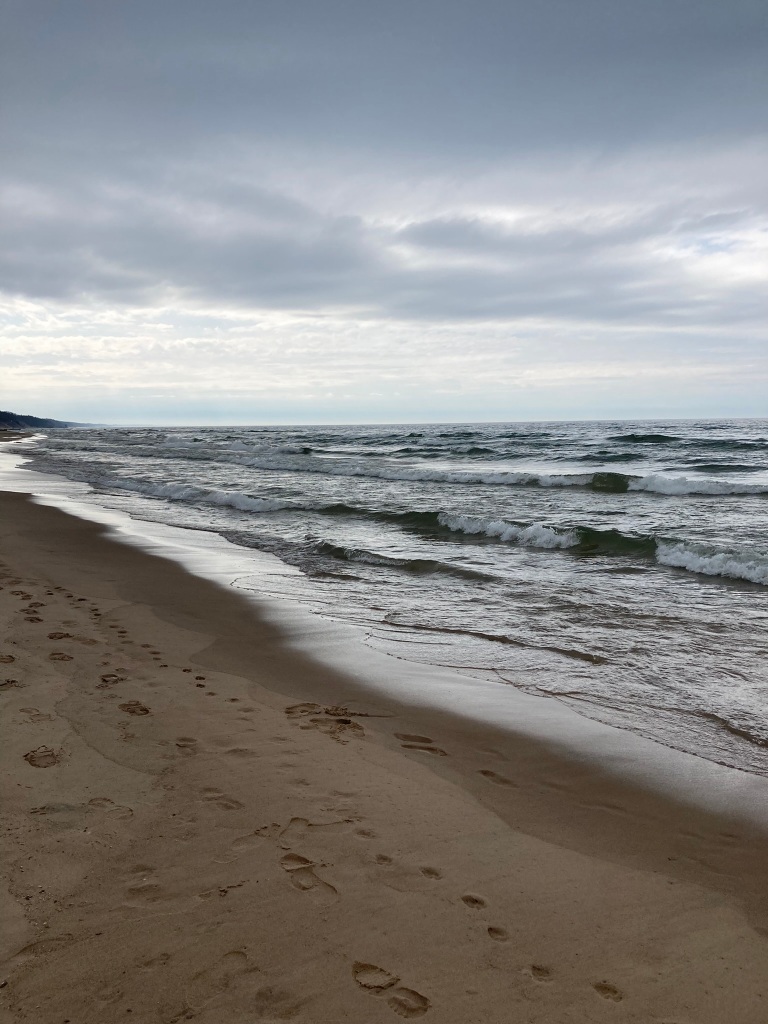
Somewhere between wrapping up the painting of the bedroom and the office and the hallway and beginning the painting of the kitchen, I felt particularly wrung out and empty, and then I sort of remembered why I was where I was. Two miles west of me was one of the best stress-busters I’ve ever known: Lake Michigan. So that morning I made my coffee and loaded Zero in the car, and we drove the short five minutes to the lake to see the morning light play on the waves. We just stayed in the car, because we see off leash dogs all the time and that is not a great thing with a reactive dog whose training got derailed. I wanted this to be a moment of calm, so we stayed cozy, and watched the other early morning people go by, or do the same thing we were doing, viewing the lake from our cars as if we were at a drive-in theater. I’m looking forward to when I’m actually living at the new place, and I can go grab moments of lake-calm for myself whenever I need to. In this particular moment, I marveled at the way the light of the morning could be both bright and soft at the same time, and the way a gull sounds different when it’s swooping around the shoreline than a gull sounds in the old Kmart parking lot in the puddle of my childhood memories.

That moment was also a reminder to seek out calm wherever I am, lake or not. Because life can feel so big and so chaotic, whether or not we’re in periods of momentous transition. It’s not as if I forgot that I need to do that, or like I wasn’t trying all along to manage my stress with yoga and walks and early morning coffee in the yard with Zero and chats with family or friends. But sometimes we tell ourselves there’s no time, or that it won’t help anyway because there’s too much to do or our feelings of overwhelm are too great.

We tell ourselves a lot of things when we’re tired or drowning in all there is to do every day. We tell ourselves there’s not enough time to sit quietly in a safe place and catch our breath. Maybe we even tell ourselves there are no safe places, and it is tragic when that is true. But sometimes we’re still learning to be our own safe place and that takes time and practice. Sometimes we tell ourselves that we miss things that weren’t particularly good for us. Sometimes there were good parts to miss, but that doesn’t change things. We might ask ourselves why we ever thought we could handle the enormity of moving farther away than we’ve moved before and then we remind ourselves that we are, in fact, handling it. We’re almost there. We’re almost home.

And still, that doesn’t erase the hard parts. Holding two opposing truths within us at the same time can cause a bit of inevitable heartache. For reasons of financial and mental health, I need to go. To follow the dream of living near the lake, I need to go. Because I want to love where I live, I need to go, and at the same time, the fact that I’ll be almost three hours from my kids instead of half an hour hurts like hell. I haven’t made peace with that. I don’t know how to. And I guess, I don’t really want to make peace with it. I want that angst to keep motivating me to find ways to make it easier for us to see each other. I don’t want to slip in to “but it’s so far and everyone is so busy.” I want to remain highly motivated to find someone who can watch my sweet but challenging pup so I can take off for a long drive and a short visit, or to take a weekend here and there to see friends and family. People figure this stuff out all the time and I will too. It’s just, in moments of high contrast, the difficult parts feel sharper. Having just had time to hang out with my kids, the prospect of missing them is looming large.

It’s as if we have to keep finding ways to be bigger on the inside than we are on the outside, so we can hold all that life seems to ask us to hold. And sometimes there is no more room, and we have to become willing and able to put something else down so we can hold on to what we want to hold on to. Maybe there are old griefs I can leave behind so that there’s space to manage this new challenge of geography and proximity to the people I love. Maybe the perplexing problems I have for so long felt gnawing at me are less about algebra (as in, how do I solve for all these variables) and more about physics (as in, this is about the realities of force, mass, and acceleration, as in, how can I move myself forward through this particular time and space). Maybe the math analogy is bad but what I’m saying is that maybe it’s time to get practical instead of theoretical.

We’re all moving—together and separately—through this particular time and space and I hope we all find ways to allow ourselves to lean on one another and to be strong when we can’t and to be strong when someone else needs to lean on us.

Love, Cath

On Pebbles, Fish, and Feathers

By Catherine DiMercurio

Hope and perseverance take various shapes these days. My house is up for sale, and there’s a hopeful contender on the west side of the state just waiting for me. I’m starting to picture where I’m going to land, how I’ll arrange the furniture. I’m trying to do two things at once: fan the flames of my hopefulness to keep it alive, and also, maintain it at only a steady low burn so I’m not overly disappointed if things don’t go my way. That’s not an easy balancing act.  

Still, when I recently visited the town I’m moving to and spent some time by the lake, I had that feeling, the one where my heart wakes up, fluttering and thundering in my chest. There is a simultaneous tug of calm peace and wild joy that tells me this is it, I belong here. I once thought love was supposed to feel that way, and maybe sometimes it has, here and there, and maybe that’s asking a lot of love.

A lot has to happen before I can move, and I’m often wondering if I’m doing it right. I don’t know the rules. I think that’s because there aren’t any. I must have made that part up, that rules exist for How to Do Things. Somewhere along the way, I convinced myself that if I could a) learn the rules and b) follow them, then the result would be everything making sense and falling into place. I imagine the gentle way it will happen, the falling into place, like a gull feather softly floating from the sky, and sighing into the sand at the water’s edge. I think I’ll sit on the floor in my new house and I’ll say, I did it, I got us here. I know it won’t make the world make sense again, but it will feel better, it will feel right and good and like home. That’s what I hope. And then I’ll get to go to the lake whenever I want, and my heart will hop and dance and trip over itself on the way, clumsy and glad.

When I say that I made that part up, about those rules existing, that isn’t entirely true. I willingly bought into beliefs and norms and societal conventions and turned them into rules inside my head because on some level, rules make me feel safe. Knowing the boundaries makes me feel confident. As in, here is a closed system and once you know how it operates you can function in a predictable way and get predictable results.

Even though I learned quite some time ago that the world doesn’t work that way at all, there is a small part of me, a thin little shadow, that stomps her feet in disbelief and frustration when things happen in ways they’re not “supposed to.” And when life gets overwhelming and more variables enter the equation, that thin little shadow grows into something larger and more solid. It’s okay. It’s something you have to learn to live with. Something I learn to live with, the shadow to bargain with, that is really just a version of me that wants to feel safe and understood. I can give her that at least, even if the world can’t. I can try.

If none of this is making sense to you then maybe you were lucky enough to play by the rules whether you believed in them or not and things fell into place for you, so much so that you’re surprised when things don’t work out for other folks. Maybe you figure that they just didn’t work hard enough, like you did. Or they weren’t positive enough or whatever enough, whatever it is that you believe got you where you are.

But if this is making sense to you, then hey, nice to see you here, hope things are going okay.

Photo by Ku00e1ssia Melo on Pexels.com

It’s hard, isn’t it, to live in this liminal space with all this uncertainty unfolding in multiple directions? It almost forces you to be the calm center of it, as if there are so many forces pushing at you from the outside that all your chaotic, uncertain, wayward and worried energy is forced back toward you, and you have to learn to metabolize it all. Because if you don’t metabolize it, you start to feel like it is crushing you. I’ve felt that way recently, like I was getting smaller and smaller. Just a pebble, really. Though, pebble-sized, everything happens around you, not to you, so maybe that’s the right way. How else does one metabolize all that chaos? Maybe it passes through you, like water through fish gills, and we take in what we need to breathe and nothing else. There probably isn’t a right way. Maybe sometimes it is a pebble day and sometimes it is a fish day.

But we all have stuff coming at us all the time. Theoretically, we could reduce the amount of chaos coming at us if we could diffuse our own response, our worry and fear and what not, and only deal with the outside forces, the unpredictable things in our lives that make us feel like things are overwhelming or out of control. But that is easier said than done. Sometimes the only thing that shows us the way is our own exhaustion. When we have no more energy left to worry because we’ve been too busy coping with what life is throwing at us. There is some relief in that somehow, in being too spent to work up enough energy to thrash against uncertainty like a caught fish in a net. That’s when we get to the point of saying, I’ll just have to roll with whatever happens next. And maybe when we’ve done that enough times we won’t have to wait until we’re completely exhausted to adopt that mindset. It’ll be a choice instead of a consequence. Sometimes that’s where the growth is; some of us only learn lessons the hard way.

When I think about leaving this house, I think about all the work I put into it, and how I turned it into a safe place to land after all. It’s a cozy refuge that has served me well. I hope it will let me go, will work its charm on the right person who is ready to make an offer any moment now, so the next set of things can fall into place for everyone.

But for now, it’s wait-and-see mode. I have moments where I’m okay with that, with the not knowing, with the in-between-ness, and there’s a part of me that actually does feel confident that I’ll be able to adapt to however the situation evolves. It’s hard to hold on to that mindset, when part of me wants to lean in so badly the particular details of how I want things to happen. Hope is a funny creature to tend to, being wild and capricious and hungry and fragile all at once.  That’s another thing there aren’t any rules for, the care and feeding of this creature called hope. Maybe we’ll all get it a little bit right today.

Love, Cath

On Identity, Negative Space, and Sand

By Catherine DiMercurio

Sometimes I feel as though this world has pinched whatever eloquence I might have once possessed, and all I can do is write earnestly about the twists and turns of my own journey. I’ve been thinking a lot lately about how, in the face of such bizarre twists and turns of this current American reality, do we keep on keeping on, keep on living our lives and pursuing dreams to the extent that we are able. But at the same time, how do we do otherwise? One of the most meaningful things we can do is to keep on living meaningful lives, right?

Part of my own such quest has long focused on the pursuit of belonging and connection, and the way the natural world informs that journey. For many years, I’ve yearned to find a way to live closer to places that ground me, and that’s what I’m currently pursuing.

In line with that goal, I got to spend some time recently by Lake Michigan. It was a grey, rainy couple of days and I was there, in a little lakeside city, to do some research. At times, I am completely overwhelmed by the prospect of moving again. There’s no getting around how demanding, complex, and disruptive it is, no matter how much you’re looking forward to the destination.  I’ve made a good home in my current location, but it wasn’t necessarily a place I was in love with. It was a practical decision and the right one at the time. In some ways, it will be hard to leave. I have good neighbors. I’m relatively close to family and friends. Within these walls, I remade myself, as we often must do during various transitions in life. There are plenty of times where I think it would be easier just to stay.

But, it’s always easier to stay, isn’t it? I have a low tolerance for chaos, always have, and moving is nothing if not chaotic. And easier isn’t always the point. Sometimes we need easy, we need to rest, and regroup, we need to feel settled and calm and peaceful, and then, we’re ready to unfold in a new direction. We all unfold and stretch and grow in different ways and at our own pace.

There are huge unknowns. Though, most of life is that way, so that should not really dissuade anyone (myself included) from exploring new possibilities. Will I be able to find and build some sense of community there? Will I feel like I belong? Will it be a good place for my dog? Will I be able to find a pottery studio? Will I find a way I can contribute to my new community?

One of the many perplexing things about life is that it is short, and therefore we should leap into our dreams but also, we have bonds with people who we find ourselves leaping away from, and we don’t want to lose those either, the dreams or the bonds, and how is all that supposed to fit together? And all those people have their own dreams and bonds, their own journeys, and we can’t anticipate all the ways and reasons people move around in their lives.

After a weekend near the lake, I have sand in my car. I like that. I like what it represents. I like the idea of living someplace with street names like Seaway and Lakeshore Drive and Beach Street. I love the frequent calls of gulls mixed in with house sparrows and robins. It sounds like a place I could call home.

I think a real sense of connection to place is hard to come by, at least it has been for me in the last several years, and I don’t know if I will have it there, in a new place, where I have no history at all, no people. I’m craving the feeling of having something fall into place and hoping to accomplish it by having me be the something falling into a new place.

Five years ago, I was preparing to move from the home I’d lived in for 20 years, where I raised my kids, and in many ways, where they raised me. I wrote a lot about the meaning and nature of home, and here I am again. At the time, I remember feeling as though the emotional work of the next part of my life needed to focus on learning to be at home with myself, wherever I was. In these last five years, I’ve tried very hard to do just that; it is an ongoing journey.

Here, in this house, I weathered the bulk of the pandemic. Here, I became an empty nester. Here, I ended a relationship. Said goodbye to the sweetest, most beloved dog, said hello, to another sweet, rambunctious furry soul. Spent a couple of years in relative solitude, on my own in all these new and different ways. At times the most lonely I’ve ever felt, at times the most free I’ve ever felt. Here, I started a new relationship.

People talk about finding yourself as if it is something you’re supposed to do when you’re young, or something people crash into doing at middle age because they never did it when they were young, but all of that is wrong. At least, we should acknowledge that it is something that can and should be ongoing our whole lives. More than anything, it is a mindset, rather than something that always requires big actions. It’s about looking, about cultivating an awareness of how we experience the world and who we want to be in it, who we are in it.

Shouldn’t we be out there looking for ourselves every day, in each little action, getting truer and truer as we go along, and finding our way back to ourselves if we get lost? We probably have to get a little lost here and there. Sometimes it is the accumulation of wrongs that points the way to what’s right for us.

My first-born is an artist, among many other things, and right now I am looking at a linocut print they made of a snail, and marveling at the way such a beautiful image is built line by line, the way with linocut, the image is revealed as a result of what is removed, the way the negative space that is created allows what remains to receive the ink.

It’s the same with the continuing process of learning who we are, and relearning that as we change and grow. What is removed from us through loss or through getting lost, or whatever life takes out of us, keeps revealing a new image of who we are now and who we are becoming.

I didn’t think I’d have sadness about leaving this place; when I moved in I did have the sense that it would be transitional. It was what I needed at the time. Things are different now. Things are always different now.

As I’m getting this house ready to sell, I think of all the ways it has held me, and all that I have put into it. All the living it has contained. And how I don’t really have to leave if I don’t want to. But just because it is hard, and just because there’s sadness, and just because I could stay if wanted to, doesn’t mean it’s not time to go.

I go over it all in my head, crunch the numbers, crunch the reasons, trust my gut, find the way. On the one hand, what’s the big deal, right? I’m just moving across the state. On the other, it’s another leap, farther than the last one. I’ll no longer be 30 minutes from where I used to live. In some ways, this feels more akin to moving away from home for the first time than it does to any of the other moves I’ve made in the past.

When I was at the lake two weeks ago, I plunged my feet in the icy water, ran barefoot along the beach, drew hearts in the sand with my toes. I felt the way the lake unlocks something in my chest, allowing me to breathe deeply and feel a big sense of centeredness I can’t seem to feel too often anywhere else. Later, I brought my dog down to the water. I know how much people like to let their dogs run on the beach, and Zero and off-leash dogs don’t mix, so I was hesitant, went early on a rainy Sunday morning. The waves were loud, but not overly large. We were only by the water a few moments, because I could see people with a dog further down the beach and didn’t want to take the chance that the dog might give chase. Zero wasn’t keen on getting too close to the water. He’d take a couple of steps toward it while the waves receded, and then dart away when the waves rushed in. I don’t know if he’ll ever be a beach dog and that’s okay. I’ve probably got enough beach dog in me for the both of us.

I observed Zero’s hesitancy as he surveyed the unknown terrain, the way he looks at me sometimes with both trust and concern. It’s as if he’s embodying what’s in my head, the part of me that’s not so sure and the part of me that trusts that I’ll get this right. Sometimes I wonder if he and I are extensions of one another, and then I wonder if we all are. It’s easy to feel that connection, to everything and everyone, even when I’m alone at the lake with my dog who kind of isn’t sure he wants to be there; he just wants to be with me.

Stay connected, and keep looking for yourself.

Love, Cath

On Works-in-Progress

By Catherine DiMercurio

For most of my life, home has looked like backyards sutured together with chain link. Neighborhoods comprised of various parts, various wholes, my yard, shared fence, our block. As I was growing up, summertime smelled like charcoal smoldering on grills. We stuck our toes into the gooey tar that mended fissures in the street in front of our house.

gray metal chain link fence close up photo
Photo by Kendall Hoopes on Pexels.com

One of the days I was working at the new house, before I moved, I smelled a neighbor’s charcoal grill and thought of my dad, tending ours when I was little, and I had the sense of returning, as if I’d just peddled home as fast as I could because the street lights were coming on and I heard my father’s distinctive get your asses home now whistle. I’ve chatted with new neighbors across old fencing, and have had thought about how easy it is to feel both at home and out of place amidst the almost familiar.

This morning I arose after waking too early and trying futilely to get back to sleep. There are still boxes to unpack, things I can’t find. At times, when fatigued or overwhelmed, I get unreasonably melancholy. I fret over the fact that I cannot fix things to their proper places here so far. Is this where the coffee cups should go? Why is it so difficult to buy a couch? The kitchen table seems right though, so that’s a beginning.

Sometimes, though I’ve only just begun sleeping here several nights ago, it feels as though I’m only borrowing the place for a little while, though we have put in so many hours and dollars to make it feel new, mine. I hope she likes it when she gets here.

I sort of thought the house would let me know what it wanted somehow. But it’s still making me do all of the work.

This sense of almost being home is perhaps exacerbated by that looming birthday, though I don’t place a lot of stock in fifty as a milestone, despite the countless ways the world says I should. I’m expected to know by now exactly if I’m going to keep coloring my greys or not, and I’m supposed to know why. I’m supposed to not care what people think, and know precisely what I think about this or that or everything. I’m supposed to know more, know me, or, I’m supposed to know how much I don’t know and embrace that.

Perhaps I’m as much almost home as I am almost me.

I do know a few things. I know that possibly I might never stop being at least a little afraid that the good things will slip away if I don’t pay close enough attention. Vigilance and worry aren’t the same as spells of protection, but I whisper incantations nonetheless. Things weren’t always so, and though I can pinpoint the exact moment when this circuit in my brain was tripped, it doesn’t seem to mean that I can access an easy remedy for it. It does mean that there is work to do, and that’s okay. Everyone has their own work to do, and it changes as we go, and as with homes, the work is never quite done, and timelines are a bit unnecessary and perhaps even unhelpful. We must be both patient and diligent, with ourselves and with each other.

I know also how the extent to which love makes so much of this so much easier, possible, fulfilling. Though I sometimes struggle with my shortcomings, though we all do, having those we love supporting us, while we offer the same loving support in return, is what stitches together our little communities of you, me, us. So much of the world around us is mended and bound together and I love the way we mend each other and bind ourselves to one another through kindness and gestures, glances, kisses, effort, words, all of it, all of us.

I don’t always know the best way to tackle the work that needs to be done, and it seems all too easy sometimes to see task after task piling up, to get overwhelmed and undone about it all. I’m trying, in this new almost-home place to give myself the space to figure it out, to get closer to where and how I want to be, to have a little more patience with myself with regard to work in progress. It’s the kindest thing we can do for ourselves, and each other.

Love, Cath

On Thresholds, Love, and Language

By Catherine DiMercurio

Sometimes we halt on a threshold and consider how words fail us.

As February inches to a halt in its slow, frozen way, and we in the Midwest stand here on the almost-verge of spring, I’m thinking of thresholds. Thresholds as in, the space existing after one thing and before another, and as in limits.

One of my earliest memories is of standing on the curb at the door of the school bus that was to take me to kindergarten. I remember the black rubber tread on the steps leading up and in, and little else. I remember feeling frozen. Years later, I asked my mother why I wouldn’t get on the bus. She said I told her it was too loud. A lot of the world feels that way, still. The overall sensory impact of a chaotic world is like a static-y radio turned up too loud. Outside that kindergarten bus, I imagine it wasn’t just the noise as overwhelming decibel level, but the clanging chaos of social unknowns, represented by overlapping voices, the chatter of classmates that I did not yet know, conversations in-progress, which I couldn’t access. My sisters were my friends, but they were in first and second grade.

I remember too the safe quiet bubble of my mother’s car as she drove me to school. I think she drove me for the first week, maybe longer. (The first time I managed to actually ride the bus was terrifying and I left my gym shoes on the bus and when everyone else was putting sneakers in cubbies against the wall, I was crying because I’d forgotten mine.) But in the car, there was reprieve. It was a hushed in-between place, and my mother was there, and it felt like everything was okay, at least for that little while, from house to school.

My son and I recently took an evening to visit my daughter at college. On the way home, he talked about how much he loved being in the car, because he did not have to be doing anything. He allowed himself to relax, chat, zone out, and not have to be productive. For him it was a reprieve from homework, student council emails, scholarship applications. Often, as I’m commuting 30 minutes or so to work, I similarly have the feeling of not wanting to get there yet. I can give myself credit for being a responsible adult going to work, but I do not yet have to face responsibilities and ingest their corresponding stresses.

I think of how much our lives create webs of responsibility and how there are very few places where we are legitimately de-obligated from fulfilling them.

Reflecting on that frozen moment when stepping onto the bus seemed equivalent to stepping off a cliff, I consider how words are such inadequate tools for conveying ideas related to feeling. We use collections of words as convenient but undersized vessels for ideas that don’t fit into them. We say terror or panic but what we mean involves the loss of a safe world, a known version of ourselves as its primary inhabitant, and the abyss of a new universe where there is no familiar anything, anyone. We try to contain with words emotions too big for our bodies, almost too big for our hearts to feel, let alone express.

I think of how else language fails us. I think of what mothering me would have been like, and though I am a mother I still can’t imagine it. I remember each of my own children’s first days – of preschool, kindergarten, high school. Dropping my daughter off at college. I imagine what it’ll be like, in a matter of months, to leave my son in his dorm room. How does one say, at such points of disembarking, I love you but I have to go this way. You have to go that way. Sometimes the simultaneous joy and pain of loving leaves us frozen.

That words never fail to fail us is especially true of love, all of our loves. We should have more words for it, better ones. There is no concise way to say I [love-that-holds-within-it-comprehension-of-all-my-maternal-shortcomings] you. No way to truly capture the sorrow of loss that grows like a long blade of grass alongside the child’s every accomplishment as witnessed from the parent’s perspective. The way loving means I am teaching you to leave me, to be you, to belong to yourself. Though you belong with me, now, you don’t belong to me. 

macro photography of droplet on green leaf during daytime
Photo by Pixabay on Pexels.com

Other ways of loving are similarly challenged by vernacular limitations. There is no easy way to express I [love-that-arrives-as-a-surprise-after-long-and-difficult-journeying] you. No way to really say that we simultaneously want to protect it as if it is vulnerable moss at the edge of a forest path in danger of being crushed by the heavy footfall of experience, and the way we lean against it as if it is the sturdiest oak in the woods.

I wonder, if we did have language for such things, would it be easier? If there were precise words for the types of love we wanted to express, would we use them more freely? Or, would our threshold for the feelings such words encapsulate still be in danger of being breached, and would we instead reach for softer words, blurry words, in order to contain? Perhaps language has limits for a reason. Perhaps as a species we have created the language we can safely wield, and nothing more.

I think, too, of those places of reprieve, and how they involve solitude sometimes, and quiet, supportive companionship at others. It might be in the car, in bed, over coffee. It might be that we don’t recognize these spaces as thresholds, as places in-between where we are allowed not to go this way or that way, not to have to deal with this responsibility, or that one. Where we don’t have to consider our threshold for what our hearts can express.

Writing this, my mind hops back to a couple of years ago when I began this blog and how the analogy of the road trip began it all, and how many times I have returned to it in various manners. Wherever you are journeying today, I hope you find that bubble of calm and quiet, when you are neither here nor there.

Love, Cath

On Cranes and Kites, Work and Wishes

By Catherine DiMercurio

Sometimes we feel fragmented, abstract; we are connected.

I keep unfolding this origami shape, trying to make a kite.

What’s the right way to look at the work we do? Does anyone notice the difference between folding and flight?

We are told to do the work, and we want to, and it comes as easily to us as flight does to a thousand paper cranes.

paper cranes
Photo by David Yu on Pexels.com

It is easy to believe we are doing it wrong. It is easy to believe that there is a dull ache, there are sore muscles, even when we are doing it right.

And everything is right.

Everything is all right.

I’m not not spelling it out in order to obfuscate; I wouldn’t do that to either of us. I’m not spelling it out because the test is wrong, and I know the answers, but not to these questions. We know everything, and we have never known any single thing.

I know this: I draw hearts in Douglas fir sawdust with my fingertip, believing always in yes, now, this.

We whisper wishes into night, day, storm, sun. We whisper gusts. We keep the kites aloft.

Some days I don’t know where to begin. I think of how hard our psyche rushes in the background, trying to escape remembered danger or pain that isn’t anything now, isn’t more than paper in a puddle, but we wake up exhausted anyway.

Sometimes we fool ourselves into thinking that the way we work is in a straight line, as if we don’t loop back around again, as if we won’t need to. And I think of the way a kite stays up, and the way when I was little, I ran in circles trying to catch the wind in the muddy field with my father. My feet in boots navigating slippery clumps of soil, heavy grey clouds churning above his head as he ran for the string that slipped through my fingers.

And I think of catching and holding, and running, and waiting for the wind, and fighting it, and those few moments in between when it’s all just grace and flight and lift and it feels like it’s no work at all.

Let’s give each other the space and grace to navigate, to slip sometimes, to falter. I’ll give chase for you.

Sometimes work is a four-letter word, the way we put ourselves back together every day, for ourselves, for each other. Do we privilege one audience over another, and why do we feel maligned for doing either, or both?

I’ve been gripped for the past several days by a certain melancholy I can’t quite source. Touching base with a number of people in my life, I hear they also feel marked in this way. I think about the things that we sense collectively, the cold heaviness of a loud, mean world. I think of the way it makes us feel separate, though we are feeling the same thing, each in our own way.

I think of this: sometimes the kite string doesn’t simply slip from our grasp because the wind was strong or because we slid in the mud. Admit it. Sometimes we let it go. Sometimes we woke up exhausted. And I think, I’ll chase that for you today. Will you help me start again, tomorrow? I think of the way I was given paper. The way I watched you transform a thousand origami cranes into kite, the way I managed to let the wind take mine again, though getting into the air in that day was a feat, and you said so.

Sometimes I try and take the view of the kite, and look down on the field, on all the endeavoring, and I’m struck by the earnestness of it all, by the web of string, the kaleidoscopic pattern of arms outstretched, by the chasing we are willing to do, for ourselves, for one another, even though you can only see it from this vantage point.

Love, Cath


Against Brokenness

By Catherine DiMercurio

Sometimes you have to close the door on perspectives that don’t serve you.

There’s a narrative at work in our world in which human brokenness plays a key role. The idea that the pain of our lives, of the world, breaks us is not a new one, but social media proliferates it in different ways. Not long after my divorce I stumbled across this Hemingway quote: “The world breaks everyone and afterward many are strong at the broken places.” I affixed myself to that notion. I viewed it as a roadmap. Not only did it acknowledge how I felt and insisted that I wasn’t alone, it showed me that there was something I could do about it – get stronger.

The first guy I dated after my divorce actually told me I was broken, and very generously offered to help put me back together – the way he thought I should be. Unsurprisingly, that situation did not work out. If I was going to be strong at the broken places, I knew my first feat of strength would be to oust him from my life. I recently saw a meme about the way dating in your 40s and 50s is like going to the dump and looking for the least broken and disgusting thing. It reminded me of the way he had looked at me, and how much I’d hated it. But it also reminded me that this “broken” narrative was also a story I had told myself for some time, and hints of it still came back. The stories we tell ourselves about ourselves are the most powerful ones that exist. This notion of human brokenness is an idea that many people respond to, and it’s not exclusive to the way romantic relationships impact us. The world is brutal enough that we all feel this way sometimes, just like Hemingway said. The world breaks everyone, with tragedies tailored uniquely to our own hearts.

But, I’m through tolerating this analogy. Even if you haven’t thought of yourself in this way for a while it’s easy to fall back in to. We begin to see ourselves as healed, as actually stronger in the broken places, and then life pushes back. We face a challenge that’s harder to work through than we thought, or we find ourselves in the process of evolving into a new relationship, and consequently a new version of ourselves, and it naturally forces us to look at who we’ve been. That can hurt, and it can make us feel as though we haven’t come as far as we thought. Or, we witness a friend or loved one going through a tough time and it reminds us of challenges we have faced, and how maybe we didn’t come through to the other side as strong as we imagined. Through all of this, it is remarkably easy to fall back into thinking of ourselves as broken. It’s easy when faced with the pain of growth to feel as though we’re not as strong in the broken place as we thought, that maybe we are still broken, that maybe parts of us will always be broken. But in reality, we are simply changing. They aren’t called growing pains for nothing.

It’s true that hearts break, it’s true that we feel overwrought and undone by life’s pain. But it is a tragic way to think of people. It is an achingly solitary way of looking at ourselves. Whether or not we are trying to do our own repair work, or hope that others can somehow fix us, or hope to align ourselves with someone who has some sort of complimentary brokenness – as if our fractured or missing pieces can somehow fit together – the idea of brokenness still seems bleak. It is a notion filled with despair, easy to embrace, and difficult to move away from.

Within this notion of brokenness, we slide further and further away from ourselves. We imagine a fractured version of us, and insist it is who we are, and the world agrees.

I’m not saying there is something wrong with feeling broken. I think it’s pretty unavoidable. If you love any human or animal in this world, one way or another you are going to crumble. Sometimes I’ve felt that the breaks I thought I repaired are in fact poorly healed, weak spots that continue to pain me. Sometimes I’ve felt that no matter what I do, some breaks will always be there, as if their sole purpose is to remind me to question happiness that comes my way. Many of us who have experienced deep pain have at least for a time believed that the things that have broken within us have rendered us incapable of loving properly, trusting fully, of receiving the love being offered to us. But we have to stop telling ourselves these stories. We have to make other ideas just as real to us as brokenness.

It’s not enough to say, today I’m stronger at the broken places. Because tomorrow may re-break us and then what? It is certain that we need ways of looking at pain that make it palatable. We need those roadmaps, and to feel understood, and to feel less alone. Let yourself feel broken when you feel it, but don’t ever let anyone – yourself included – tell you that you are. Search the world for other metaphors.

red brick wall
Photo by Chris F on Pexels.com

I spent the spring exploring the natural world in search of metaphors about renewal and growth (remember those crickets we talked about?). Lately, I’m loving this idea of rebuilding, rehabilitation, renovation – not of broken things, but of the parts of ourselves that get neglected when we the world hurts us. The process of renovation is slow, and non-binary. It is not a journey from broken to repaired, or, to come back to Hemingway, from broken to stronger. It’s a process of devoting attention to different areas of our lives and quietly reviving them, nurturing them, clearing away debris and shining a light on the strength of our foundations. It is about making things stronger, but the focus is not on the brokenness. The focus is on seeing all the potential and helping it come into being in a new way. It recognizes the past but builds toward the future.

The rest of that Hemingway quote is this: “But those that will not break it kills. It kills the very good and the very gentle and the very brave impartially. If you are none of these you can be sure it will kill you too but there will be no special hurry.” Hemingway saw first-hand much of the world’s pain and he did a fair amount of causing it himself. Maybe we can listen to other stories than this one. Maybe there is no roadmap to renewal in quotes about the way life is either going to break or kill us. Let’s not live by quotes or memes. Let’s remember resilience, let us recall strength that comes not from how many times we’ve gotten ourselves through something tough, but the strength that’s deeper than that in us, that has always been there. There is a part of us willing to find new metaphors if that’s what we need to move forward, there’s a part of us that embraces love even though we know the risks, there is a part of us that recalls even in the most painful moments of our lives that we are more than a collection of broken parts. Let us remember that in insisting on our own brokenness we inflict more wounds.

We all handle hurt differently. I rally around metaphor, my Pied Piper leading me someplace new. I crave new ways of looking at things, hoping to understand better the world around me, the people in it, the universe of my own heart. I think our strength lies in the seeking, more so than in whatever we find.

Love, Cath

On a Revolutionary Way of Trusting

By Catherine DiMercurio

Maybe vulnerability and trust are not connected in the way we thought they were.

Being away from our usual routines often affords us new insights, but sometimes it isn’t until we return home that new ways of looking at things emerge. I recently travelled to the Vermont College of Fine Arts for a week-long writing retreat. While there, I attended a panel discussion with other writers, led by the retreat’s faculty members, on being vulnerable and what it means as a writer. Inevitably, in the days that followed, I considered what it meant to be vulnerable as a regular woman-person, not exclusively as a writer-person. Like many people, I have experienced the emotionally wrenching side effects of vulnerability. I don’t see much difference between allowing one’s self to be emotionally vulnerable and the notion of being open hearted. It is a deliberate choice, an act, to open ourselves to others.

As writers (in our relationship with our work and with our audience), and as “regular” people (in our relationships with the loved ones in our lives), the risks of vulnerability include pain, rejection, being misunderstood—in short, isolation. We expose ourselves in order to seek connection, and the risk we take is that the opposite effect will occur. And the more we’ve been hurt in our past, or misunderstood, or rejected, the greater the perceived risk of this exposure. We simultaneously want to protect ourselves and want to be open, to seek out all those things that make us feel good about being a person in this world.

Most of us want to understand and be understood, regardless of our perspectives as writers, artists, lovers, family members, friends. But I think it goes a bit deeper than this longing. In endeavoring to connect with one another, we seek to reveal not just what we think, but how our brains operate, not just that we love but how our hearts function. It is in the intricacies of these processes of thinking and loving that we truly engage with one another, and understanding them in ourselves and in others offers us pathways to the sought-after connection.

We want roadmaps as we wander through the mazes of each other’s heartscapes, and each of us in our own way wants to offer the same guidance to those we welcome into our worlds. It is not just why some people make art, it is why we all read it, see it, hear it, touch it, taste it.

aerial shot of maze
Photo by Tom Fisk on Pexels.com

Being vulnerable, or, opening our hearts to each other, is an act of trust. It is an act of relinquishing (perceived) control of outcomes. But when we extend and open ourselves in this way, we are often filled with self-doubt. Will isolation instead of connection be the result of our exposure? We can’t know. But we trust. In many ways, in all of the emotional interactions we seek out, we place our trust in the other party – whether it be a partner, a family member, a friend, or those who consume our art. We place our trust in them, hoping that what we offer will be accepted, that the roadmap will be decipherable, that the other person or people will willingly journey with us. We hope that in return, we may receive the reciprocal invitation to understand and connect. It is a seemingly simple conversation, an exchange, but beneath it exists a complex system of highways and byways, along which race countless thoughts and emotions as we try and gauge the success or failure of a particular act of vulnerability.

I think though what we often fail to realize is how unfair all that is, and the burden it places on those we care about. We delude ourselves into thinking we are entering into a pact and in doing so we are obligating others to behave in a certain way.

How freeing it would be to look at it another way, to consider that when we decide to be vulnerable, we are only making an agreement with ourselves, trusting that in opening ourselves in this way, we are welcoming whatever good may come of it. And if there is pain, or sorrow, or rejection, we welcome that too, not for the hurt itself, but for the growth that comes from it.

How kind it would be to those with whom we seek connection to let them off the hook, to not have any expectations of reciprocity.

How loving it would be to invite them into our worlds, offer them that roadmap, and then, simply be. Be there when they get there. Be understanding if they got lost along the way. Be joyful if they are delighted for the opportunity for connection and welcome us with open arms into their headspace and heartspace.

Maybe trust should not be about what we hope for from one another. Maybe it should be about what we are offering, and why.

We are never in control of outcomes that are tied to the emotional responses of others, and that is a beautiful thing. Maybe it is about trusting ourselves to know what is best for us, trusting ourselves to offer our world to those we love, to those we seek connection with. Our vulnerability lies in our willingness to do that, regardless of how we will be responded to.

Our lives are so full of uncertainty, in so many areas, professionally and personally. It is understandable that we want to control an outcome here or there, understandable to think that we actually can. At the novel retreat, participants were invited to read from their work to the other writers present, participants and faculty members alike. As a group, we discussed this as an act of vulnerability, this offering of our art in a public way, when we know all the ways it could be misunderstood, deemed unworthy, when we know that our physical performance too is under scrutiny. At the time, I looked at this endeavor under the dual lens of vulnerability and trust, and I told myself that it was my ability to trust this room of writers to be open to me that allowed me to be up at the podium reading my work. They did not let me down. They were kind and generous in their response to me and to my work. Yet, I could have entered into the reading in another way, trusting my desire to share my work, trusting that regardless of how it was received, this was what I wanted for myself. Audiences will receive us how they will.

It would be disingenuous of me to say that this way of looking at trust is anything but experimental. It feels sort of revolutionary to me to consider that trust perhaps has, or should have, little to do with the other party. But what right do we have to obligate others, however obliquely, to respond to us in a certain way? If I expose thoughts and emotions, my true self, to others in a vulnerable way, and I do so because I trust both my instinct and my willingness to accept the outcome of this particular exposure, it is a gift to bear witness to how this act of exposure is received. Consider too how miraculous are the gifts offered to us by others, when those we love are expressing themselves in a space free of demand, obligation, or expectation. Perhaps being vulnerable and being truly trusting work quite differently than we thought.

Love, Cath